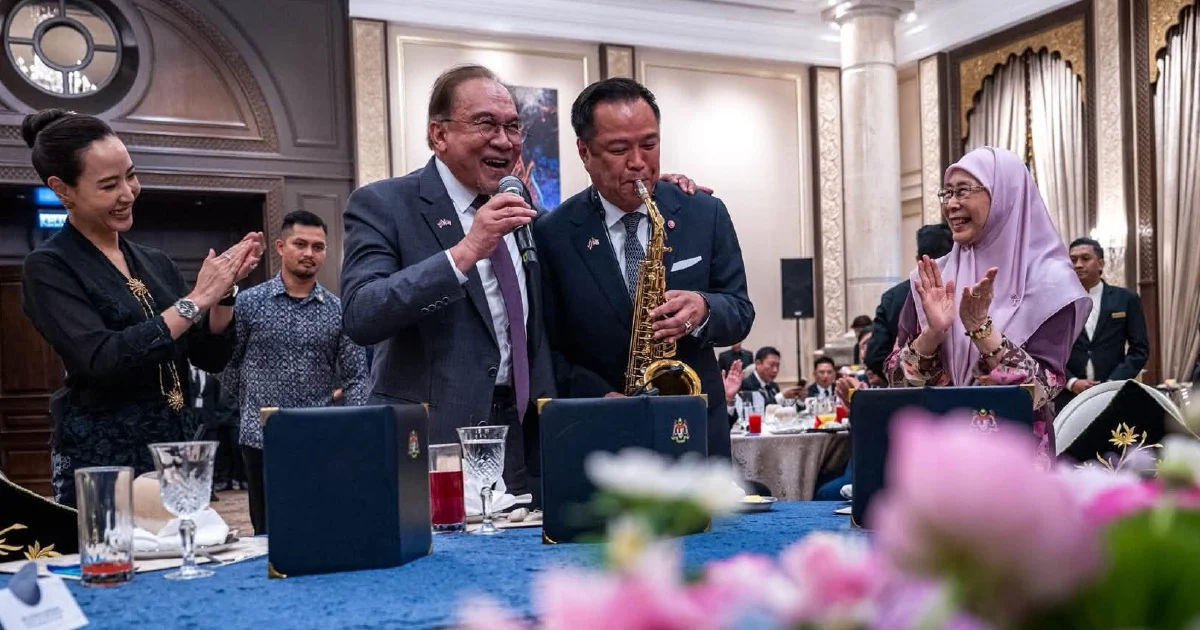
Prime Minister Datuk Seri Anwar Ibrahim and his Thai counterpart Anutin Charnvirakul chose an unconventional approach to conclude their high-level bilateral talks in Putrajaya, entertaining a room of dignitaries and officials with an unexpected musical interlude. The two leaders' decision to perform Frank Sinatra's My Way at an official luncheon marked a decidedly informal moment in what would normally be a formal state visit programme, reflecting a growing trend among regional leaders to leverage personal chemistry in advancing diplomatic relations.
The impromptu performance came after substantive discussions between the two governments on matters affecting their shared interests in Southeast Asia. Such light-hearted moments during high-level visits often signal a thaw in bilateral relations or an effort to humanise political leadership beyond their formal roles. For Malaysia and Thailand, neighbours separated by a shared border and interlocked histories, opportunities to project camaraderie carry particular significance in a regional context where diplomatic gestures frequently translate into tangible policy cooperation.
Anwar's vocal rendition of the Sinatra classic, paired with Anutin's saxophone accompaniment, demonstrated an appetite among the two leaders to step beyond the constraints of traditional protocol. The choice of My Way—a song about independence, self-determination, and unconventional life choices—carried subtle resonance given both leaders' political trajectories and their respective nations' assertions of regional autonomy. Neither leader is a professional musician, yet the willingness to perform publicly underscored a confidence in their respective positions and perhaps a recognition that diplomatic influence extends beyond formal negotiation chambers.
Thailand's Deputy Prime Minister and Commerce Minister, Anutin Charnvirakul, has cultivated a public persona that embraces unconventional interests outside the conventional bounds of government work. His participation in musical performance aligns with a broader pattern among contemporary Asian leaders who increasingly blend personal interests with public representation. For Malaysian audiences, the imagery of a Thai leader publicly supporting the Malaysian Prime Minister through musical accompaniment carries underlying messages about bilateral harmony and mutual respect.
The luncheon setting itself represented a carefully choreographed diplomatic event where informal moments are often strategically inserted to build personal rapport between leaders. Such gatherings typically include extensive bilateral agendas, but the allocation of time for performances indicates both leaders' commitment to strengthening personal relationships—a cornerstone of effective regional diplomacy. In Southeast Asia, where personal relationships between political figures often influence the trajectory of state-to-state relations, these moments carry practical importance beyond mere entertainment value.
For Malaysian observers, the performance offered a rare glimpse of their Prime Minister in a relaxed setting, revealing aspects of his personality that remain largely confined to formal governmental contexts. This humanising approach has become increasingly common in modern diplomacy, where social media amplification and public interest in leaders' private lives create opportunities for governments to shape narratives around their representatives. The footage of the performance, likely to circulate widely on digital platforms, serves multiple strategic purposes for both governments' public diplomacy efforts.
The bilateral talks preceding the musical performance presumably addressed substantive issues affecting Malaysia-Thailand relations, including cross-border trade, investment flows, security cooperation, and migration management. These perennial topics shape the relationship between the two nations and often generate tensions requiring careful diplomatic navigation. The decision to frame the visit's conclusion with a lighter, more personal moment suggests confidence that the substantive discussions either reached productive conclusions or laid groundwork for continued engagement on outstanding issues.
Thailand's role as a significant regional economic player and its strategic location in mainland Southeast Asia make the Thailand-Malaysia relationship particularly consequential for Malaysian foreign policy calculations. Enhanced bilateral ties facilitate smoother regional cooperation within ASEAN mechanisms and create synergies in economic integration initiatives. The kind of personal rapport demonstrated through the musical performance can serve as a foundation for resolving inevitable disagreements and facilitating pragmatic compromises on contentious matters.
For Thai observers, the image of their Deputy Prime Minister's saxophone performance serves as a diplomatic signal of engagement and goodwill toward Malaysia. Thailand has historically navigated complex relationships with its neighbours, and periodic reassertions of commitment to bilateral cooperation through high-level visits carry particular significance. The musical component of this visit demonstrates an effort to move beyond transactional diplomacy toward relationship-building that acknowledges both leaders' humanity and individuality.
The broader context of Malaysia-Thailand relations encompasses long-standing challenges including cross-border trafficking, maritime boundary demarcation, and coordination on transnational crime. While a musical performance cannot independently resolve such complex issues, it reflects a commitment to maintaining channels of communication and personal rapport that enable productive dialogue even on sensitive topics. Both nations share interests in regional stability, economic growth, and managing transnational challenges that require sustained cooperation.
The viral nature of the performance, as indicated by its emergence across social media and news platforms, demonstrates how modern diplomacy increasingly operates in spaces where formal state visits intersect with digital culture. The Malaysian public's reception of their Prime Minister's musical willingness to engage in cross-cultural performance may influence broader perceptions of his leadership style and openness to informal diplomacy. Similarly, Thai audiences see their Deputy Prime Minister projecting confidence and musical capability on an international stage alongside a regional peer.
This visit exemplifies the evolution of Southeast Asian diplomacy, where leaders recognise that personal connections and informal moments of shared cultural expression can reinforce formal diplomatic objectives. The performance did not overshadow substantive bilateral discussions but rather complemented them, creating a memorable impression of two leaders willing to engage authentically with one another. As Malaysia and Thailand navigate ongoing regional challenges and opportunities, such moments of demonstrated personal rapport may prove instrumental in facilitating the trust necessary for effective collaboration on matters of mutual importance.

