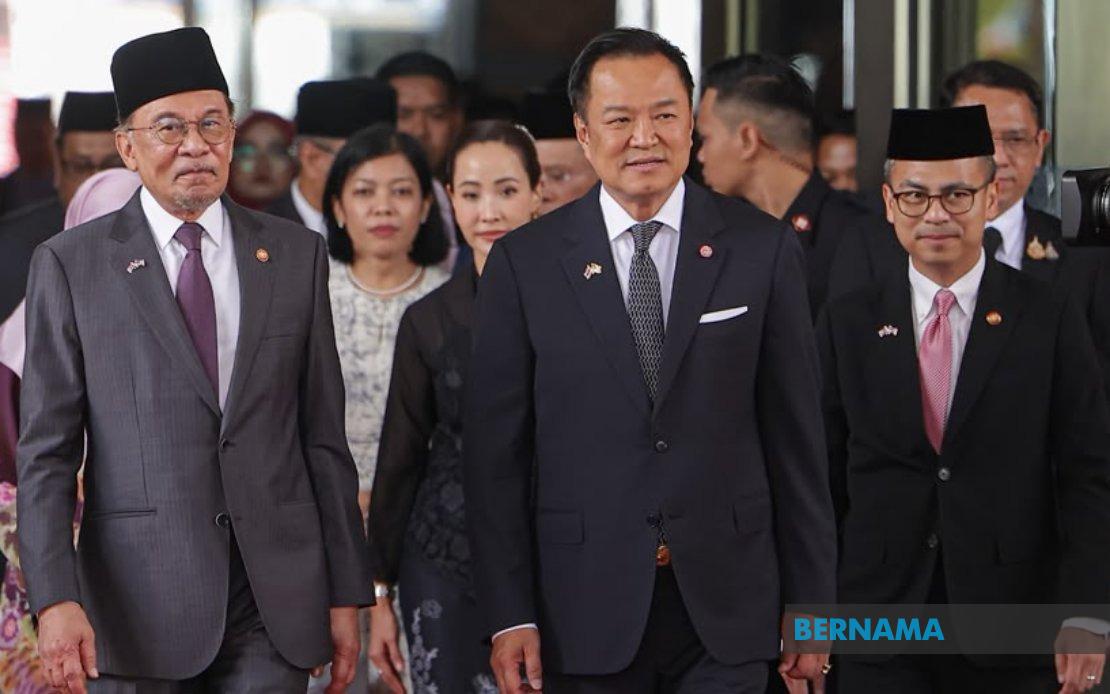
Prime Minister Datuk Seri Anwar Ibrahim and Thailand's Prime Minister Anutin Charnvirakul convened for substantive bilateral discussions at the Perdana Putra Complex in Putrajaya on July 9, signalling renewed momentum in Malaysia-Thailand relations at the highest political level. The meeting provided both leaders with a platform to assess the current state of bilateral ties and chart a course for enhanced cooperation across multiple sectors of mutual concern and economic interest. The formal engagement underscored the importance both governments place on strengthening cross-border partnerships as regional challenges and opportunities continue to reshape Southeast Asia's strategic landscape.
Anutin arrived at Kuala Lumpur International Airport at 11.11 am, where Anwar extended a formal welcome before both leaders proceeded to the Perdana Putra Complex for their closed-door discussions. The Thai Prime Minister's two-day official visit came at Anwar's invitation, reflecting the ceremonial significance attached to the engagement and the desire to elevate the bilateral relationship. The careful choreography of the reception, with the Malaysian leader greeting his counterpart at the nation's premier airport terminal, communicated the seriousness with which Malaysia treats its ties with its northern neighbour.
The bilateral agenda encompassed a broad spectrum of policy domains reflecting the interconnected nature of modern cross-border governance. Trade and investment featured prominently, given that Malaysia and Thailand maintain substantial commercial relationships spanning manufacturing, automotive sectors, and digital commerce. Border connectivity discussions carried particular weight, as improved transportation infrastructure and logistics between the two nations promise to unlock significant economic gains for communities in border regions. Security cooperation represents another critical pillar, with both countries facing transnational challenges ranging from trafficking and smuggling to cybersecurity threats that require coordinated responses.
Agriculture emerged as a focal point for collaboration, a sector where both nations possess considerable expertise and complementary strengths. Malaysian agricultural expertise in palm oil cultivation and tropical farming methods aligns with Thailand's significant rice production and food processing capabilities, creating natural opportunities for knowledge transfer and joint ventures. Tourism and people-to-people exchanges also figured in the conversations, recognising that cultural and leisure travel generates significant revenue while fostering grassroots understanding between Malaysian and Thai populations. Educational collaboration, including student exchange programmes and institutional partnerships, likewise promises to strengthen bilateral bonds across generations.
The composition of delegations reflected the comprehensive nature of the partnership. Malaysia fielded representation from ten Cabinet ministers, including Deputy Prime Minister Datuk Seri Fadillah Yusof, Foreign Minister Datuk Seri Mohamad Hasan, and ministers overseeing critical portfolios such as transport, agriculture, home affairs, trade, and human resources. This broad ministerial presence enabled discussion of technical details across sectors and provided opportunities for officials to establish working relationships that would facilitate implementation of any agreed initiatives. Thailand's delegation similarly comprised high-ranking officials, with three Deputy Prime Ministers leading various portfolios including foreign affairs, transport, and finance, alongside ministers responsible for tourism, defence, agriculture, and labour.
Regional and international developments relevant to both nations occupied space on the agenda, particularly matters falling within ASEAN's ambit and other multilateral frameworks. As ASEAN members navigating an increasingly complex Indo-Pacific environment, Malaysia and Thailand share interests in regional stability, free and open trade, and the centrality of Southeast Asia in managing great power competition. Both nations maintain stakes in maritime security, freedom of navigation, and the peaceful resolution of disputes, issues that periodically demand ASEAN-level coordination and consensus building. The bilateral dimension thus feeds into and supports the broader regional architecture within which both countries operate.
The scheduled signing of a Memorandum of Understanding on agricultural cooperation provided concrete substance to the discussions, moving beyond rhetorical commitments to establish institutional frameworks for sectoral advancement. Such MOUs typically establish joint committees, define areas of collaboration, allocate resources, and create accountability mechanisms ensuring that agreed initiatives translate into tangible outcomes. In agriculture particularly, where both nations face pressures from climate change, rising input costs, and shifting consumer preferences, structured cooperation enables economies of scale and risk-sharing that individual countries struggle to achieve alone. The timing of this agricultural MOU reflected the sector's strategic importance to both economies, where farming communities represent significant population segments and food security remains a political priority.
For Malaysia, deepening ties with Thailand carries particular strategic importance given Thailand's role as a crucial land bridge between Southeast Asia and the broader region. Improved bilateral relations facilitate smoother trade flows, reduced transaction costs, and enhanced security coordination that benefit Malaysian businesses operating across borders. The northern border regions of Malaysia, particularly Kelantan and Terengganu, possess substantial potential for economic development through enhanced cross-border collaboration, yet remain among the nation's less developed areas. Bilateral initiatives in infrastructure, tourism, and agricultural cooperation carry particular significance for these communities, potentially generating employment and attracting investment that has historically bypassed these regions.
Thailand's perspective on the engagement similarly emphasises mutual benefits. As Thailand pursues economic diversification and seeks to bolster relationships with key ASEAN partners, deepened ties with Malaysia offer commercial opportunities and reinforce Thailand's position as a regional economic hub. Thai manufacturers benefit from Malaysian supply chains and markets, while Thai agricultural exports find receptive buyers across the Malaysian peninsula. Enhanced border connectivity serves Thai interests by integrating Thai production networks more effectively with downstream regional economies and reducing logistics costs for Thai exporters seeking broader Southeast Asian distribution.
The bilateral format allowed both governments to address sensitive bilateral issues that might prove difficult to navigate in multilateral settings. Border security concerns, including smuggling and irregular migration, require candid discussion and coordinated operational responses that bilateral channels facilitate more easily than regional forums. Similarly, trade disputes or non-tariff barrier complaints can be aired and negotiated privately before escalating to formal dispute mechanisms, enabling relationship-preserving resolution. The trust established through regular high-level engagement creates space for addressing contentious issues without permitting disagreements to fester or damage broader partnerships.
Looking forward, the substantive engagement between Anwar and Anutin establishes a foundation for Malaysia-Thailand cooperation that extends well beyond the government-to-government dimension. Business associations, sectoral organisations, and civil society groups benefit from political signals indicating openness to expanded engagement, often translating government initiatives into private sector opportunities. The ministerial delegations present at discussions create networks of officials who will implement agreed upon policies and programmes, establishing working relationships that persist across political transitions and administrative changes. The momentum generated through such high-level meetings typically cascades through bureaucratic structures, accelerating previously stalled initiatives and generating new proposals for collaboration.
For Southeast Asia's broader political and economic trajectory, Malaysia-Thailand cooperation carries implications extending beyond bilateral relations. Both nations' commitment to strengthening partnerships models the regional cooperation that ASEAN principles emphasise while demonstrating practical alternatives to great power competition that some fear may fragment Southeast Asia. Economic integration between Malaysia and Thailand, pursued through trade, investment, and infrastructure development, creates constituencies within both nations with vested interests in stability and peaceful relations, effectively embedding cooperation incentives across multiple levels of society. This layered approach to bilateral partnership, combining government coordination with commercial integration and people-to-people contact, represents the durable framework through which modern Southeast Asian nations navigate an era of complex interdependence and evolving strategic competition.

