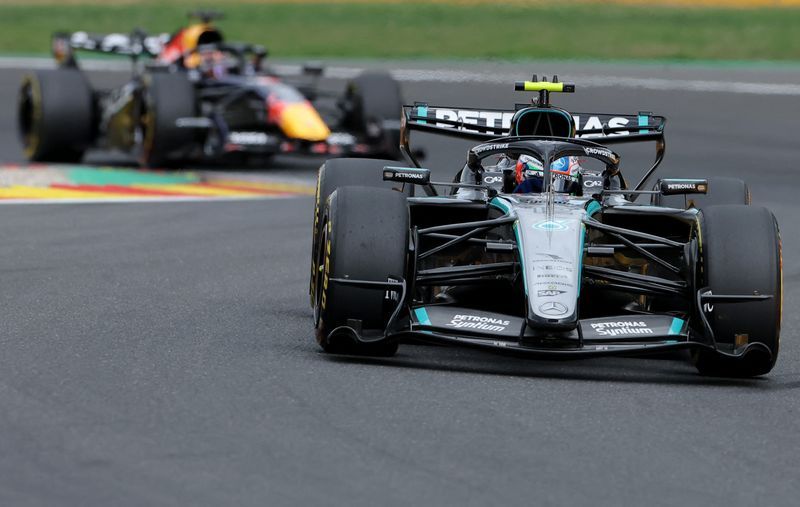
Kimi Antonelli delivered a commanding performance at Spa-Francorchamps on Sunday, guiding his Mercedes to victory in the Belgian Grand Prix and substantially reinforcing his grip on the 2024 Formula One title race. The 19-year-old Italian's triumph proved particularly consequential because it unfolded amid dramatic circumstances affecting his principal rivals, most notably his own teammate George Russell, who had arrived at the circuit as the championship's closest challenger and departed with a severely damaged title bid.
Russell's devastating retirement during the opening lap fundamentally reshaped the competitive landscape. The British driver, seeking to capitalise on a strong starting position, initiated an ambitious overtaking manoeuvre that resulted in contact with Lewis Hamilton. The collision sent Russell spiralling off the racing surface into the gravel trap, eliminating him from contention before most spectators had settled into their seats. The incident encapsulated the thin margins that define elite motor racing and served as a stark reminder that championship campaigns can transform instantaneously through mechanical misfortune or tactical miscalculation.
Antonelli's pathway to victory, while ultimately successful, demanded considerable tactical execution and capitalised substantially on fortune's shifting favour. The Italian had claimed pole position, maintaining Mercedes' perfect qualifying record throughout the season, yet found his lead threatened during the race's middle phases. When officials deployed a virtual safety car, Ferrari's Charles Leclerc executed a perfectly timed pit stop that temporarily promoted the Monégasque driver into the lead. However, Antonelli's subsequent driving and Mercedes' strategic decisions combined to restore the German constructor's dominance, with Antonelli ultimately crossing the finish line 1.952 seconds ahead of Leclerc in the 44-lap contest.
Leclerc's second-place finish represented Ferrari's solid operational performance at a circuit where the Scuderia has historically achieved competitive results. The Monégasque driver's tactical awareness during the virtual safety car phase demonstrated Ferrari's continuing championship ambitions, yet the result underscores how Antonelli's consistency throughout the campaign has created a substantial points buffer that grows more commanding with each contested round. The Ferrari driver's presence on the podium, however, proved less consequential than developments involving Red Bull and the championship's broader competitive balance.
Max Verstappen's third-place result provided Red Bull with an important milestone, marking the team's 300th Formula One podium finish. The achievement, while historically significant for the Austrian energy drink manufacturer's motorsport programme, offered limited immediate sporting relief to Verstappen's championship prospects. The Dutch driver's inability to challenge for victory at Spa, traditionally regarded as one of the grid's preeminent venues where aerodynamic efficiency and top-end performance determine outcomes, suggested Red Bull's recent competitive trajectory remains concerning despite occasional strong performances.
Hamilton's fourth-place finish concealed a more troubling reality regarding the veteran British driver's current championship position and Mercedes' internal dynamics. The seven-time world champion served a five-second penalty for the opening-lap collision that had eliminated Russell, yet subsequently faced ongoing investigation concerning an unsafe pit release that could precipitate his descent to fifth place. The regulatory complications surrounding Hamilton's afternoon illustrated how championship battles extend beyond pure driving skill to encompass strategic consistency and operational precision. His points total now sits significantly adrift of Antonelli's commanding advantage, effectively removing Hamilton from realistic title contention despite his undeniable technical mastery.
Antonelli's post-race commentary revealed the psychological intensity accompanying his championship challenge. The teenager acknowledged previous rounds had proven troublesome, confirming that his absence from victory in two of the preceding three contests had generated momentum concerns. His ability to acknowledge how championship dynamics swing unpredictably, coupled with his determination to exploit every available opportunity, reflected a maturity exceeding his chronological years. The Italian's recognition that fortune favoured his Belgian campaign, yet that seizing such advantages remained fundamentally important, suggested a competitor balancing tactical awareness with championship pragmatism.
The secondary places throughout the field demonstrated McLaren's continuing competitiveness despite the team's inability to mount serious championship challenges. Oscar Piastri secured fifth position, while reigning champion Lando Norris recovered from a disadvantageous 13th-place grid position to finish seventh despite accepting a 10-place penalty related to power unit component changes. McLaren's capacity to score consistently, if not dominantly, suggests the British-headquartered constructor will eventually emerge as a significant championship force once its operational integration and strategic decision-making mature further.
Gabriel Bortoleto's eighth-place finish provided Audi with continued evidence that the Volkswagen group's ambitious Formula One re-entry strategy continues generating competitive returns. The Brazilian driver's consistent point-scoring bodes well for Audi's long-term programme objectives, while simultaneously indicating that the sport's mid-field increasingly features legitimate competitors capable of occasionally challenging established frontrunners. Racing Bulls and Alpine completed the classified finishers through Arvid Lindblad and Franco Colapinto respectively, with both drivers continuing their campaigns of developmental progress within competitive Formula One machinery.
The championship standings now reflect Antonelli's domination, with his 45-point advantage over Hamilton and 50-point margin over Russell effectively determining the title's likely destination. Five races remain in the calendar, yet Antonelli's mathematical advantage and demonstrated consistency suggest Mercedes will almost certainly claim both drivers' and constructors' championships. The Belgian Grand Prix crystallised a narrative arc that extends back through the entire season: Antonelli's combination of technical excellence, consistency, and strategic acuity has created an insurmountable advantage, while his principal rivals have experienced insufficient occasion to generate the aggressive momentum required to mount meaningful challenges. For Malaysian and broader Southeast Asian motor racing enthusiasts, the championship now resembles a formality awaiting administrative confirmation rather than an unresolved competitive question.

