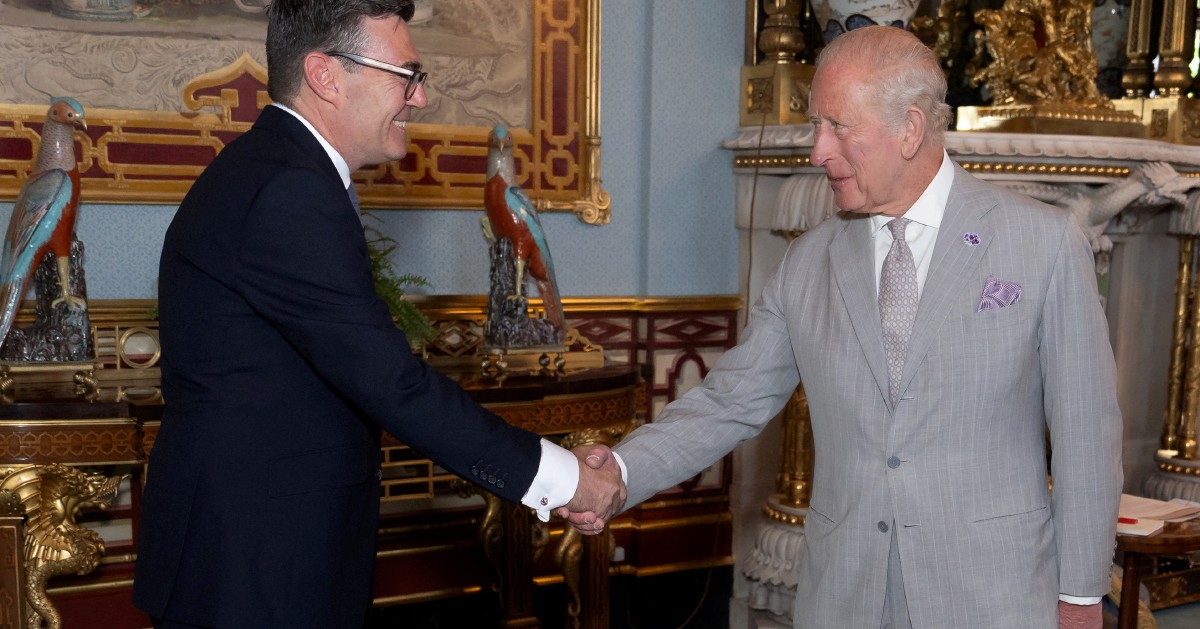
Andy Burnham has assumed the office of British Prime Minister after a formal meeting with King Charles III at Buckingham Palace on Monday, marking a significant political transition in Westminster. The appointment concludes a period of political uncertainty and positions Burnham to articulate his agenda for governance as he takes the reins from his predecessor Keir Starmer.
The constitutional formality of meeting the monarch represents the final step in Burnham's path to power, a ceremonial requirement that grants him the authority to form and lead government. As Britain's new chief executive, Burnham inherits both the machinery of state and the substantial challenges facing the nation across multiple policy domains. His elevation to Number 10 reflects shifting dynamics within the political landscape and indicates that his party has secured sufficient parliamentary backing to command confidence in the House of Commons.
Burnham's transition to the highest executive office carries particular significance for observers of British politics given his extensive background in public service and local government. His previous role managing substantial administrative portfolios provides him with operational experience, though the transition from regional to national leadership typically demands a recalibration of priorities and approach. The new Prime Minister now confronts immediate pressures on public services, economic management, and the complex inheritance of existing government commitments and international obligations.
The change of leadership occurs within the broader context of European political evolution, where several nations have experienced recent shifts in their governing coalitions and executive leadership. For Malaysia and Southeast Asia, transitions in London remain consequential given historical ties, ongoing trade relationships, and the United Kingdom's strategic involvement in Indo-Pacific affairs through defence partnerships and diplomatic engagement. The direction Burnham charts will influence bilateral relationships and Britain's regional posture over the coming years.
As Burnham prepares to unveil his administrative priorities and policy framework, particular attention will focus on his approach to economic policy, the National Health Service, education reform, and climate commitments. These domains represent both inherited challenges and opportunities for the new administration to establish distinct priorities that differentiate it from the Starmer government. Early signals regarding these areas will shape market sentiment, investor confidence, and public expectations for his tenure.
The mechanics of power transfer in the Westminster system, while constitutionally straightforward, involve extensive preparatory work behind the scenes. Burnham will inherit a civil service apparatus, ongoing legislative initiatives, and diplomatic relationships that require immediate attention. His team's ability to maintain policy continuity where appropriate while implementing desired change will determine the administration's early effectiveness.
International observers, including those monitoring developments from Southeast Asia, will scrutinise Burnham's approach to trade negotiations, defence arrangements, and regional security frameworks. His government's stance on critical issues including relations with China, support for Ukraine, and engagement with Pacific partners will carry implications for broader geopolitical alignment. Malaysia and other ASEAN nations maintain diverse interests in British foreign policy positioning, particularly regarding trade access and security cooperation.
The appointment also carries domestic ramifications for Burnham's party, which now faces the challenge of implementing an election mandate or governing mandate within the constraints of parliamentary mathematics. Party cohesion, managing backbench expectations, and maintaining focus on delivery will occupy his attention alongside the considerable weight of national administration. The period immediately following leadership change typically provides political opportunity for momentum-building, though also exposes new administrations to heightened scrutiny and pressure for rapid progress.
Burnham's public pronouncements following his palace audience will carry additional weight as market participants, international partners, and domestic audiences calibrate their assessment of his premiership's direction. Signals regarding economic management, industrial policy, and social priorities will provide initial benchmarks against which his tenure can be evaluated. The narrative he establishes during these opening days often proves difficult to substantially revise, making the framing of his vision a strategic priority.
The transition from Starmer to Burnham completes a chapter in recent British political history whilst opening another with uncertain outcomes. Burnham enters office with the conventional advantages of executive authority and the party machinery, yet faces substantial expectations and entrenched challenges across public services, economic performance, and social cohesion. His success will be measured against both the record of his predecessor and the specific commitments he articulates in the coming days and weeks.
For regional observers, Burnham's assumption of power merits attention as Britain continues calibrating its post-European Union positioning and seeking influence in global affairs. His government's approach to Indo-Pacific engagement, trade policy, and security partnerships will shape the context within which Malaysia and its regional partners navigate their own international relationships. The new Prime Minister's early decisions regarding these matters will provide important signposts for understanding British priorities and capabilities in an evolving global landscape.

