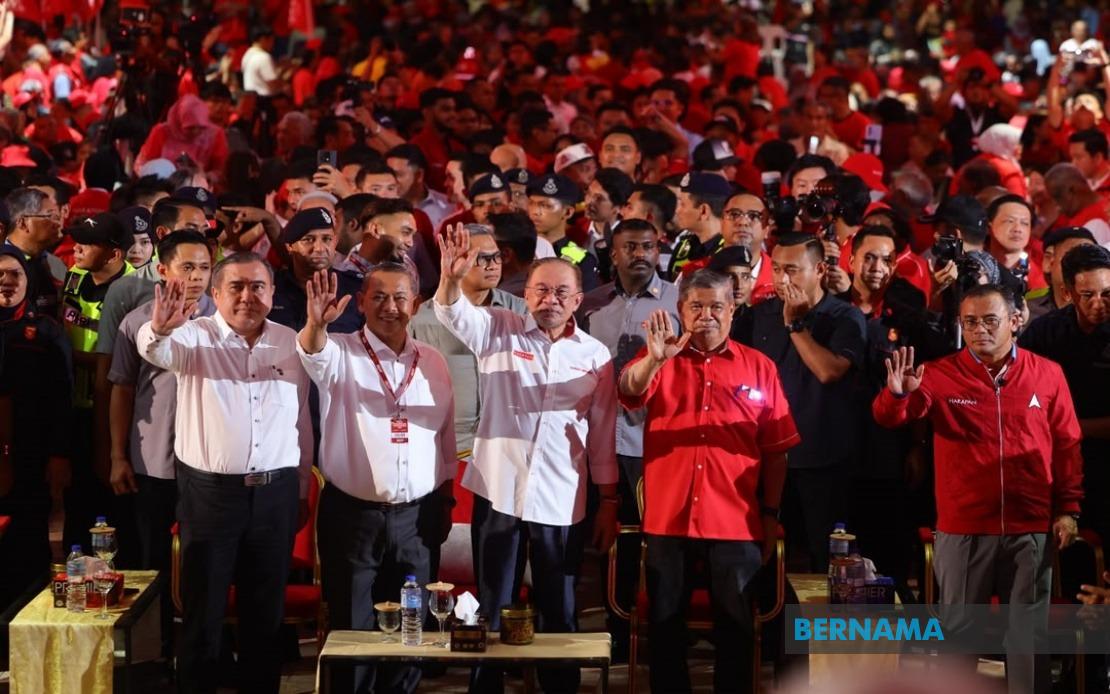
Negeri Sembilan's Pakatan Harapan leadership has launched its campaign for the upcoming 16th state election, with coalition chairman Datuk Seri Aminuddin Harun calling on voters to provide PH with renewed political authority to sustain economic momentum and governance continuity. Addressing supporters at a candidate announcement ceremony in Kuala Pilah on July 14, Aminuddin framed the election as a choice between maintaining stability or risking disruption to development initiatives that have taken hold since the coalition came to power in 2018.
The stability argument has become central to PH's electoral strategy across the region, reflecting a broader consensus among incumbent coalitions that voter confidence in government operations depends on institutional consistency. Aminuddin articulated this through concrete claims about investor behaviour, noting that sustained political certainty encourages capital inflows and allows multi-year projects to reach completion without interruption. For Negeri Sembilan specifically, he pointed to RM19.1 billion in accumulated foreign and domestic investment as evidence that business confidence in state governance remains robust, a particularly salient argument in a state with significant manufacturing and industrial corridors along the Kuala Lumpur-Selangor border.
Beyond investment figures, Aminuddin highlighted social welfare expansion as a hallmark of PH administration, citing education assistance schemes and tablet distribution to schoolchildren as manifestations of the coalition's commitment to human capital development. These programmes carry particular weight in a state where income disparities between urban and rural constituencies could influence voter behaviour, particularly among younger families in smaller towns and villages who depend on government support systems. The administration's welfare trajectory, however, remains contestable terrain, as opposition parties will likely argue that such initiatives represent baseline expectations rather than exceptional achievements.
One striking metric cited by Aminuddin concerned religious charitable collections, with zakat revenue rising dramatically from approximately RM80 million to nearly RM200 million since his assumption of office. This expansion reflects broader trends across Malaysian states in recent years as religious institutions and state governments have prioritized formal collection mechanisms and transparency. For PH, highlighting this figure serves dual purposes: it demonstrates fiscal dynamism and also signals respect for Islamic institutions, a particularly important messaging element for a coalition that has historically faced scrutiny from communal and religious constituencies regarding its secular credentials and governance priorities.
DAP secretary-general Anthony Loke's remarks explicitly positioned Negeri Sembilan as compensatory territory following PH's underperformance in the preceding Johor state election, where the coalition failed to retain control despite entering as the defending government. Loke's language—characterizing the Negeri Sembilan campaign as PH's "second round" and calling for a rebuilding of coalition momentum—acknowledged electoral setbacks while framing the upcoming contest as an opportunity to reset electoral trajectories. This rhetorical strategy reflects a calculated assessment that voters distinguish between different state contexts and that losses in one jurisdiction need not predict outcomes elsewhere, provided campaigns effectively mobilize party machinery and messaging.
Loke's emphasis on maintaining campaign decorum and respecting Negeri Sembilan's royal institutions and constitutional arrangements revealed sensitivity to accusations that DAP, as PH's largest component party, operates with insufficient regard for local customs and institutional traditions. By explicitly restating DAP's commitment to the Federal Constitution, constitutional monarchy, and the Rukun Negara, and pledging loyalty to the Yang Dipertuan Besar and Undang Yang Empat, Loke attempted to preempt opposition narratives suggesting that PH governance represents a threat to traditional institutions. This defensive posturing, while standard in Malaysian electoral politics, underscores ongoing tensions between secular-progressive governance models and culturally conservative constituencies that remain significant in smaller states.
The presence of multiple senior PH figures at the Kuala Pilah event—including Amanah president Datuk Seri Mohamad Sabu, communications director Datuk Seri Fahmi Fadzil, and election director Datuk Seri Amirudin Shari—signalled coalition-wide commitment to retaining Negeri Sembilan, a state where PH's hold has appeared less secure than in larger urban-dominated jurisdictions like Selangor. Negeri Sembilan's transitional character, combining relatively developed areas like Kuala Lumpur's satellite towns with more rural constituencies in Seremban, Jelebu, and Jempol, requires coalition messaging that speaks simultaneously to both urban progressives and rural traditionalists.
Amiuddin's repeated emphasis on federal-state cooperation carries implications extending beyond electoral messaging into questions about PH's broader governance coalition structure. The reference to strengthening collaboration with the Federal Government for development implementation suggests that state-level PH success remains dependent on federal resource allocation and policy coordination, a particularly significant consideration given that PH controls the federal government through its Pakatan Negeri Sembilan arrangement with other coalition partners. Should federal-state dynamics deteriorate, the state government's capacity to deliver on promised initiatives could diminish, potentially undermining electoral messaging grounded in demonstrated developmental achievements.
For Malaysian voters outside Negeri Sembilan, this campaign offers insights into how incumbent coalitions approach mid-term state elections in post-2018 political contexts. The emphasis on policy delivery, welfare programme continuation, and investor confidence reflects a pragmatic electoral calculus: that voters evaluate governments substantially on governance competence and tangible benefits rather than purely on ideological or personality-driven considerations. Whether this approach succeeds in Negeri Sembilan will carry implications for how PH and opposition coalitions structure campaigns in upcoming state elections across Peninsular Malaysia and East Malaysia.
The timing of the Negeri Sembilan election, coming after Johor's PH setback, positions the state as a bellwether for coalition capacity to recover electoral momentum. Success would suggest that PH's Johor difficulties reflected state-specific factors rather than systemic coalition weaknesses, while failure would reinforce narratives of declining PH electoral competitiveness. For Malaysia's political trajectory, the outcome matters beyond Negeri Sembilan's borders, as state election cycles increasingly function as mid-term assessments of federal coalition performance and voter satisfaction with governmental direction.

