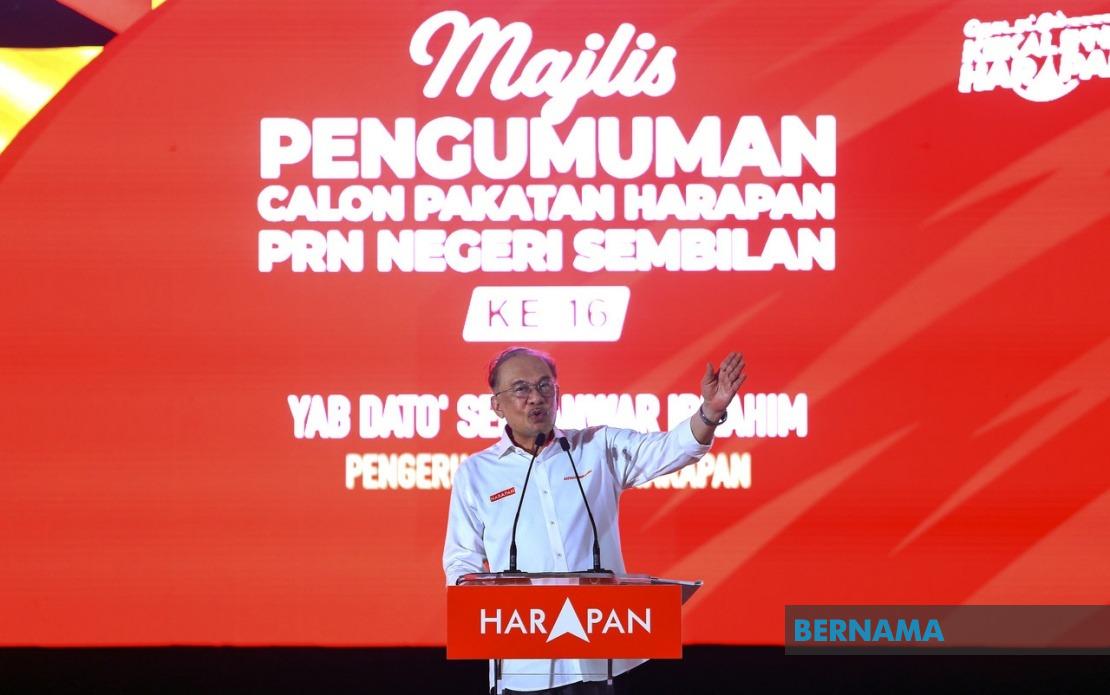
Pakatan Harapan has formally unveiled its candidacy for two crucial state seats in Negeri Sembilan's upcoming election, signalling the coalition's strategy for maintaining its political dominance in the peninsular state. Prime Minister Datuk Seri Anwar Ibrahim announced the nominations at a packed candidate unveiling ceremony in Kuala Pilah, where he declared Menteri Besar Datuk Seri Aminuddin Harun would contest the Linggi constituency and DAP secretary-general Anthony Loke would defend his long-held Chennah seat.
Amiruddin's transition to Linggi represents a notable shift in his electoral positioning after nearly two decades of consecutive representation. The Negeri Sembilan Menteri Besar has served four successive terms representing the Sikamat state constituency since 2008, establishing himself as a formidable political force within the state's legislative landscape. His move away from Sikamat to the Linggi seat underscores internal coalition recalibrations aimed at strengthening PH's electoral footprint across the state's diverse constituencies. The decision reflects broader considerations about candidate placement and resource allocation in what observers view as a critical election for the coalition's peninsular strongholds.
Loke's continuation as PH's standard bearer in Chennah provides continuity in a seat he has successfully defended since 2013, building more than a decade of constituent relationships and legislative experience. The DAP leader has become synonymous with the Chennah constituency, having weathered previous electoral cycles and consolidated his political base through consistent grassroots engagement. His renomination signals PH's confidence in his ability to withstand opposition challenges while serving the state's broader democratic interests.
The nominations were unveiled during an elaborate ceremony that drew PH's top echelon, including Amanah president Datuk Seri Mohamad Sabu, communications director Datuk Seri Fahmi Fadzil, and election director Datuk Seri Amirudin Shari. The gathering of thousands of party supporters underscored the significance of these candidacy announcements for coalition morale and messaging. For Malaysian observers tracking the trajectory of multiethnic coalition politics, the nominations reflect how PH navigates internal power dynamics between its member parties while maintaining electoral competitiveness.
Negeri Sembilan holds particular significance within Malaysia's political matrix. As a swing state with strong historical ties to UMNO, its electoral outcomes frequently signal broader peninsular sentiments and coalition viability. The state's diverse socioeconomic composition—combining urban voters in Seremban with rural constituencies dependent on agriculture and small commerce—requires nuanced campaign strategies that balance competing policy interests. PH's candidate selections must therefore appeal across these demographic divides while reinforcing the coalition's governing narrative.
For regional observers, these candidacy announcements illuminate the evolving dynamics within Southeast Asia's complex multiparty democratic systems. Malaysia's coalition politics demand constant internal negotiation and compromise between component parties with distinct ideological orientations and constituency bases. DAP's continued prominence in Negeri Sembilan candidacies reflects its capacity to retain urban and Chinese-Malaysian support, while Amanah's participation represents the coalition's efforts to broaden appeal among Malay-Muslim voters who traditionally supported UMNO.
Aminutdin's repositioning also raises questions about succession planning and institutional continuity in Negeri Sembilan governance. As the state's chief executive officer, his candidacy directly impacts speculation about PH's capacity to maintain administrative control following the election. A successful Linggi victory would enable him to retain the Menteri Besar position, assuming the coalition secures overall majority. Conversely, an electoral reversal could fundamentally reshape the state's political configuration and undermine PH's broader peninsular positioning.
The timing of candidate announcements carries strategic implications for electoral momentum and campaign narrative construction. By formalizing nominations early, PH seeks to consolidate grassroots support and channel energies toward constituency-level mobilization. The Anwar-led announcement approach also demonstrates prime ministerial endorsement, effectively signalling federal-level commitment to these particular candidacies and the broader electoral effort in Negeri Sembilan.
From a Southeast Asian perspective, these nominations exemplify how established democracies manage succession and coalition continuity within complex institutional frameworks. Unlike some regional systems where political transitions occur through extra-constitutional means, Malaysia's reliance on electoral processes—however contested—reinforces democratic legitimacy even amid significant partisan competition. The Negeri Sembilan campaign will likely showcase both the strengths and vulnerabilities of multiparty democratic governance, particularly regarding vote-splitting and coalition coordination.
For Malaysian voters and stakeholders, the stakes extend beyond Negeri Sembilan's borders. State-level elections frequently serve as barometers for national sentiment, influencing federal policy considerations and determining resource allocation for subsequent budgetary cycles. A successful PH performance could strengthen Anwar's government's parliamentary position, while disappointing results might embolden opposition voices and complicate the administration's legislative agenda. The contest therefore functions as both a state-level electoral exercise and a referendum on broader federal governance performance.

