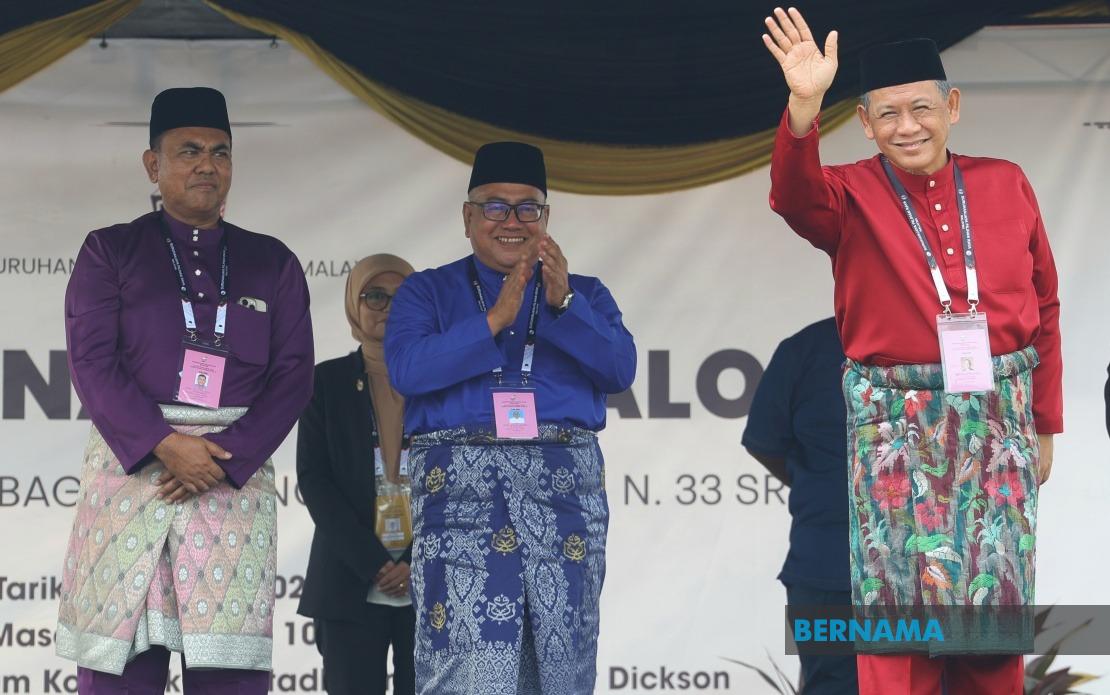
The Negeri Sembilan state election is shaping into a complex political battle, with Pakatan Harapan's Menteri Besar Datuk Seri Aminuddin Harun confronting an unexpectedly competitive field in what was presumed to be his stronghold. His bid for re-election in the Linggi seat has evolved into a three-cornered fight after nominations closed on Wednesday morning at the Port Dickson District Administration Complex. The Negeri Sembilan leader must now navigate simultaneous challenges from incumbent Datuk Mohd Faizal Ramli, representing Barisan Nasional's continued effort to reclaim ground in the state, and Datuk Zamri Md Said, fielded by Bersatu as part of the coalition's broader strategy across the peninsula.
The emergence of multiple challengers in Linggi signals the increasingly fragmented political landscape in Negeri Sembilan, where traditional two-cornered fights have given way to complex multi-party contests. Bersatu's decision to field Zamri in this seat underscores the party's determination to establish itself as a significant political force in the state, even as it remains aligned with Perikatan Nasional at the national level. For Aminuddin, the incumbent's presence means the race cannot be dismissed as merely ideological competition between government and opposition. Instead, the PH leader must contend with the practical challenge of vote-splitting in a three-way contest where regional dynamics and localized grievances may prove decisive.
Across the state's contested constituencies, similar patterns are emerging. In Sri Tanjung, Dr G. Rajassekaran, the incumbent PH representative, faces pressure from both BN's A. Achutan and Bersatu's Leevineshwaraan Murugan, another first-time candidate for the party. The Lukut seat presents a different configuration, with PH incumbent Choo Ken Hwa battling Perikatan Nasional's Sathes Kumar Nilameham and independent candidate Teo Seng Lee, suggesting that conventional party machinery alone may not determine outcomes. Bagan Pinang showcases yet another variation, pitting PAS incumbent Abd Fatah Zakaria against Nasir Raman of PH and Sheikh Junaidy Jamaludin representing Bersatu, demonstrating how the Islamist party's traditional strongholds are now subject to credible challenges from multiple directions.
The Chuah seat stands as an exception to the proliferating multi-cornered contests, remaining a straight fight between PH incumbent Yew Boon Lye and BN's Pau Jeou Ching. This binary contest may prove atypical for Negeri Sembilan's political environment, where traditional two-party competition has increasingly fragmented. The relative simplicity of this race could amplify its importance as a bellwether for voter sentiment, particularly if either candidate achieves an unexpectedly decisive margin that defies current polling expectations or ground assessments.
The Election Commission has scheduled polling day for August 1, with early voting opportunities available on July 28. This compressed timeline between nomination closure and election day affords candidates limited time to conduct intensive ground campaigns and respond to emerging issues. The early voting provision, typically utilized by military personnel, police officers, and their immediate families, reflects institutional recognition that serving personnel require accommodation in electoral processes. These procedural elements, while administrative in nature, carry strategic implications for how campaigns unfold and which voter segments might prove most accessible during the brief mobilization window.
Negeri Sembilan's electoral register encompasses 889,490 eligible voters, a figure that encompasses 867,151 ordinary citizens, 16,884 military personnel and spouses, and 5,455 police personnel and spouses. This composition reveals that approximately two percent of registered voters belong to uniformed services or their families, a constituency traditionally considered more predictable in voting patterns than the general population. The scale of the ordinary voter base, however, ensures that civilian political preferences and localized campaign effectiveness will likely determine election outcomes across most constituencies. The substantial voter population also indicates that the state remains demographically significant within Malaysia's electoral architecture, making it a meaningful testing ground for national coalition strategies ahead of future federal contests.
For Pakatan Harapan, Negeri Sembilan represents a critical battleground where the coalition must defend its 2023 position and demonstrate sustained voter confidence. The emergence of Bersatu as a systematic challenger in multiple constituencies suggests that Bersatu's Perikatan allies may view this state election as an opportunity to test campaign messaging and organizational capacity before larger contests. Barisan Nasional's continued presence in three-way races indicates that the coalition retains baseline electoral support but confronts a more fragmented competitive environment than existed in previous electoral cycles. The various configurations across constituencies mean that generic national messaging may prove less effective than localized positioning responsive to community-specific concerns and established patterns of representation.
Bersatu's strategic insertion into multiple Negeri Sembilan seats reflects the party's broader repositioning since the 2023 general election. By fielding candidates across various constituencies rather than concentrating resources in traditional strongholds, Bersatu appears intent on establishing credibility as an alternative voice within Malaysian politics. Whether this approach generates meaningful breakthrough or merely fragments opposition votes benefiting incumbent governments remains uncertain. The party's performance in Negeri Sembilan could signal to national observers whether Bersatu possesses genuine organizational depth or represents primarily a vehicle for specific leadership interests and negotiated political arrangements.
PAS's presence in Bagan Pinang, contesting the seat it currently holds, exemplifies how the Islamic party maintains its parliamentary footprint in Negeri Sembilan despite national coalition politics favoring other partners. The fact that Abd Fatah Zakaria must defend against determined challenges from both PH and Bersatu underscores that even traditionally secure seats cannot be taken for granted in Malaysia's evolving political environment. For PAS, protecting Bagan Pinang while expanding influence elsewhere requires careful calibration of messaging between its Islamic advocacy platform and the practical governance concerns of ordinary constituents.
The overall structure of Negeri Sembilan's 16th state election reveals a political system in transition. The proliferation of three-way and multi-cornered contests, while creating uncertainty for traditional power structures, also reflects genuine voter choice and fragmentation of political loyalty patterns. Candidates can no longer assume that party affiliation alone guarantees victory, and campaigns must engage substantive policy differentiation or demonstrate superior constituent service records. This environment may ultimately produce a more competitive and responsive political culture, though it complicates the formation of stable governing coalitions and may dilute the coherence of policy implementation if outcomes fragment legislative majorities significantly.

