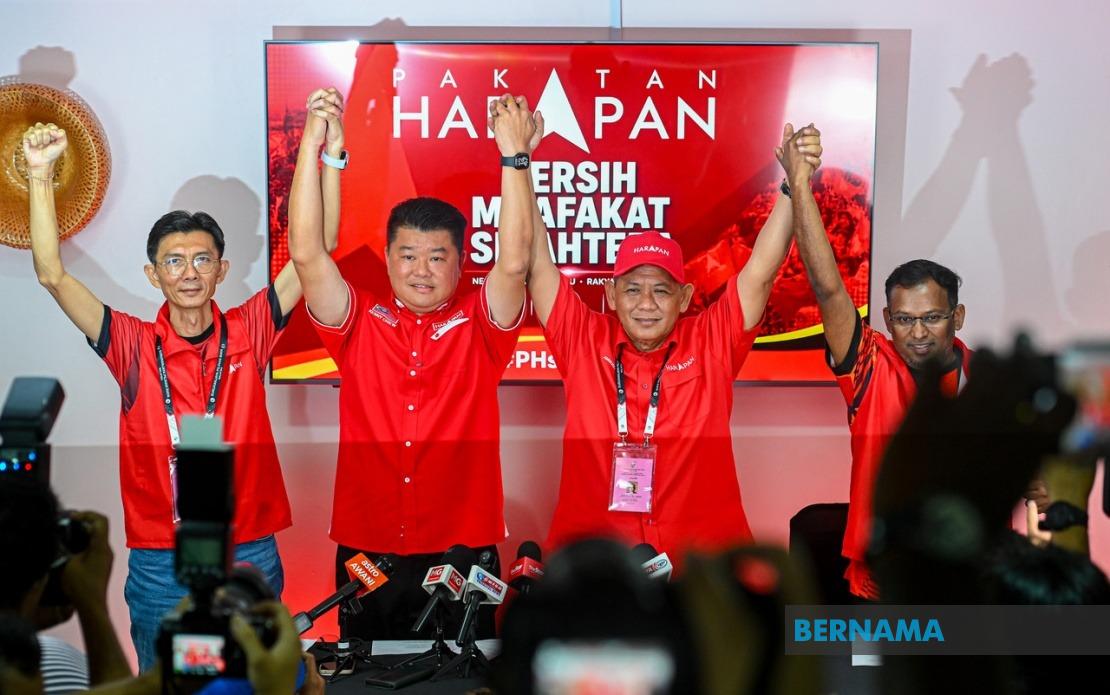
With voting just days away in the Negeri Sembilan state election, Datuk Seri Aminuddin Harun, the Pakatan Harapan coalition's most senior figure in the state, sought to extinguish persistent rumours of friction within the alliance's ranks across constituencies feeding into the Port Dickson parliamentary seat. Speaking in Port Dickson on July 20, the menteri besar and State PKR chairman rejected characterisations that disagreements had fractured party unity or compromised campaign efforts ahead of polling on August 1.
The controversy at the centre of the denial involves Datuk Yew Boon Lye's re-nomination as the PH candidate for the Chuah state seat, a decision that reportedly sparked discontent within the Port Dickson PKR division hierarchy. Datuk Kenny Chiew Chi Kin, the deputy chief of the Port Dickson PKR branch, had apparently expressed frustration through social media channels over his own exclusion from the candidate slate, a development that caught the attention of party observers and opposition commentators seeking to portray the coalition as internally divided. Rather than downplaying the matter, Aminuddin confronted it directly, indicating that senior leadership had already resolved the underlying tensions through private discussions.
According to Aminuddin, Chiew has now formally committed to channelling his energies entirely toward ensuring victory for all five PH candidates competing across the constituencies of Chuah, Lukut, Sri Tanjung, Bagan Pinang and Linggi under the Port Dickson federal seat boundary. The statement represents an attempt to transform what could have been a persistent source of internal friction into a demonstration of discipline and shared purpose. Aminuddin characterised Chiew as a dedicated party servant whose contributions to strengthening the Port Dickson PKR division during his tenure remained valuable, notwithstanding his non-selection for this particular election cycle.
The timing of such tensions is strategically sensitive. Negeri Sembilan elections invariably attract keen observation from national party structures, and any visible fault lines within the dominant coalition can provide ammunition for opposition narratives about governance instability. The Perikatan Nasional and Barisan Nasional opposition camps have both sought to exploit real or perceived weaknesses in PH's electoral positioning, making the state leadership's effort to project unity more than merely a communications exercise—it represents a defensive measure against sustained attacks on coalition credibility.
Yew Boon Lye, whose re-nomination occasioned the dispute, secured the Chuah seat in 2023 with a commanding majority of 6,298 votes against Perikatan Nasional's Tang Jay Son. His status as an incumbent with demonstrated electoral strength likely justified his selection for another term, yet the internal dialogue regarding candidate selection processes appears to have generated friction that required visible resolution. This time, Yew faces a fresh challenger in Barisan Nasional's Pau Jeou Ching, suggesting a shifted opposition alignment that may alter the competitive dynamics of the contest.
Aminuddin, who doubles as Port Dickson's Member of Parliament and the coalition's own candidate for the Linggi state seat, positioned himself at the intersection of state and federal party hierarchies in making his statement. His capacity to broker internal settlements and publicly vouch for Chiew's renewed commitment carries institutional weight that junior party figures could not deploy. By framing the earlier discontent as externally manufactured grievance rather than genuine internal discord, Aminuddin attempted to reorient narrative focus away from PH's candidate selection methodology toward accusations of sabotage by unnamed opponents.
The suggestion that certain quarters deliberately amplified the Chuah re-nomination controversy to damage the coalition's electoral standing reflects broader patterns of political messaging during election periods. Whether such external manipulation genuinely occurred or served primarily as an explanatory framework for internal tensions remains open to interpretation. What matters operationally is that senior PH management has publicly committed to moving forward with unified messaging and coordinated campaign effort across the five constituencies.
For Malaysian voters and observers of peninsular state-level politics, the Port Dickson seat configuration merits particular attention. The concentration of five state constituencies under a single federal parliamentary umbrella creates unusual interdependencies where local candidate selection decisions and perceived fairness in candidate nomination ripple across the broader electoral landscape. When such decisions generate controversy, they risk activating latent divisions along regional, factional or personality lines that have historically characterised political contests in Negeri Sembilan.
The practical timeline reinforces urgency in settling public disagreements. Early voting occurs on July 28, providing just eight days from Aminuddin's public statement for any residual scepticism about internal unity to dissipate. Polling takes place on August 1, meaning the coalition has compressed its window for undoing any reputational damage from the weeks of social media speculation preceding the menteri besar's intervention. In Malaysian electoral contexts, where candidate selection controversies frequently generate disproportionate attention, the speed of formal resolution signals confidence in underlying organisational discipline.
Aminuddin's assertion that the Port Dickson PKR division remains fundamentally sound despite the nomination dispute carries implicit reassurance for broader party members and allied organisations coordinating campaign activities across the five constituencies. PKR's role as the dominant component of the Negeri Sembilan PH machinery means that any significant fracturing within its Port Dickson branch could theoretically compromise coordination with coalition partners Amanah and DAP operating in adjacent divisions. The public resolution Aminuddin announced therefore serves functions extending well beyond the immediate question of Yew Boon Lye's candidacy.
Goals for the upcoming election remain clearly stated: PH aims to secure all five seats across Chuah, Lukut, Sri Tanjung, Bagan Pinang and Linggi. Achieving this objective requires not merely formal candidate selection but sustained volunteer mobilisation, voter engagement and coordinated messaging from local through federal levels. Any perception of leadership disunity at the state or divisional level undermines such coordination at precisely the moment when intensity and focus matter most. Aminuddin's intervention, framed around securing Chiew's public commitment to coalition victory, addresses this requirement directly.

