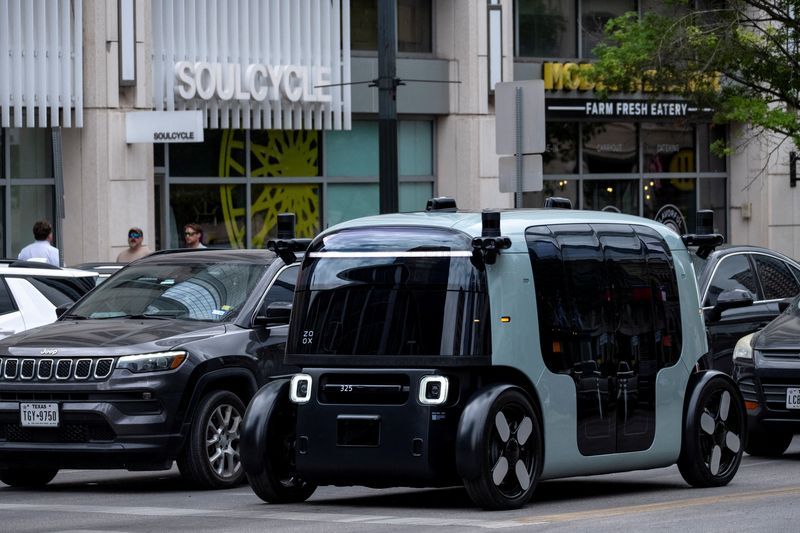
Amazon's autonomous vehicle subsidiary Zoox has announced the commencement of commercial robotaxi operations in Las Vegas beginning Monday, marking a significant milestone in the maturation of driverless ride-hailing services. The move follows regulatory approval from the U.S. National Highway Traffic Safety Administration (NHTSA), which greenlit the company's vehicles for commercial deployment without human safety drivers—a distinction that sets Zoox apart from competitors still adapting conventional vehicles for autonomous operation.
The Las Vegas rollout represents the culmination of Zoox's extended testing phase across four major American cities. Prior to this commercial transition, the company had been operating its distinctive electric carriage-style vehicles—featuring two rows of inward-facing seats—on complimentary basis in Las Vegas, San Francisco, Austin, and Miami. This protracted developmental period allowed Zoox to accumulate extensive real-world driving data and refine its autonomous systems before introducing paid passenger services.
Zoox's pricing strategy positions its offering within the premium segment of ride-hailing markets. The company will charge fares comparable to the "comfort" tier available through traditional ride-hailing platforms, which typically commands a 20 to 40 percent premium over standard services. This positioning reflects the vehicle's design philosophy emphasizing passenger comfort through spacious interiors and modern electric powertrains. The fare structure will employ a conventional model combining base charges with time and distance calculations, with all destination-specific surcharges—including airport fees—disclosed transparently before passenger confirmation.
The regulatory breakthrough achieved by Zoox carries particular significance within the autonomous vehicle industry. As the inaugural robotaxi operator to secure NHTSA exemption from federal safety regulations mandating human controls, Zoox has established a precedent for purpose-built autonomous vehicles developed independently rather than retrofitted from existing platforms. However, the approval encompasses important limitations, restricting commercial operations to a maximum of 2,500 vehicles annually across the next two years, reflecting the regulator's cautious approach to scaling autonomous transportation.
NHTSA's determination that Zoox's vehicles meet safety equivalency standards for federally mandated motor vehicle safety benchmarks provides regulatory validation, yet the agency imposed supplementary reporting obligations. Operators must document incidents including collisions and unintended immobilization on public roadways, establishing accountability frameworks that extend beyond traditional vehicle safety metrics. This supervisory structure acknowledges the novel operational characteristics of fully autonomous systems requiring distinct safety oversight mechanisms.
For Malaysian and Southeast Asian markets observing the autonomous vehicle landscape, Zoox's Las Vegas launch signals accelerating commercialisation timelines for robotaxi technology. Regional regulators and transportation authorities monitoring international developments face mounting pressure to establish regulatory frameworks accommodating autonomous ride-hailing. The pace of deployment across multiple American jurisdictions—with Waymo already operating paid services in several cities and Tesla expanding its offerings—demonstrates the technology's trajectory toward mainstream adoption in developed markets.
The competitive dynamics within the American robotaxi sector underscore the capital intensity and technological sophistication required for successful autonomous ride-hailing operations. Alphabet's Waymo, possessing decades of autonomous driving expertise and substantial financial resources, established early mover advantages across multiple metropolitan areas. Tesla's entry leveraging its manufacturing capabilities and existing vehicle fleet introduces additional competitive pressure. Zoox's entry as an Amazon subsidiary equipped with comparable financial reserves creates a three-player competitive structure that will likely accelerate innovation cycles and service expansion.
Despite regulatory approval, Zoox confronts ongoing safety validation challenges that extend beyond governmental certification. The company has issued multiple software recalls over a two-year period, most recently in July following an incident where one robotaxi failed to identify heavy smoke at an emergency scene. These episodes highlight the persistent technical challenges autonomous systems face in detecting anomalous environmental conditions and responding appropriately to unpredictable real-world scenarios. Emergency scene interactions represent a particular vulnerability area for autonomous vehicles, as such situations demand sophisticated decision-making capabilities beyond routine transportation operations.
The operational parameters that Zoox has committed to—including protection against unplanned route extensions and corresponding fare increases—address consumer concerns regarding autonomous system transparency and fairness. By implementing guaranteed optimal routing and upfront fee disclosure, Zoox attempts to differentiate itself through consumer-friendly operational practices. However, such commitments necessitate robust route optimization algorithms and fare-calculation systems that must function reliably across diverse urban environments and traffic conditions.
Looking forward, Zoox has not disclosed timelines for expanding paid operations beyond Las Vegas into San Francisco, Austin, or Miami, suggesting a methodical approach to scaling commercial services. This measured expansion strategy likely reflects management awareness that premature scaling risks creating operational difficulties that could damage both commercial viability and regulatory relationships. Successful execution in Las Vegas will provide crucial performance data informing subsequent market entries.
For Southeast Asian stakeholders, the Zoox case study offers instructive lessons regarding autonomous vehicle deployment trajectories and regulatory management. The extended testing period, incremental geographic expansion, and layered safety oversight mechanisms provide a template that regional governments might adapt when developing their own autonomous transportation frameworks. Additionally, the commercial viability demonstrated by substantial technology companies entering this sector suggests that autonomous ride-hailing will eventually extend beyond developed markets, potentially creating both opportunities and challenges for the region's mobility ecosystem.

