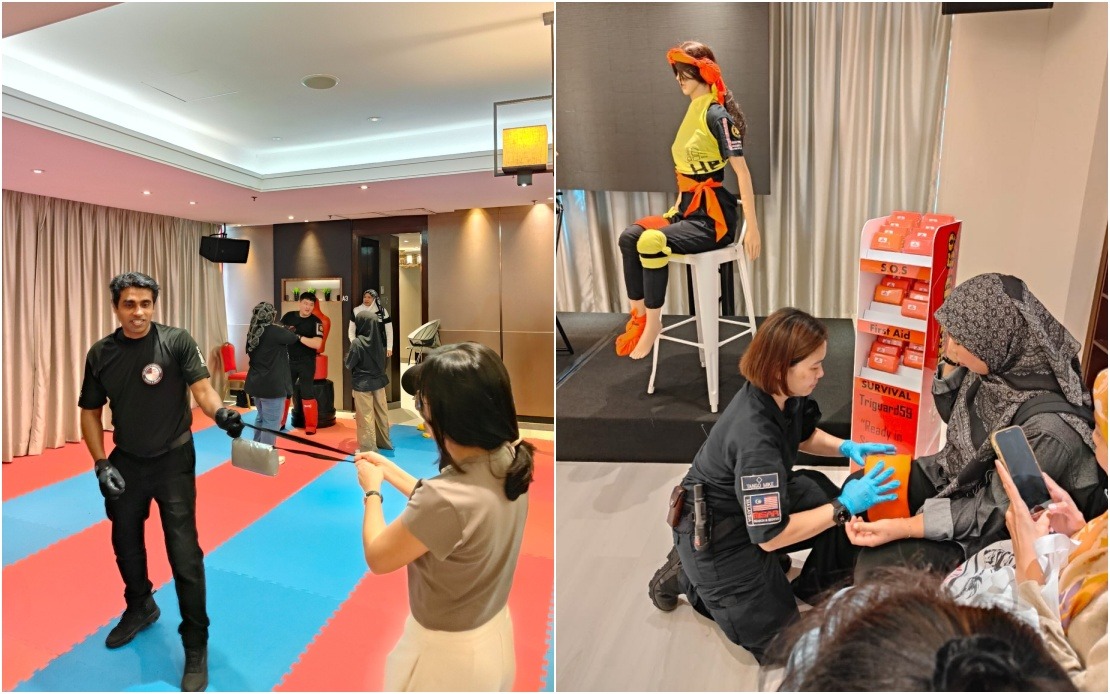
Insurance company Allianz Malaysia has deepened its commitment to community safety by staging the ninth iteration of a women-focused street crime awareness programme, developed in partnership with Kelab Marshal Keselamatan Jalan Raya Kuala Lumpur (RSMC). The event, conducted at Wisma Huazong YTL Hall in Seri Kembangan, Selangor, attracted 200 participants and represented a significant step in the insurer's ongoing corporate social responsibility initiatives aimed at reducing vulnerability to street-level criminal activity across Malaysia.
Designed for women aged 16 and above, the full-day programme addressed a spectrum of safety concerns that disproportionately affect female residents in urban and suburban areas. Rather than confining itself to theoretical frameworks, the campaign integrated both educational presentations and hands-on demonstrations to ensure participants could translate learning into practical protective measures. This dual-methodology approach reflected growing recognition that awareness alone does not necessarily translate into behavioural change; participants require concrete tactical knowledge to navigate real-world threats effectively.
The curriculum covered a deliberately broad range of threats reflecting the diverse environments in which Malaysian women navigate daily life. Street-focused dangers included handbag snatching and carjacking incidents, while domestic security was addressed through modules on home break-in prevention and recognition of stalking behaviour. Road safety featured prominently, encompassing both accident response protocols and prevention of road-based scams targeting motorists. Self-defence training and emergency preparedness rounded out the offerings, creating a holistic safety framework rather than addressing isolated risks in isolation.
A notable enhancement distinguishing this year's campaign from previous iterations was the introduction of structured dialogue sessions bringing participants into direct conversation with RSMC safety experts. Rather than treating awareness as unidirectional knowledge transfer, organisers created space for attendees to raise specific concerns drawn from their own lived experiences. This approach acknowledged that generic safety advice often fails to address contextual risks unique to particular communities, neighbourhoods, or individual circumstances. By enabling personalised guidance, the programme attempted to bridge the gap between abstract principles and applicability to individual participants' actual threat environments.
Allianz Malaysia Chief Executive Officer Sean Wang articulated an ambitious vision extending well beyond the immediate event. He highlighted the emerging interest among community leaders in replicating the programme within their own neighbourhoods, suggesting that the campaign had catalysed broader grassroots momentum for safety initiatives. This observation carries particular significance for Malaysia, where community-led safety advocacy remains relatively underdeveloped compared to formal government or corporate initiatives. Wang explicitly rejected a metrics-focused approach measuring success purely through attendance numbers, instead emphasising the multiplicative effect of knowledge dissemination as participants relay learning to family members and social networks.
The multiplication effect Wang described reflects a recognition that structural safety improvements require cultural shift alongside technical knowledge. When participants return home and discuss newly acquired self-defence techniques or scam-recognition skills with spouses, children, and neighbours, the programme's reach extends exponentially beyond its official venue and timeframe. This approach aligns with public health models demonstrating that community-embedded advocates often prove more credible and influential than institutional voices, particularly among populations with limited trust in formal safety infrastructure.
RSMC Founder and President Captain K. Balasupramaniam framed the programme's objective within an empowerment paradigm, emphasising confidence and decision-making capacity rather than fear-based messaging. This distinction carries weight in a context where excessive safety awareness campaigns sometimes paradoxically increase anxiety while reducing agency. By equipping participants with skills and knowledge, Balasupramaniam suggested, the programme aimed to convert passive vulnerability into active capability. His explicit hope that attendees would become safety advocates within their immediate circles echoed Wang's multiplication-effect rationale, positioning the campaign as a network-based intervention rather than a standalone event.
The partnership between Allianz Malaysia and RSMC itself merits consideration as a model for corporate-community collaboration in Malaysia. Rather than treating safety as purely a government or NGO responsibility, the arrangement positions the insurance sector as having legitimate interest in community wellbeing alongside its commercial motivations. From an actuarial perspective, insurers benefit when policyholders reduce exposure to preventable risks; from a societal perspective, this alignment of commercial and community interests can generate resources for initiatives unlikely to secure adequate government funding alone.
The Seri Kembangan location selection carried implicit acknowledgment of geographic vulnerability patterns in the Klang Valley region. As one of Malaysia's most densely populated areas with significant commuter populations and complex socioeconomic stratification, the region experiences street crime rates and patterns distinct from other Malaysian contexts. Targeting the campaign to this specific location rather than conducting a nationwide initiative suggested organisers' recognition that safety risks and appropriate responses vary substantially across Malaysia's diverse urban, suburban, and rural landscapes.
The nine-iteration trajectory of this campaign indicates sustained commitment rather than one-off corporate publicity. Repeat programming at this scale requires consistent resource allocation and demonstrates either significant institutional commitment or strong evidence of programme effectiveness sustaining donor interest. For Malaysian women seeking reliable safety training outside formal police channels, the campaign's longevity provides assurance of ongoing opportunity to access practical skills training and expert guidance.
Looking forward, the reported interest from community leaders in extending the programme to additional neighbourhoods could signal emergence of a grassroots safety movement rooted in women's agency rather than institutional mandates. If such replication proceeds, the original Allianz Malaysia-RSMC collaboration may be remembered less as an isolated corporate initiative than as a catalyst for broader community-driven safety advocacy. Whether this potential translates into sustained action will depend substantially on how effectively the campaign equips community leaders with resources, training, and frameworks to adapt the model to their specific contexts and constituencies.

