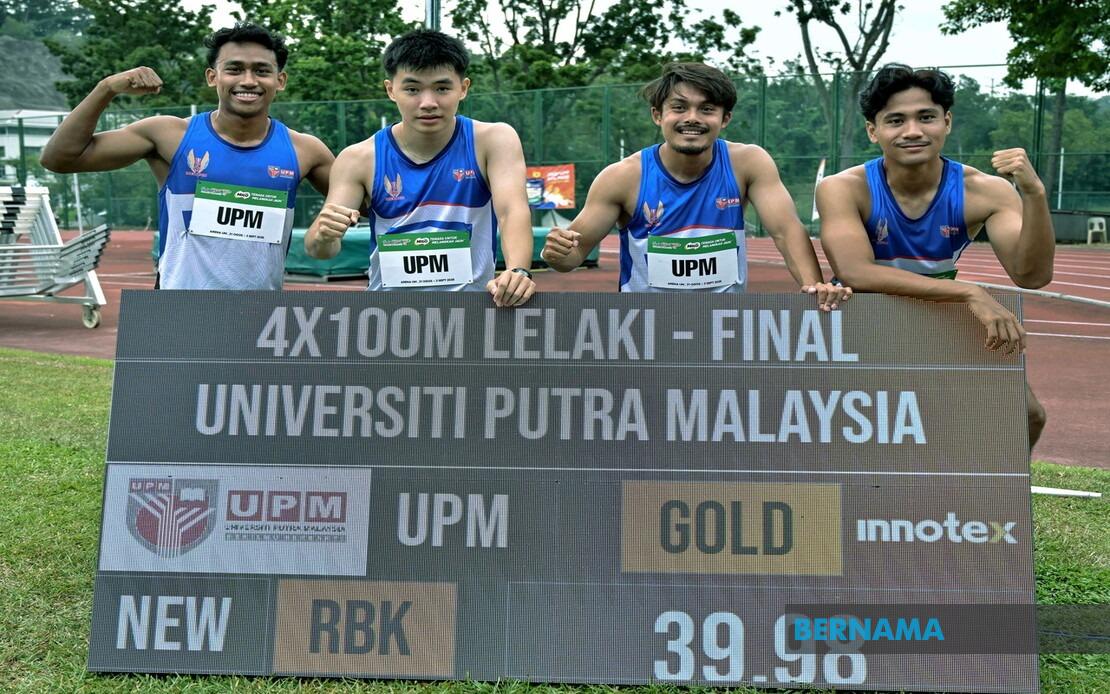
Universiti Putra Malaysia (UPM) secured the men's 4x100-meter relay gold medal at the 2026 Higher Education Institutions Sports Games (SUKIPT) by clocking 39.98 seconds, obliterating the previous games record of 40.98 seconds in the process. The achievement marks a watershed moment for the university's athletics programme, demonstrating that the transition from its established generation of sprinters to a cohort of promising newcomers is proceeding successfully.
What made the victory particularly notable was the composition of UPM's winning quartet. Aliff Iman Mohd Fahimi, a seasoned competitor and veteran of multiple SUKIPT campaigns, anchored a relay team comprising entirely junior runners making their championship debuts. This generational blend proved potent, with the younger athletes combining their raw speed and hunger with Aliff Iman's experience and steady hand on the anchor leg. The gold medal underscores a deliberate strategy by UPM athletics to cultivate fresh talent whilst leveraging the mentorship of accomplished senior athletes during the critical transition period.
For Aliff Iman, the triumph carried special significance as he bid farewell to SUKIPT competition. Speaking at UM Arena on the Universiti Malaya campus, he reflected on the broader implications of the achievement beyond the medal itself. He characterised the result as a renewal for UPM's relay and sprint programmes, one that validated the potential residing within the university's emerging athletes. His framing of the moment emphasised the continuity of institutional legacy—the passing of the torch from distinguished predecessors to the next generation of championship contenders.
The responsibility Aliff Iman felt extended beyond personal performance. He acknowledged the weight of upholding the standards established by previous UPM luminaries such as Jonathan Nyepa and Zulfiqar Ismail, runners whose achievements had defined the university's athletics identity. In his final SUKIPT appearance, he positioned himself as a custodian of that legacy, committed to ensuring that the foundation laid by those celebrated athletes would continue to support future champions. This custodial mindset shaped his approach to the relay, informing both his preparation and his belief in his junior teammates' capabilities.
The confidence Aliff Iman displayed in his quartet members proved well-founded and was rooted in concrete performance data. He disclosed that each of his relay partners possessed individual 100-meter personal bests in the 10.4 to 10.5 second range, a speed tier that mathematically positioned them to breach the 40-second barrier collectively if execution proved clean. This analytical approach—setting high but achievable targets grounded in verifiable individual performance metrics—demonstrated how serious preparation and rational planning underpinned the record-setting effort. The strategy worked flawlessly, with each runner delivering performances consistent with their established capabilities.
Not all members of the triumphant quartet enjoyed optimal conditions leading into the final. Reeve Kua, one of Aliff Iman's relay partners, competed while still recovering from a significant fever that had gripped him the previous day. His bout with illness was severe enough to cast doubt on his participation, yet through a combination of rest, fever-reducing medication, and sheer determination, he took to the track and executed his leg without apparent diminishment. His willingness to push through physical adversity contributed meaningfully to the team's gold medal outcome, illustrating the mental fortitude that distinguishes championship-level competitors.
The anchor position, traditionally the most pressure-laden in relay racing, fell to Ahmad Amir Aiman Mohd Kamaruddin. Tasked with receiving the baton in the final handoff, Ahmad Amir possessed no direct control over his team's destiny until the moment of exchange. His role required absolute trust in the three runners preceding him—faith that they would deliver the baton cleanly and position him competitively for the final 100 meters. This interdependence and mutual reliance among the four athletes reinforced the relay's essential character as a discipline demanding collective excellence rather than individual dominance. Ahmad Amir's composure in the anchor leg, cradled by the confidence instilled by his experienced senior, proved instrumental to the final outcome.
UPSI's national-level sprinter Danish Iftikhar Muhammad Roslee mounted a formidable challenge, leading a strong Universiti Pendidikan Sultan Idris team to second place in 40.16 seconds. The proximity of UPSI's time to UPM's winning mark—a gap of merely 0.18 seconds—underscored how competitive elite university athletics has become in Malaysia. The presence of a national-calibre runner in UPSI's lineup ensured that victory remained genuinely contested until the final strides. Malaysian Polytechnics secured bronze with a time of 41.75 seconds, completing the podium.
The records set and records shattered at SUKIPT carry implications beyond individual universities. As Malaysia's premier multi-sport competition for higher education athletes, SUKIPT serves as an incubator for national talent. The 39.98-second clocking represents the current level of excellence achievable within the domestic university athletics ecosystem, suggesting that Malaysia's pipeline of young sprinters remains robust. Athletes like Aliff Iman's junior teammates, now baptised by SUKIPT success at the games record level, become prime candidates for development into national representatives for broader regional and international competitions.
The narrative of generational transition at UPM also offers broader lessons for Malaysian sports development. Rather than experiencing a cliff-edge decline when established stars retire, UPM demonstrated that structured mentorship models—where veterans remain active contributors whilst younger talent receives championship exposure—can produce tangible competitive benefits. This approach contrasts with systems where generations operate in isolation, with knowledge and institutional culture at risk of discontinuity. Aliff Iman's final championship appearance, far from being a valedictory gesture, functioned as a critical bridge ensuring that UPM's athletics programme would not merely survive his retirement but would thrive through inherited knowledge and freshly established records.
Looking forward, the implications of this record extend across Malaysia's collegiate athletics landscape. UPM's 39.98-second relay time has become the benchmark that rival universities must now exceed. The performance establishes a new standard of expectation, one that younger athletes nationwide will regard as the target to pursue. Within UPM itself, the precedent is set for future relay campaigns: the bar has been raised, the record exists to be chased by subsequent cohorts of athletes, and the institutional culture has been reinforced that championship records fall not through individual brilliance alone but through calculated team preparation, generational mentorship, and the willingness to embrace young talent whilst leveraging experienced leadership.

