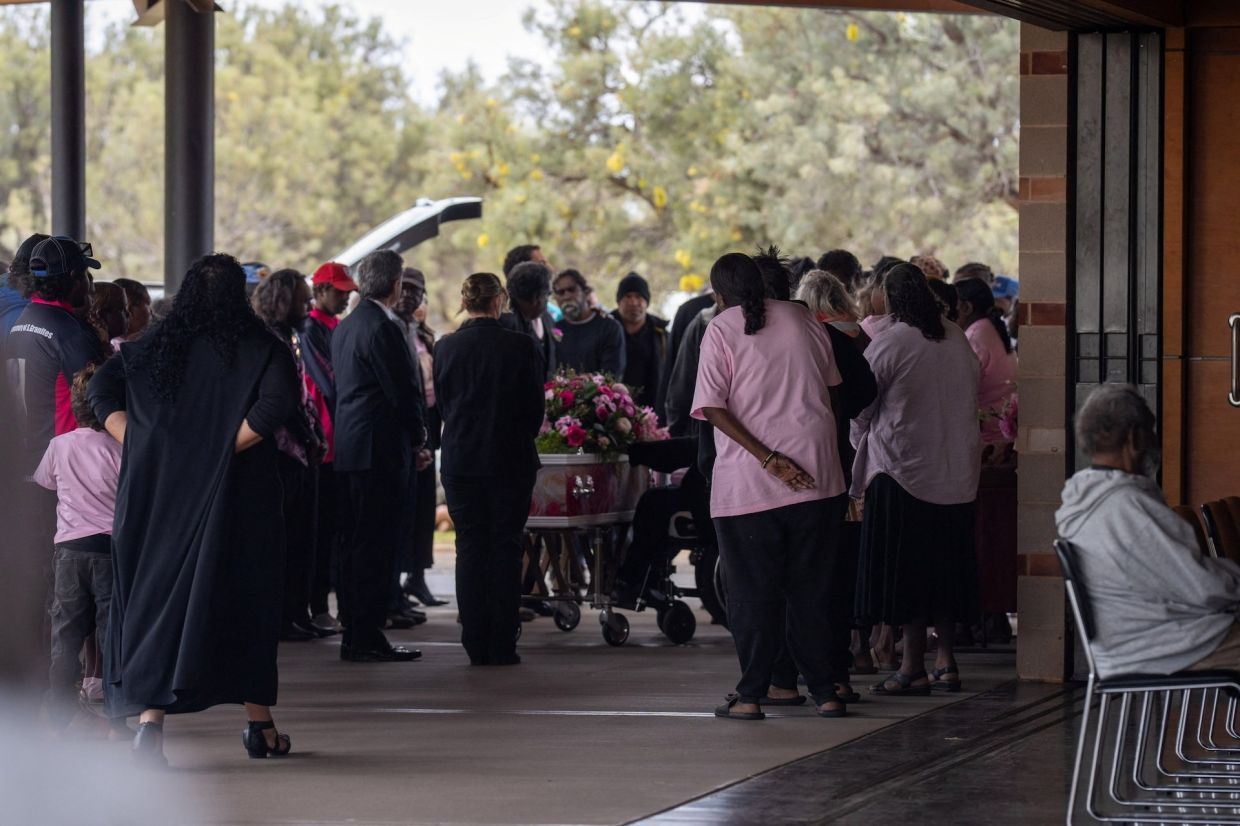
Hundreds of mourners gathered at Alice Springs' Garden Cemetery on Saturday to attend the funeral service for Kumanjayi Little Baby, a five-year-old Indigenous girl whose death in April sent shockwaves through Australia and ignited civil unrest in the remote Northern Territory town. The ceremony, attended by grieving family members and community members, many dressed in the child's favourite colour pink, marked a pivotal moment for a town confronting both tragedy and systemic dysfunction. The funeral brought to a close the formal "sorry business" — the period of mourning and cultural observance that follows the death of an Indigenous person in Aboriginal tradition — though the broader questions raised by her death remain far from resolved.
The circumstances surrounding Kumanjayi Little Baby's killing and the community response revealed deep fractures in Alice Springs, a town of approximately 25,000 people located roughly 1,250 kilometres south of Darwin. After her death, the arrest of the suspect, Jefferson Lewis, 47, who was discovered and beaten by local residents before police intervened, triggered violent clashes that illuminated the raw frustrations of a population long marginalised and underserved. Those riots became the visible manifestation of decades of accumulated grievances, transforming a personal tragedy into a symbol of broader Indigenous dispossession and inequality.
The composition of Alice Springs itself underscores the tensions at play. About one-fifth of the town's population identifies as Indigenous, yet thousands of Aboriginal people live in sprawling camp communities on the town's periphery where basic services remain woefully inadequate. Housing shortages are endemic, overcrowding is rampant, and access to healthcare, education, and employment opportunities lags significantly behind the broader Australian population. These camps exist in stark contrast to the more established residential areas, creating a visible geography of inequality that compounds historical grievances and perpetuates cycles of poverty and disadvantage.
Lewis has been charged with murder alongside two additional offences, though legal restrictions prevent public disclosure of the specifics of those secondary charges. The legal proceedings will unfold over months or years, but for many in Alice Springs, the criminal justice response alone feels insufficient to address the underlying conditions that enable such violence. The suspect's apprehension by vigilante community members, rather than police discovery, raised uncomfortable questions about the relationship between Indigenous communities and law enforcement, and whether formal institutions have lost the trust and legitimacy needed to maintain order and deliver justice.
Prime Minister Anthony Albanese acknowledged these systemic failures in statements following the killing, directly calling on Northern Territory authorities to prioritise improvements to living conditions within the camp communities. His intervention at the federal level suggested recognition that the crisis in Alice Springs extends beyond individual criminal acts to encompass failures of housing policy, resource allocation, and governance. Yet whether such political pressure translates into concrete funding, policy reform, and genuine community engagement remains uncertain, particularly given the competing priorities and budget constraints facing Australian governments across multiple levels.
The funeral service itself, documented by the Australian Broadcasting Corporation, presented a community united in grief yet divided by persistent structural inequalities. The coffin, adorned with flowers and transported in a black hearse, symbolised both the individual loss experienced by the child's family and the collective trauma of a community where Indigenous youth face disproportionate risks. The attendance of hundreds underscored the ripple effects of her death throughout Alice Springs and beyond, touching not only those with direct family connections but broader networks bound by shared cultural identity and lived experience of disadvantage.
For regional Southeast Asian observers, the Alice Springs case offers uncomfortable parallels to Indigenous and marginalised community experiences across the region. Malaysia, Indonesia, Thailand, and the Philippines all contend with significant Indigenous populations facing comparable challenges: inadequate housing, limited service provision, restricted economic opportunity, and systemic underrepresentation in decision-making institutions. While the immediate trigger in Alice Springs was a specific violent act, the underlying dynamics — poverty, inequality, social exclusion, and community alienation — resonate across borders and suggest that these are regional rather than merely national problems requiring coordinated policy responses.
The "sorry business" observance in Alice Springs reflects Indigenous Australian approaches to death and mourning that prioritise community healing and cultural continuity. Yet the term carries additional resonance in this context, as it implicitly references the broader need for societal acknowledgment of wrongs and commitment to rectification. The funeral represented both a conclusion to formal mourning protocols and potentially a beginning point for more serious engagement with the conditions that enabled this tragedy. Whether Australian policymakers will match the solemnity of Saturday's ceremony with substantive action on housing, services, and Indigenous self-determination remains the crucial question.
The killing of Kumanjayi Little Baby and its aftermath have forced uncomfortable reckoning within Alice Springs and across Australia regarding the quality of governance, resource distribution, and respect for Indigenous rights. As the community moves beyond the funeral and begins processing grief within the framework of their cultural traditions, the challenge facing elected officials and institutional leaders is equally clear: to translate expressions of concern into measurable improvements in the material conditions and social standing of Alice Springs' Indigenous population. Without such concrete action, future tragedies may well follow, and the cycle of violence and marginalisation will persist.

