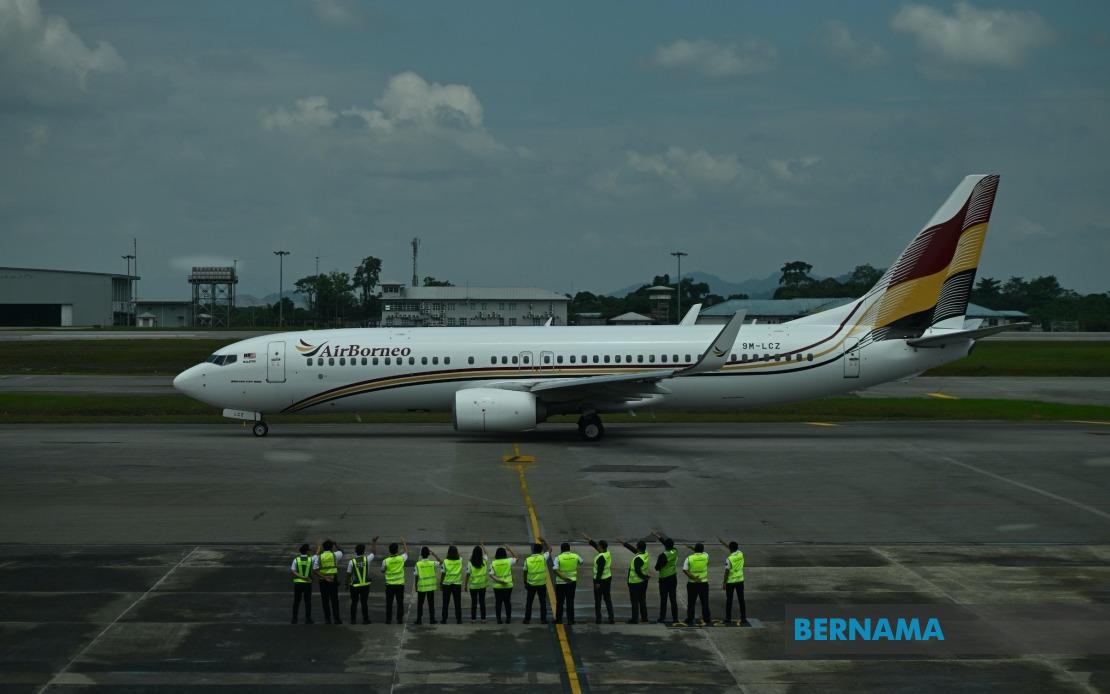
AirBorneo has entered a new chapter in its operational history by commencing jet aircraft services, with the inaugural Kuching–Kuala Lumpur flight departing on July 20 as a watershed moment for the state-owned airline. Flight MY5005 lifted off from Kuching International Airport at 1.20 pm bound for Kuala Lumpur International Airport, carrying among its passengers Sarawak Premier Tan Sri Abang Johari Tun Openg, whose presence underscored the political significance of this expansion beyond the airline's traditional regional footprint.
The launch represents the culmination of strategic ambitions set in motion when AirBorneo absorbed the operations of MASwings Sdn Bhd on January 1 this year. By deploying a Boeing 737-800 jet aircraft on the Peninsular Malaysia route, the airline has fundamentally altered its service capability, moving beyond the regional turboprop operations that have historically defined Borneo's aviation landscape. This transition carries implications not merely for commercial aviation in the region but for the broader economic positioning of Sarawak within Malaysia's domestic economy.
During the launch ceremony, Premier Abang Johari articulated a vision of aviation connectivity as a cornerstone of economic development, drawing parallels to Japan's post-war reconstruction strategy. He argued that Japan Airlines' establishment formed the foundation for the nation's subsequent industrialisation and regional prominence, suggesting that Sarawak's own national carrier could similarly catalyse economic transformation. This framing positions AirBorneo not simply as a transportation service provider but as an instrument of state economic policy, linking air connectivity directly to export capacity and global trade integration.
The strategic comparison to Japan illuminates how the Sarawak government perceives aviation infrastructure within a broader development narrative. Japan's island geography necessitated robust air links to compensate for maritime limitations, a parallel that resonates strongly with Sarawak's own peninsular separation and relatively limited land-based transportation corridors to other Malaysian states. By investing in domestic jet operations, the state government is effectively arguing that bridging the geographical divide between Borneo and Peninsular Malaysia constitutes essential infrastructure for economic participation.
AirBorneo's commercial framework reflects a competitive positioning within Malaysia's domestic aviation market. The airline introduced the Kuching–Kuala Lumpur route with twice-daily service frequency on July 7, when ticket sales opened to the public. Economy Class fares are set at RM375 one-way inclusive of airport taxes and fuel surcharges, while Business Class passengers face a premium of RM736. These price points position the service within the middle-market segment, targeting both business travellers requiring regular connectivity and leisure passengers seeking a direct alternative to road or rail transport.
The acquisition of MASwings operations represents a consolidation strategy that enabled AirBorneo to inherit an established network and customer base while progressively modernising the fleet. Rather than building market presence entirely from scratch, the takeover provided immediate operational scale and established route permissions, allowing rapid transition to jet service once integration was complete. This approach mirrors consolidation patterns observed across Southeast Asia, where regional carriers frequently absorb smaller operators to achieve economies of scale.
For Malaysian readers beyond Sarawak, this development carries implications for regional competition and air service patterns. The direct Kuching–Kuala Lumpur service potentially diverts traffic from alternative routing through intermediate hubs, particularly services requiring connections in Kota Kinabalu or other regional centres. Passengers previously accepting longer journey times and connections may now opt for the direct jet service, reshaping demand flows across the domestic network. Incumbent carriers operating these routes will likely respond with competitive adjustments.
The broader context includes Sarawak's economic development trajectory and its position within the national federation. State governments across Malaysia increasingly view aviation and connectivity as strategic assets meriting direct government ownership or investment. By maintaining majority control of AirBorneo and directing it toward Peninsula-facing routes, Sarawak is making a statement about its economic autonomy and its determination to manage connectivity directly rather than relying entirely on privately operated carriers based in Peninsular Malaysia. This reflects deeper patterns of state-level economic nationalism observable across Malaysian politics.
Operationally, sustaining the Kuching–Kuala Lumpur route with twice-daily jet service requires managing maintenance, crew scheduling, and fuel logistics across a considerable distance. AirBorneo must establish competitive advantages sufficient to justify passenger selection against established competitors. Brand positioning, punctuality, on-board amenity offerings, and loyalty programme value will determine whether the new service captures sustainable market share or remains a politically symbolic but commercially marginal operation.
The inaugural flight's ceremonial character, confirmed by the Premier's participation, indicates that the Sarawak government regards this milestone as significant beyond pure aviation metrics. Political leaders frequently utilise infrastructure inaugurations to project images of progress and capability to their constituencies. By personally boarding the maiden flight, Abang Johari associated himself directly with the achievement, a signalling technique common among Malaysian political executives announcing signature development projects.
Looking ahead, AirBorneo's route expansion into Peninsular Malaysia opens possibilities for further growth. Additional trunk routes linking Sarawak to other Peninsula cities could follow if demand supports the investment, potentially including services to secondary cities such as Ipoh, Penang, or Johor Bahru. The airline may also explore regional international routes once the Peninsula domestic network is consolidated, positioning Kuching as a secondary hub for passengers transiting between Borneo and the broader Asia-Pacific region.
The airline's success ultimately depends on executing reliable, competitively priced service that passengers perceive as superior to alternative transport modes. AirBorneo operates within Malaysia's regulated aviation environment, competing against Malaysia Airlines, AirAsia, and other carriers with established Peninsula networks. Sustaining growth requires not just political support but genuine operational excellence and customer satisfaction. The historic first flight represents a beginning rather than an endpoint for AirBorneo's ambitions to reshape regional connectivity patterns.

