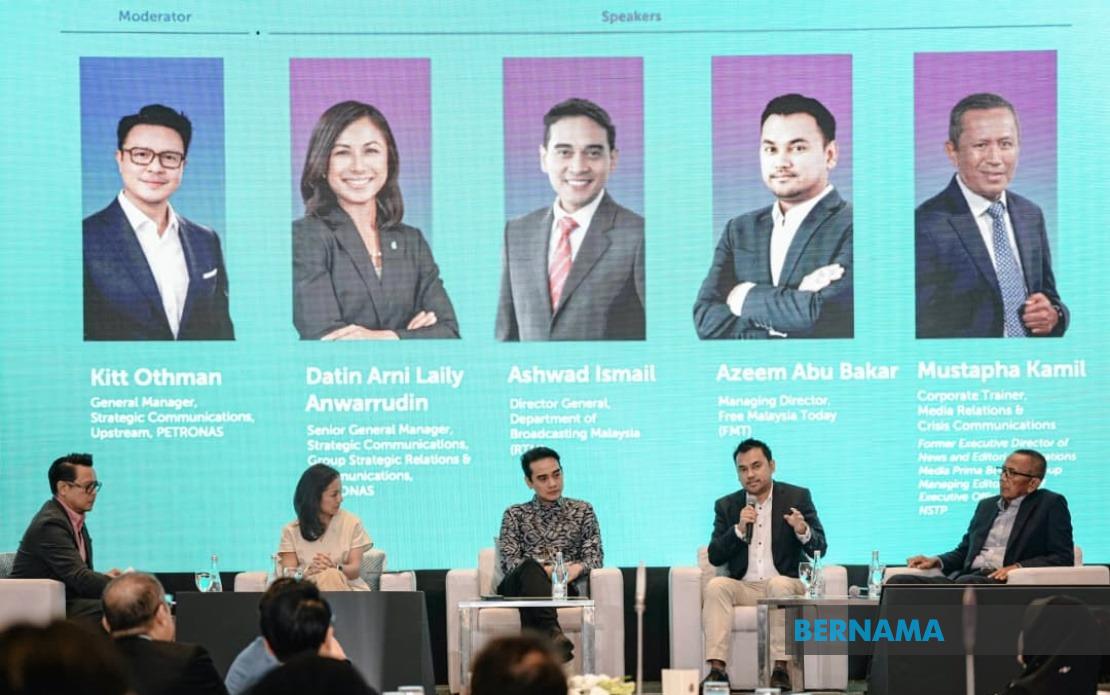
The accelerating capabilities of artificial intelligence have created an unprecedented communications crisis for corporate Malaysia. At a gathering hosted by PETRONAS and the Malaysian Press Institute, industry leaders confronted a stark reality: the traditional playbook for managing corporate reputation and crisis response has become obsolete in an ecosystem where false information spreads globally within minutes and public perception can shift before a company can mount a coherent response.
Datin Arni Laily Anwarrudin, PETRONAS Senior General Manager of Strategic Communications, articulated the fundamental challenge facing modern organisations: AI now enables the rapid dissemination of unverified narratives that can inflict severe damage to brand reputation long before verification or rebuttal becomes possible. This technological reality has stripped away the luxury of time that corporations once enjoyed when orchestrating their public messaging. The implication for Malaysian enterprises is clear—passivity in shaping one's corporate story is now a commercial liability rather than a prudent caution.
The pressure to control narrative flow extends beyond defensive positioning. Arni Laily emphasised that organisations must now aggressively own their own stories, anticipating that silence or delay will simply invite external actors to fill the vacuum. This represents a significant cultural shift for many Malaysian corporations accustomed to operating with discretion. The calculus has changed: transparency and proactive communication now serve as protective mechanisms rather than exposure risks. Without authoritative company narratives circulating in digital channels, competitors, critics, or malicious actors will supply alternative versions that may prove far more damaging to organisational interests.
The death of the traditional crisis communication timeline underscores the operational challenges now confronting corporate communications departments across Malaysia and Southeast Asia. Mustapha Kamil Mohd Janor, a veteran of Malaysia's media landscape through his roles at Media Prima Berhad and NSTP Group, highlighted how the once-standard 16-hour window between incident and newspaper publication has completely evaporated. Breaking news now cascades across social platforms instantaneously, compressing decision-making cycles from hours into minutes. For Malaysian organisations operating across multiple jurisdictions or managing geographically dispersed operations, this temporal compression creates genuine operational difficulty in assembling accurate information, consulting with relevant stakeholders, and formulating considered responses before pressure mounts to react.
Mustapha Kamil recommended that corporations treat the establishment of dedicated media crisis teams as an urgent priority rather than a peripheral function. This reflects a broader recognition that the volume and velocity of digital communication now demands permanent, well-trained infrastructure rather than ad hoc responses mobilised when crises emerge. Malaysian enterprises that have not yet institutionalised crisis communication protocols are operating at genuine competitive disadvantage, particularly those whose operations or supply chains intersect with reputationally sensitive industries or politically contested sectors.
Yet amid the acceleration of information flows, media practitioners themselves have insisted upon preserving a core journalistic function that transcends technological change. Radio Televisyen Malaysia director-general Ashwad Ismail and other panellists articulated a vision of journalism as a stabilising force—a searchlight directing public attention toward consequential questions and helping societies navigate complex choices with greater clarity. This perspective matters for Malaysian audiences precisely because information overload combined with algorithmic fragmentation threatens to overwhelm rather than illuminate public understanding. Professional journalism, in this framing, becomes a scarce resource whose value actually increases as information abundance grows.
The tension between technological capability and human judgment has emerged as a defining characteristic of the AI era. Azeem Abu Bakar of Free Malaysia Today proposed that media organisations should abandon the fantasy that AI can replace human journalists and instead focus on cultivating what he termed "SUPER" journalists—professionals who combine exceptional source cultivation with deep contextual understanding, pattern recognition across complex information landscapes, operational efficiency, and a hard-won reputation for reliability. This framework acknowledges that technology handles well-defined tasks but falters at the nuanced work of understanding causation, identifying significance, and communicating truth to publics accustomed to manipulation.
The implications for Malaysian media organisations are profound. As global tech companies export AI-powered content generation and curation systems to Southeast Asia, local newsrooms face a choice between attempting to compete on automation or deliberately investing in journalistic depth and credibility that machines cannot replicate. The panel discussion implicitly endorsed the latter path—recognising that sustainable media business models in the AI era will rest upon distinctive human insight rather than speed or volume of content production.
For Malaysian corporations attending such forums, the takeaway extends beyond defensive crisis management. The panellists essentially proposed that organisational credibility now depends upon transparent engagement with journalists and public audiences rather than message control. This represents a fundamental reorientation from information gatekeeping toward information participation. Companies that can build constituencies of informed stakeholders—employees, customers, industry partners, policymakers—will weather reputational storms far more effectively than those that have cultivated only passive audiences for their official communications.
The PETRONAS Lunch Escape 2026 programme, organised in collaboration with the Malaysian Press Institute, signalled that Malaysia's corporate leadership and media establishment recognise the structural transformation underway. Both institutions—business and journalism—face declining authority and influence in an environment where unmediated communication and algorithmic distribution have fragmented once-unified public spheres. Their shared vulnerability creates an opportunity for alignment around credibility standards and transparent communication practices that serve broader public interests.
Moving forward, the challenge for Malaysian organisations involves operationalising these insights. Restructuring crisis communication protocols to preserve deliberation while responding to urgency, recruiting and developing journalists who can provide reliable guidance through information chaos, and building corporate communications capabilities that emphasise transparency over spin will require sustained investment and cultural change. The alternative—attempting to navigate the AI era with communications infrastructure designed for earlier technological conditions—virtually guarantees that organisations will find themselves perpetually behind the curve, reactive rather than purposeful, defending reputation rather than building it.

