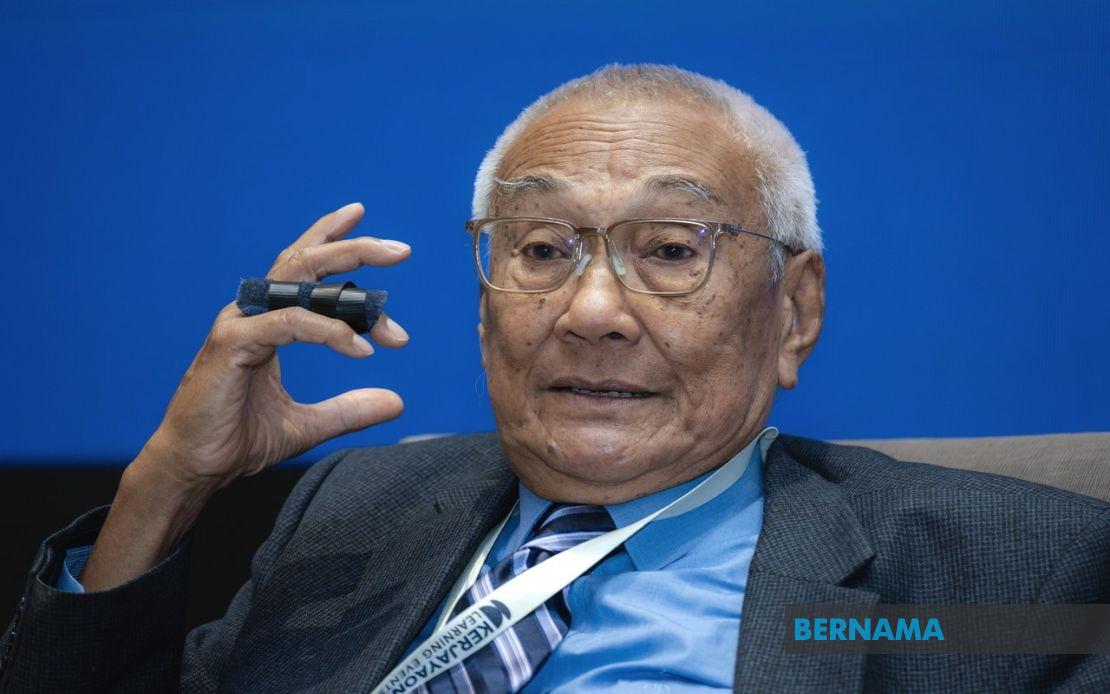
The judiciary must never surrender its fundamental responsibility to human minds, according to Tun Zaki Azmi, the former Chief Justice who now leads Pertama Digital Berhad. Speaking at the Wisdom Malaysia 2026 Conference in Kuala Lumpur, he articulated a vision of artificial intelligence as an auxiliary technology that enhances efficiency without displacing the core function of judicial reasoning. His remarks reflect a critical juncture for Malaysia's legal system as courts worldwide grapple with integrating AI into their operations whilst preserving the human element that defines jurisprudence.
Tun Zaki distinguished between AI's legitimate applications and its fundamental limitations. Whilst acknowledging that artificial intelligence can offer novel analytical frameworks and expedite preliminary investigative work, he stressed that consequential determinations must ultimately rest with qualified human decision-makers guided by professional experience, ethical frameworks, and reasoned analysis. This nuanced position recognises the technology's genuine utility without succumbing to techno-optimism that oversells AI's capabilities in domains requiring nuanced interpretation of law and human behaviour.
The former Chief Justice drew upon his experience at the Dubai International Financial Centre Courts to illustrate practical safeguards. That institution has mandated disclosure protocols requiring legal practitioners to explicitly notify the court whenever artificial intelligence has contributed to research compilation or document preparation. This transparency mechanism ensures judicial awareness and enables courts to apply heightened scrutiny to AI-assisted work products. For Malaysia's legal community, such precedents offer valuable models as the bar associations and courts contemplate their own governance frameworks for technology integration.
Tun Zaki emphasised a particular vulnerability inherent to artificial intelligence systems: their tendency toward "hallucinations," a technical term denoting instances where AI generates plausible-sounding but entirely fabricated information. For judges tasked with interpreting legislation and assessing evidentiary credibility, such errors could undermine the integrity of judicial findings. His warning reflects genuine technical concerns that AI researchers and ethicists have documented, particularly regarding large language models' propensity to confidently assert false propositions when they lack training data on specific subjects. Judges who outsource critical analysis to these systems without independent verification risk importing these errors into legally binding judgments.
The existence of appellate review mechanisms, Tun Zaki argued, demonstrates why multiple human minds remain indispensable to judicial systems. Courts of Appeal and the Federal Court deliberately convene panels of three, five, seven, or nine judges precisely because experienced legal professionals frequently reach divergent conclusions when interpreting statutory language or evaluating witness credibility. This institutionalised disagreement reflects the irreducible complexity of legal reasoning. Technological systems, by contrast, generate deterministic outputs; they cannot genuinely deliberate or weigh competing values in the manner that human judges, drawing upon different life experiences and jurisprudential philosophies, naturally do. The appellate structure itself—premised on the possibility of legitimate disagreement—embodies skepticism toward any monolithic decision-making approach.
The conference itself, convened under the theme "Learning from the Past, Looking to the Future," addresses a structural challenge confronting Malaysian institutions: the intergenerational transmission of institutional wisdom. Datuk Seri Abdul Mutalib Razak, chairman of KerjayaOne PLT which organised the gathering, positioned the event as a deliberate effort to bridge generational gaps in leadership. He characterised wisdom as something forged through extended engagement with difficult choices, crisis management, and the hard-won lessons extracted from both triumph and failure. Knowledge of this calibre, he suggested, cannot be algorithmically compressed or efficiently transferred; it requires mentorship, dialogue, and the gradual absorption of experience across professional cohorts.
The conference attracted prominent figures from Malaysia's corporate and institutional landscape, bringing together perspectives from diverse sectors. Tan Sri Che Khalib Mohamad Noh, former president of Tenaga Nasional Berhad, contributed to discussions alongside Tan Sri Abdul Wahid Omar, who leads both Cypark Resources Berhad and IOI Corporation Berhad. Datuk Dr Mohd Khalis Abdul Rahim, former chief human capital officer of Malaysia Aviation Group, added insights from the aviation sector. This cross-sectional representation underscores that the tension between technological advancement and human judgment extends far beyond the judiciary into governance structures across the economy.
For Malaysian policymakers and legal institutions, Tun Zaki's intervention carries particular weight given his stature and dual perspective—he combines experience within the Malaysian system with exposure to international practices at the Dubai financial courts. His advocacy for transparent disclosure protocols and enhanced judicial vigilance offers practical guidance as Bar Council committees develop professional standards governing AI deployment. Rather than resisting technological adoption, this approach channels it toward legitimate efficiency gains whilst maintaining robust human oversight of consequential decisions.
The implicit message extends beyond courts to broader governance questions. As Malaysia navigates digital transformation across public administration, the judiciary's careful approach to artificial intelligence offers a model: embrace tools that genuinely enhance capability and efficiency, but resist the seductive notion that complex human decisions involving interpretation, credibility assessment, and ethical judgment can be automated away. The judges sitting in appellate panels, Tun Zaki suggested, embody institutional wisdom precisely because they remain engaged with the irreducible human dimension of law. That engagement cannot be outsourced to machines.

