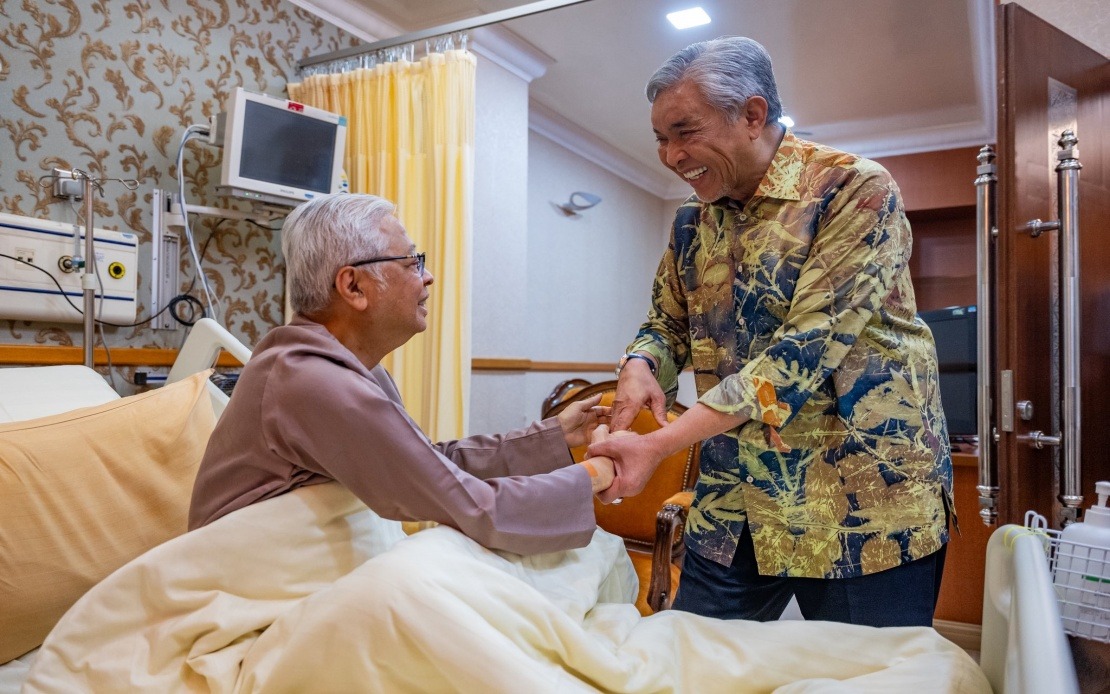
Deputy Prime Minister Datuk Seri Dr Ahmad Zahid Hamidi made a courtesy call on former Prime Minister Datuk Seri Ismail Sabri Yaakob on August 10, with the Bera parliamentarian currently hospitalised at the National Heart Institute (IJN) in Kuala Lumpur undergoing cardiac treatment. The visit, which Ahmad Zahid documented on social media platform X, underscores the continued camaraderie between senior figures within the ruling coalition despite recent political transitions at the highest levels of government.
Through his social media statement, Ahmad Zahid extended his wishes for Ismail Sabri's swift recovery, emphasising prayers that the former premier would regain full health and be restored to his normal daily routines and official responsibilities. The Deputy Prime Minister's message reflected sentiments of unity and support, articulating hope that all obstacles to Ismail Sabri's wellbeing would be removed and that he would experience complete restoration of his physical condition. Such gestures of solidarity among Malaysia's political leadership carry symbolic weight, particularly during periods when individuals face health challenges that temporarily remove them from their public duties.
Ismail Sabri's hospitalisation stemmed from a medical emergency that occurred on August 6 while he was at the Malaysian Anti-Corruption Commission (MACC) premises in Kuala Lumpur for a scheduled statement recording. During this visit, the Bera MP experienced acute health complications that necessitated immediate emergency medical intervention. He was swiftly transported to IJN, Malaysia's premier cardiac care facility, where medical specialists evaluated his condition and determined that he required surgical intervention to address the underlying cardiac issue.
Following clinical assessment, IJN physicians performed a procedure to implant a wireless pacemaker device designed to regulate Ismail Sabri's heart rhythm and manage the abnormal cardiac condition that had triggered the health episode. Modern wireless pacemakers represent a significant advancement in cardiac care, offering patients improved quality of life with minimally invasive surgical approaches compared to traditional pacemaker systems. The procedure itself typically involves a shorter recovery period, allowing patients to resume normal activities more quickly while maintaining reliable cardiac rhythm management.
The incident highlights the unpredictable nature of health emergencies, even for individuals in positions of high responsibility and access to premium healthcare services. Ismail Sabri's presence at MACC was related to an ongoing investigative matter, indicating that the former Prime Minister remains subject to formal inquiries despite no longer holding office. The timing of his medical emergency during an official government appointment added an element of urgency to the situation, with paramedics and hospital staff mobilising to provide immediate life-saving intervention.
Ismail Sabri's tenure as Prime Minister from August 2021 to November 2022 represented a significant chapter in Malaysian politics, occurring during a period of considerable political instability and coalition reconfiguration. His transition from the office and the circumstances surrounding his various legal and investigative matters have remained topics of public interest and media scrutiny. The current health challenge, however, has prompted expressions of solidarity transcending political divisions, reflecting a broader acknowledgment that personal health crises deserve compassion and support regardless of political standing.
The National Heart Institute, established as Malaysia's dedicated cardiac care centre, serves as a tertiary referral hospital for complex heart conditions affecting patients from across the country. The facility's expertise in advanced interventional procedures, including wireless pacemaker implantation, positions it at the forefront of cardiac medicine in Southeast Asia. Ismail Sabri's treatment there reflects both the availability of sophisticated medical technology within Malaysia's healthcare system and the accessibility of premium cardiac services to senior government figures.
Ahmad Zahid's public visit and expressed concern align with established protocols of senior government leadership expressing solidarity with colleagues facing health challenges. Such demonstrations of unity serve multiple functions within political culture, signalling to the public that despite competitive or contentious relationships in other spheres, Malaysian leaders maintain fundamental respect and concern for one another's wellbeing. The statement's religious dimension, invoking prayers for recovery and ease of circumstances, also resonates with Malaysia's cultural and spiritual values.
The episode provides a reminder that even those wielding significant political power remain vulnerable to the vicissitudes of human health. Medical emergencies do not discriminate based on status or position, and sudden cardiac events can strike unexpectedly, as occurred in Ismail Sabri's case. The successful emergency response and subsequent surgical intervention demonstrate the readiness of Malaysia's medical infrastructure to manage critical cardiac emergencies effectively, even for high-profile patients whose cases attract intense public attention.
Looking forward, the focus for observers will centre on Ismail Sabri's recovery trajectory and his ability to resume parliamentary duties representing his Bera constituents. The wireless pacemaker implant, provided it functions optimally, should enable him to return to normal activities without significant lifestyle restrictions. His recovery will also be watched by those following the various investigative and legal matters that have continued to touch his life since leaving the Prime Minister's office, as such proceedings may require his participation or presence at various official venues.

