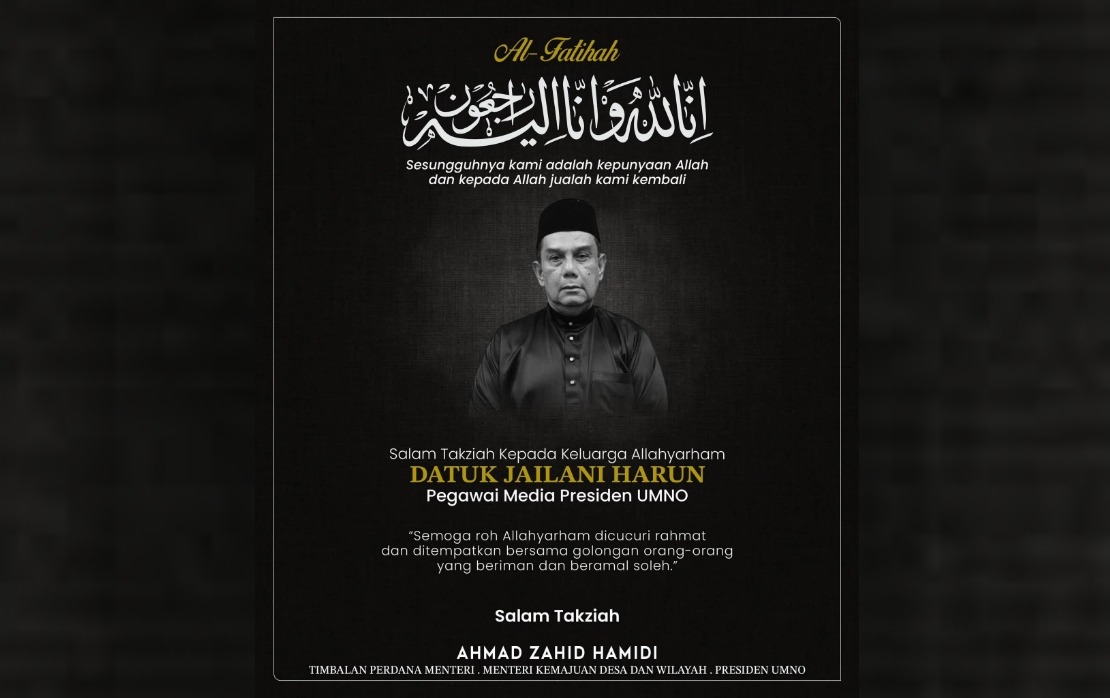
Deputy Prime Minister Datuk Seri Dr Ahmad Zahid Hamidi has extended his deepest condolences to the family of Datuk Jailani Harun, a prominent journalist and media officer who served at the UMNO President's Office. Jailani passed away on July 7 at Serdang Hospital at 11:34 am, aged 66. The UMNO leader's tribute underscores the significant loss felt within the party and broader media community over the veteran communicator's death.
Ahmad Zahid visited the deceased at Serdang Hospital in the early hours of the morning on the day Jailani died. During that visit, the Deputy Prime Minister observed the gravity of Jailani's condition firsthand, an encounter that visibly affected him. In his public statement, Ahmad Zahid reflected on the emotional weight of the moment, admitting that despite his initial hopes for a miraculous recovery, he recognised that divine will had ultimately claimed his longtime colleague and friend.
The characterisation offered by Ahmad Zahid painted a portrait of a man whose personal qualities extended far beyond his professional achievements. Describing Jailani as kind, humble, and widely respected, the Deputy Prime Minister highlighted virtues that had evidently shaped his relationships throughout a long career in journalism and political communications. Such qualities, particularly in the often-contentious world of political media relations, command genuine appreciation from those who worked alongside such individuals.
In his Facebook post, Ahmad Zahid extended formal condolences to Jailani's family, acknowledging the profound grief of losing a beloved family member. The Deputy Prime Minister called upon his condolences to grant them the strength and fortitude necessary to navigate the difficult period ahead. Such public expressions of sympathy from senior government figures serve an important social function, validating the loss experienced by bereaved families while reinforcing the broader community's sense of shared mourning.
The religious dimension of Ahmad Zahid's tribute reflected the deeply Islamic nature of Malaysia's political culture. He prayed for Allah's forgiveness of Jailani's sins, requesting divine mercy upon him and the placement of his soul among the faithful and righteous servants of God. These supplications form a traditional part of Muslim funeral practices and political discourse in Malaysia, where such spiritual sentiments carry significant cultural weight and demonstrate respect for both the deceased and his family's faith.
Jailani's funeral arrangements proceeded according to Islamic custom and tradition. The funeral prayers were scheduled to take place after asar, the late afternoon prayer, with burial to follow at Alam Damai Muslim cemetery in Cheras. This location, situated in the Kuala Lumpur area, is a well-established burial ground serving the Muslim community of the capital and its surrounding regions. The timing and location of the funeral reflected standard practices for individuals of Jailani's standing within the community.
The death of an individual serving in Jailani's capacity within UMNO's institutional structure carries particular significance for the party's internal dynamics and public image management. Media officers and journalists operating within political party environments occupy crucial positions, serving as bridges between leadership and public discourse. Their credibility and relationships with broader media networks directly influence how party narratives reach the electorate and how political messaging resonates across different demographic segments.
Jailani's career spanning multiple decades placed him among a generation of Malaysian media professionals who witnessed and documented the nation's political evolution from the Mahathir era onward. His experience as both an independent journalist and later as a party communications functionary provided him with unique perspectives on the intersection of media and politics in Malaysia. Such individuals often command respect from peers across political divides, as their professional integrity becomes known through years of consistent engagement with the journalism community.
The loss of experienced communicators like Jailani represents a departure of institutional memory and professional networks that take years to rebuild. In an era when political communication has become increasingly sophisticated and contested, individuals with established credibility and long-standing relationships within media circles become invaluable assets. Their absence creates gaps that younger generations of party operatives may struggle to fill, particularly in navigating the complex relationships between political messaging, traditional media, and contemporary digital communication platforms.
Ahmad Zahid's public acknowledgment of Jailani's passing reflected broader recognition within UMNO of the contributions made by media professionals who have served the party throughout its modern history. By personally visiting Jailani at the hospital and subsequently issuing a formal statement of condolence, the Deputy Prime Minister elevated the significance of this individual's death beyond routine party personnel matters. Such gestures carry symbolic importance in Malaysian political culture, signalling the value placed upon loyalty, service, and the human relationships that underpin institutional functioning.

