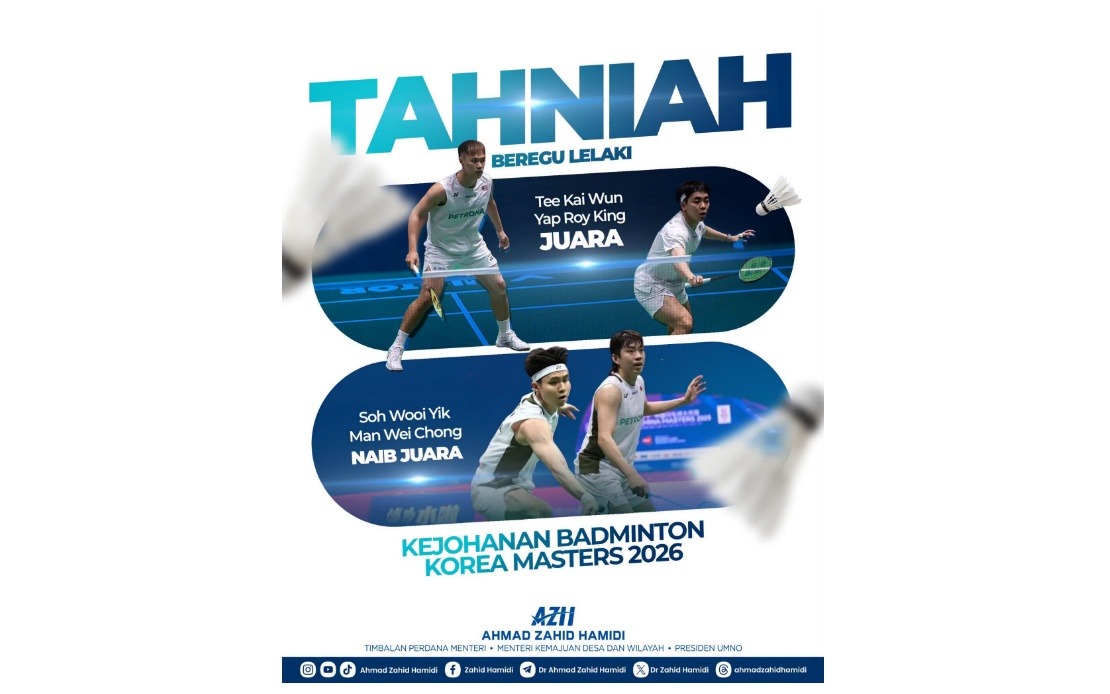
Deputy Prime Minister Datuk Seri Dr Ahmad Zahid Hamidi has lauded the achievements of Malaysia's badminton contingent following an impressive showing at the 2026 Korea Masters Badminton Championships, where the nation's men's doubles teams demonstrated competitive excellence on the international platform. The recognition comes as the country continues to build momentum in one of its historically strong sporting disciplines.
Tee Kai Wun and Yap Roy King etched their names into the tournament's record books by capturing the championship title at their debut appearance in the Korea Masters. Playing at the Yi Sun-sin Gymnasium in Asan, the pair delivered a commanding performance to overcome their compatriots Soh Wooi Yik and Man Wei Chong with a convincing 21-13, 21-18 victory that lasted 31 minutes. The triumph underscores the depth of talent currently flowing through Malaysia's badminton pipeline, particularly in the men's doubles category.
The result proves particularly significant given that the runners-up finish by Wooi Yik and Wei Chong, while not the ultimate prize, still represents a substantial achievement for a newly formed pairing. Both pairs' presence in the final speaks to the systematic development taking place within Malaysian badminton's coaching and training infrastructure. For the nation's sporting administration, such performances at prestigious international tournaments validate the investment in player development programmes and technical expertise.
Ahmad Zahid's public commendation serves multiple purposes within Malaysia's sports ecosystem. By acknowledging the players' efforts through an official statement, the Deputy Prime Minister reinforces the government's commitment to supporting athletic excellence and signals to the broader sporting community that individual and team achievements receive recognition at the highest levels of government. This alignment between political leadership and sporting success has historically proved instrumental in maintaining momentum and motivation within competitive sports disciplines.
The Korea Masters holds particular resonance for Malaysian badminton, given its status as a prestigious continental championship. The tournament's prestige derives partly from its historical significance and the calibre of opposition typically encountered. Malaysia's ability to place two pairs in the final demonstrates that the nation remains a formidable force in doubles badminton, a category that has traditionally served as a strength for Malaysian players on the world stage.
This marks the second occasion that Malaysia has claimed the Korea Masters men's doubles crown, with the previous victory occurring in 2024 when Soh Wooi Yik partnered with Aaron Chia to secure the title. The back-to-back success across different partnership combinations illustrates that individual players possess the fundamental skills and tactical understanding necessary to compete effectively with various partners, suggesting a healthy competitive ecosystem where multiple viable pairings can contend for major honours.
For Malaysian badminton enthusiasts and analysts, the tournament result carries implications extending beyond mere medal acquisition. The competitive depth demonstrated by having two pairs capable of reaching the final indicates that the national programme is generating multiple podium-capable units rather than relying on single partnerships to carry the nation's hopes. This redundancy strengthens Malaysia's position within international badminton rankings and creates a more sustainable platform for success across multiple tournaments.
The performances at Asan also merit consideration within the broader context of international badminton's competitive landscape. Southeast Asian nations, with Malaysia prominent among them, have maintained their position as significant forces in doubles disciplines despite intensifying competition from countries across Asia and beyond. The continued success of Malaysian pairs in prestigious tournaments helps maintain the region's relevance in global badminton discourse.
Ahmad Zahid's expression of gratitude toward "everyone involved" acknowledges the ecosystem supporting elite athletic performance. Beyond the athletes themselves, this includes coaches, support staff, medical professionals, and the various administrative structures that enable players to prepare and compete at the highest levels. Such recognition helps underscore that international sporting success represents a collective achievement rather than an individual accomplishment.
Looking forward, the momentum generated by the Korea Masters performances can serve as a springboard for the pairs involved to pursue additional silverware at other major championships scheduled throughout the competitive calendar. The experience gained through facing top-quality opposition in a final match scenario provides invaluable competitive knowledge that players carry into subsequent tournaments. For Malaysian badminton, sustaining this trajectory while developing additional competitive partnerships remains essential for maintaining the nation's position within the sport's elite tier.

