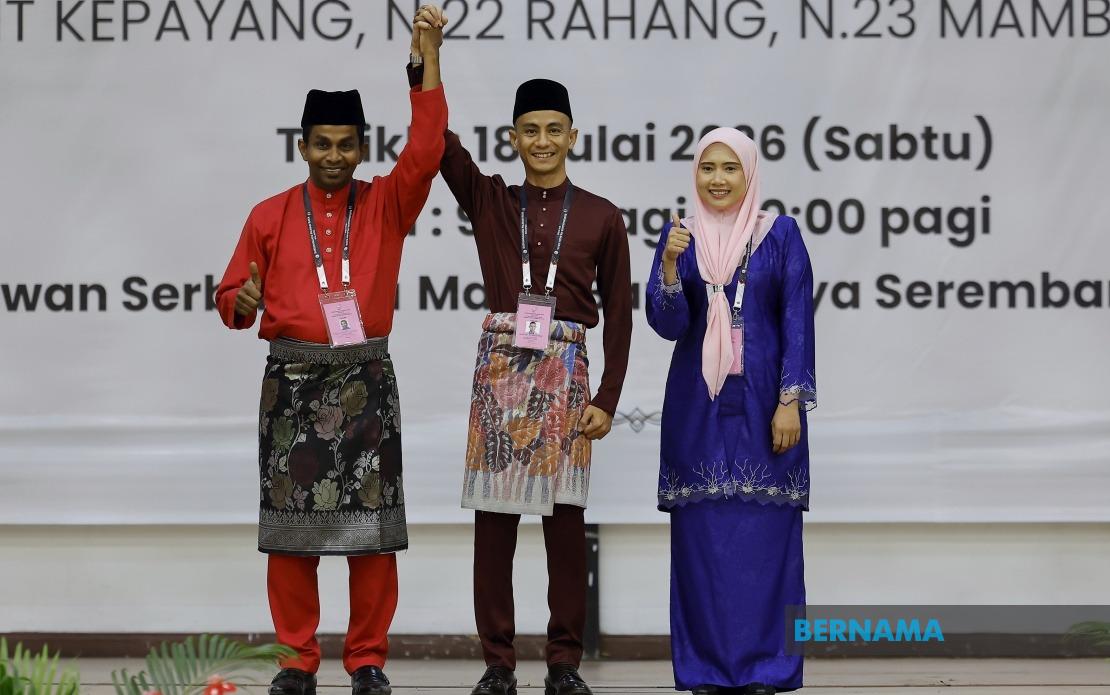
Datuk Ahmad Faez Abdul Razak is entering the political arena with measured optimism, contesting the Labu state seat for Pakatan Harapan under the PKR banner in the forthcoming 16th Negeri Sembilan state election. The property developer's maiden electoral campaign carries the weight of reclaiming a seat that coalition partners have lost, yet he projects confidence grounded in extensive groundwork. Having immersed himself in community affairs across Labu for nearly three years, Ahmad Faez told reporters after the nomination process that public sentiment appears increasingly receptive to his candidacy, tempering what he described as a mixture of excitement and apprehension about his first contest.
The Labu constituency represents one of Negeri Sembilan's most dynamically transforming electoral divisions, a reality that colours Ahmad Faez's campaign messaging and policy priorities. The state seat registered 32,884 eligible voters as of the Election Commission's updated roll in May 2026, comprising principally 32,869 ordinary citizens alongside 15 personnel from the police force and their families. This electoral landscape saw the incumbent, Mohamad Hanifah Abu Baker representing Bersatu and Barisan Nasional, secure victory in 2023 with a comparatively narrow 1,640-vote margin over Datuk Ismail Ahmad of PKR, who gathered 10,021 votes. The closeness of that margin underscores the competitive nature of the constituency and perhaps explains Pakatan Harapan's determination to recapture ground lost in the previous cycle.
Ahmad Faez's primary differentiator centres on his professional credentials as a property developer, positioning him to navigate the tension between economic expansion and community preservation. He contends that his background equips him uniquely to ensure that Labu's development trajectory advances in tandem with residents' welfare rather than at their expense. This messaging resonates particularly given that Labu sits within the sprawling Malaysia Vision Valley development corridor, a vast initiative encompassing between 11,000 and 12,000 hectares designated for industrial and residential projects. The economic potential embedded within this corridor is substantial, promising employment avenues for local populations, yet Ahmad Faez acknowledges that realising those opportunities without eroding community fabric demands deliberate stewardship.
Central to his manifesto stands a commitment to construct both a community centre and recreational facility explicitly designed for youth engagement. Ahmad Faez identifies a conspicuous absence of such infrastructure within Labu, framing their establishment as addressing a tangible gap in local amenities. This targeted pledge speaks to the demographic composition of emerging constituencies in Negeri Sembilan, where younger residents increasingly comprise the electorate. By directing campaign promises towards youth infrastructure, Ahmad Faez attempts to cultivate support among voters for whom employment prospects and social spaces materially affect quality of life amid rapid geographic transformation.
The synchronisation between state-level governance initiatives and federal policy frameworks forms another pillar of Ahmad Faez's electoral argument. He contends that the Negeri Sembilan administration's alignment with national development strategies has bolstered public confidence in existing structures and demonstrates institutional coherence. This positioning implicitly endorses the current state government while delegitimising alternative visions, a tactic designed to reassure voters that backing Pakatan Harapan at the state level maintains continuity with federal direction. For Malaysian constituencies where developmental outcomes depend partly on federal-state coordination regarding infrastructure funding and regulatory approval, such institutional harmonisation carries material implications.
The Malaysia Vision Valley corridor itself warrants closer examination for Southeast Asian regional observers tracking Malaysia's economic restructuring. This development initiative reflects deliberate spatial planning aimed at attracting manufacturing, logistics, and technology sectors away from congested Klang Valley zones towards Negeri Sembilan's relatively undeveloped hinterland. The corridor's scale—encompassing over 11,000 hectares—positions it as a significant contributor to national economic diversification objectives and middle-income trap mitigation strategies. However, such ambitious industrialisation simultaneously generates environmental pressures, infrastructure demands, and demographic shifts that incumbent administrations must manage carefully to avoid alienating traditional constituents whose livelihoods or cultural practices face disruption.
Ahmad Faez's emphasis on balancing development against community interests reflects broader Malaysian electoral dynamics wherein constituencies undergoing rapid transformation become theatres for competing visions of modernisation. Urban and peri-urban voters increasingly expect development to incorporate safeguards protecting established residential character, preserving green spaces, and ensuring that industrial expansion does not overwhelm existing social infrastructure. His assertion that careful management remains essential suggests recognition that Labu residents, despite proximity to significant employment opportunities, simultaneously harbour concerns about congestion, environmental degradation, and the erosion of neighbourhood cohesion. This positioning attempts to capture the political centre ground occupied by voters supportive of growth but wary of uncontrolled change.
The three-cornered contest pitting Ahmad Faez against incumbent Mohamad Hanifah Abu Baker and Barisan Nasional nominee Siti Nur Umaira Hasim introduces competitive complexity absent from two-cornered races. The 2023 victory margin of just 1,640 votes suggests that neither the Bersatu-BN coalition nor Pakatan Harapan commands overwhelming support, creating space for the third contender to influence outcomes should either major candidate fail to exceed 40 percent of votes. Such fragmented contests frequently pivot on candidate personality and localised campaign intensity rather than national partisan trends, potentially advantaging Ahmad Faez's three-year engagement strategy. His relative newcomer status, paradoxically, might constitute an asset if voters perceive him as unburdened by previous legislative records or unfulfilled promises.
The timing of nomination proceedings in mid-July positions the campaign squarely within Malaysia's monsoon season, when transportation challenges and weather disruptions complicate door-to-door canvassing in constituencies containing both urban clusters and dispersed rural settlements. The Election Commission's schedule mandates early voting on July 28 and general polling on August 1, compressing campaigning into approximately two weeks. This compressed timeframe places particular pressure on candidates possessing established community networks, potentially disadvantaging newcomers despite their stated grassroots engagement. Ahmad Faez's extended presence in the constituency over preceding months thus assumes heightened strategic importance as a foundation upon which condensed campaign activities can build.
For regional observers monitoring Malaysian electoral dynamics, the Labu contest encapsulates broader patterns reshaping Southeast Asian politics at subnational levels. Constituencies undergoing economic transition increasingly select candidates offering technical expertise in managing growth rather than purely partisan credentials. Ahmad Faez's professional background in property development appeals to voters prioritising competent administration over ideological positioning. This trend mirrors phenomena across Thailand, Indonesia, and the Philippines, where development-adjacent crises in rapidly urbanising regions elevate technocratic credentials in candidate selection. The Malaysian instance suggests that even within established democratic systems, voters facing tangible infrastructure and environmental pressures during growth phases gravitate towards candidates promising pragmatic solutions.
Packatan Harapan's decision to field Ahmad Faez represents a calculated repositioning in Negeri Sembilan, moving beyond purely partisan messaging towards candidate-specific appeals grounded in professional expertise. Should he prevail, his mandate would encompass not merely coalition representation but implicit endorsement of development-mediated governance approaches. Conversely, victory by the BN candidate or incumbent Mohamad Hanifah would signal voter preference for alternative stewardship of Labu's transformation. Regardless of outcome, the contest will illuminate whether electorates in Malaysian constituencies undergoing rapid industrialisation prioritise experienced developers or incumbent administrators when evaluating candidates' capacity to harmonise growth with community preservation.

