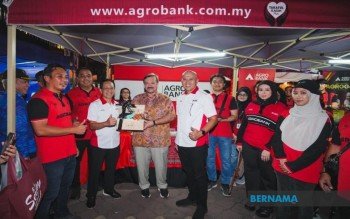
Agrobank is scaling up its effort to democratise access to business capital by taking its lending services directly to street traders and small vendors. The development finance institution has gathered financing applications exceeding RM8 million through a series of on-site engagement sessions designed to reach hawkers and micro-entrepreneurs where they work, signalling a pragmatic response to persistent gaps in financial accessibility across Malaysia's small business ecosystem.
The bank's expansion into Sabah represents a notable shift in strategy, moving beyond established financial hubs in the Klang Valley to underserved markets in Borneo. Recent sessions at Api-Api Night Market on Jalan Gaya in Kota Kinabalu and Papar Tamu Farmers' Market connected the institution with 248 traders across both venues. These locations were deliberately chosen because night markets and farmers' markets function as vital engines of grassroots economic activity, generating employment and serving as distribution channels for local agricultural produce and handcrafted goods that form the backbone of many rural and semi-urban economies.
The financing requirements explored during these sessions predominantly centred on working capital and business expansion needs. Hawkers and traders operating at modest scales often struggle to meet the formal documentation and collateral requirements that traditional banking channels demand. By positioning loan officers and financial advisors at the point where commerce happens, Agrobank seeks to demystify the application process and tailor products to the actual operational realities of informal sector participants. Working capital, essential for restocking inventory or managing cash flow gaps between wholesale purchase and retail sales, represents the most pressing financing concern for vendors operating on tight margins.
Datek Tengku Ahmad Badli Shah Raja Hussin, Agrobank's group president and chief executive officer, framed the expansion as a commitment to geographical equity in financial services. His articulation of the bank's philosophy acknowledges a critical insight: small business communities in different regions face distinct constraints and opportunities that cannot be adequately addressed through generic, urban-centric policy frameworks. A trader in Kota Kinabalu's night market faces different supply chain dynamics, seasonal demand patterns, and competitive pressures than a vendor in Petaling Jaya. Locating financial services proximate to these entrepreneurs permits nuanced conversations about their specific circumstances, enabling the bank to structure loan facilities that align with their actual business cycles rather than imposing standardised products.
This ground-level approach also signals implicit recognition that financial exclusion among informal traders stems partly from information asymmetry and perceived distance from banking institutions. Many small vendors lack exposure to formal financial concepts or may harbour misconceptions about lending requirements. By demystifying these processes and offering explanatory support on-site, Agrobank reduces the friction costs associated with accessing credit. The bank simultaneously positions itself to gather market intelligence about emerging segments, unmet needs, and product design improvements that could enhance its relevance to its core constituency.
The initiative occurs within a broader policy mandate. Prime Minister Datuk Seri Anwar Ibrahim has directed financial agencies to accelerate deployment of RM5 billion in concessional financing targeting small traders, reflecting heightened political priority on inclusive growth and poverty alleviation through entrepreneurship support. This top-down directive provides institutional momentum for Agrobank's ground engagement strategy, aligning departmental objectives with broader economic development goals. The RM8 million in applications gathered thus far represents meaningful progress toward the larger disbursement target, though substantial acceleration will be required to deploy the full RM5 billion within reasonable timeframes.
Finance Minister II Datuk Seri Amir Hamzah Azizan's attendance at the Api-Api Night Market session underscores the political salience of financial inclusion for informal traders. Ministerial presence signals that such initiatives receive sustained high-level government backing and may prompt coordinated support across government agencies involved in small business development. This inter-agency coordination becomes critical because finance alone cannot ensure sustainable trader prosperity; complementary support in business skills development, market linkages, regulatory reform, and supply chain integration remains necessary for durable outcomes.
The RM8 million in financing applications should not be interpreted merely as a banking success metric but as evidence of latent demand for accessible credit among traders who previously lacked convenient channels to express borrowing needs. Many applicants at these sessions may never have approached a financial institution before, suggesting that Agrobank's initiative effectively mobilises previously invisible demand. Capturing this demand generates valuable data about market size, borrowing preferences, and repayment capacity that shapes product development and risk management strategies going forward.
However, translating applications into actual loan disbursement presents distinct challenges. Agrobank must develop efficient appraisal processes that do not require extensive collateral while maintaining prudent risk assessment. This demands investment in alternative credit assessment methodologies, possibly incorporating trader associations' attestations, revenue verification through tax records or wholesale suppliers' documentation, or asset-backed lending arrangements. Processing bottlenecks could emerge if internal loan approval mechanisms prove insufficiently nimble to handle high application volumes from informal sector participants whose documentation typically differs substantially from salaried formal sector applicants.
The expansion to Sabah also reflects competitive repositioning within Malaysia's development finance landscape. Agrobank faces implicit competition from other institutions and informal lending channels that informal traders might access. By establishing visible presence and demonstrating responsiveness to traders' actual requirements, the bank builds institutional credibility and customer loyalty that can extend into broader financial relationships encompassing savings, insurance, and advisory services. Regional expansion thus represents both development impact and market capture strategy.
Looking forward, Agrobank's engagement model requires sustainability mechanisms. The cost of operating mobile lending services across dispersed market locations demands careful financial engineering. The bank might consider partnerships with market management authorities or trader associations to share operational costs or leverage existing infrastructure. Digital tools including mobile application systems could eventually reduce per-transaction operational costs while extending reach beyond physical sessions to broader trader populations.
The success of these engagement sessions ultimately depends on loan performance and trader business outcomes following disbursement. If Agrobank can demonstrate that financed traders experience measurable improvements in revenue, employment generation, or market expansion, the model becomes replicable and scalable. Conversely, if default rates prove elevated or traders struggle to service debt, the initiative risks generating negative outcomes that undermine the bank's development mandate. Consequently, complementary support services including business advisory, market information, and financial literacy deserve equal emphasis as capital deployment to maximise probability of sustainable trader business growth.

