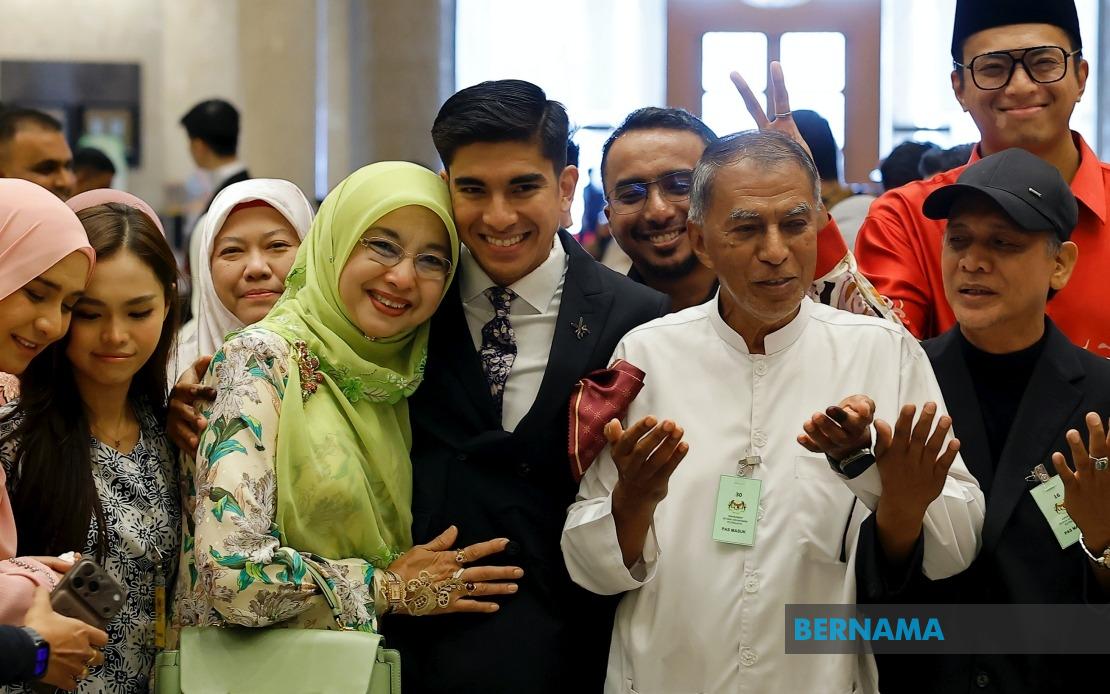
The Federal Court has upheld the acquittal of Muar Member of Parliament Syed Saddiq Syed Abdul Rahman on all charges, bringing to a close a gruelling six-year legal ordeal that captivated the nation's political landscape and tested the country's judicial system. The 33-year-old politician, who faced four charges of abetting criminal breach of trust, misappropriation of property and money laundering involving funds belonging to Angkatan Bersatu Anak Muda (Armada), responded to the court's decision with an emotional prostration in gratitude alongside his family members at the Palace of Justice in Putrajaya on July 13.
Syed Saddiq's vindication represents a significant moment in Malaysia's recent political history, particularly given the high-profile nature of his case and the prominence of his position as the nation's former youth and sports minister. The charges stemmed from allegations connected to funds belonging to Armada, the youth wing of Perikatan Nasional, and had cast a shadow over his career for nearly two decades at the national level. His acquittal now allows him to pursue his political endeavours without the legal encumbrance that has dominated much of his professional life since 2018.
In addressing journalists at the Palace of Justice, Syed Saddiq articulated a philosophical reflection on his ordeal, emphasising that his unwavering conviction in his own righteousness had sustained him through the lengthy proceedings. He characterised the past six years as an invaluable educational experience that reinforced deeper truths about Malaysia's institutional framework. The former minister drew explicit connections between personal integrity and institutional strength, arguing that his case vindicated the fundamental principle that courage derives from moral certainty rather than political convenience or expediency.
The psychological and emotional toll of the case extended far beyond the individual defendant, according to Syed Saddiq's own reflections. His parents, extended family, political allies and supporters experienced collateral distress throughout the protracted legal process, creating ripples that extended into Malaysia's broader political ecosystem. Such secondary effects of high-profile prosecutions often remain invisible in judicial records but profoundly shape public confidence in both political institutions and the legal system itself. Syed Saddiq's explicit acknowledgment of these impacts demonstrates an awareness of justice's social dimensions beyond mere verdicts.
The acquittal carries particular significance for Malaysia's ongoing navigation of judicial independence and institutional credibility. Syed Saddiq framed his vindication not as a personal victory but as a strengthening of the pillars upon which national governance rests. By emphasising the independence of Malaysia's justice institutions as foundational to the country's broader strength, he positioned his case within a larger conversation about institutional resilience and public trust. This framing suggests that acquittals in politically sensitive cases carry meaning beyond individual exoneration, touching on questions of systemic legitimacy that resonate throughout Southeast Asia's democracies.
Regarding his immediate future, Syed Saddiq indicated a measured approach to political participation that prioritises personal restoration over institutional advancement. He announced intentions to step back from active political engagement to devote attention to family matters and personal affairs, though he reaffirmed his continued membership in MUDA, the political party he co-founded and has long championed as a vehicle for generational renewal in Malaysian politics. This measured withdrawal suggests recognition that sustained legal jeopardy exerts cumulative costs that extend beyond the courtroom into personal and family relationships.
The politician also indicated that his parents have consented to his proceeding with long-delayed wedding plans, signalling that the acquittal permits him to resume life milestones interrupted by legal proceedings. Such personal matters, though seemingly peripheral to the charges themselves, underscore how extended criminal trials disrupt normal biographical progression and constitute a form of social penalty even when legal guilt is not established. Syed Saddiq's ability to move forward with matrimonial plans represents a return to the ordinary rhythms of personal life that protracted legal disputes so thoroughly disrupt.
Datuk Hisyam Teh Poh Teik, Syed Saddiq's legal counsel, expressed gratitude to the judicial panel for their deliberations and acknowledged the defendant's trust throughout the proceedings. Defence counsel statements in acquittal cases often reflect the emotional investment required to sustain lengthy legal battles, particularly in cases where initial convictions suggest potential miscarriage of justice. The legal team's public acknowledgment of appreciation underscores the collaborative effort required to navigate Malaysia's multi-tiered appellate system successfully.
The prosecution's response revealed uncertainty about whether to seek a formal review of the acquittal decision, with authorities indicating that determination of next steps awaited intervention from the Attorney General's office. This circumspection reflects established practice in high-profile cases where prosecutorial decisions carry broader institutional implications beyond immediate case management. The stated respect for the court's decision, whilst technically diplomatic, recognises the finality that Federal Court determinations carry within Malaysia's legal hierarchy and the limited grounds upon which such decisions might be revisited.
Syed Saddiq's case arrives amid broader international discourse about prosecutorial discretion in politically sensitive cases and the risks that selective enforcement of criminal law poses to democratic governance. His six-year ordeal provides Malaysian and regional observers with concrete evidence of both the vulnerabilities and resilience within the country's judicial architecture. The acquittal suggests that despite pressures that might encourage instrumental use of the criminal justice system, appellate review processes ultimately functioned to reach conclusions aligned with evidence and legal principle.
For Malaysian politics more broadly, Syed Saddiq's vindication potentially reshapes factional dynamics within his parliamentary faction and within MUDA itself, particularly given the generational appeal he has cultivated. His temporary withdrawal from active political engagement provides space for MUDA's institutional development independent of his personal prominence, whilst his exoneration removes obstacles to his eventual return to heightened political participation should he choose to re-engage with party machinery and parliamentary responsibilities.
The resolution of this protracted legal saga carries implications extending beyond individual rehabilitation to encompass questions of institutional legitimacy that affect public confidence in Malaysia's ability to administer justice impartially. Syed Saddiq's articulation of faith in Malaysia's judicial institutions, delivered at the moment of vindication, contributes to reconstructive narratives around judicial performance during periods when public confidence in institutional impartiality has been subject to sustained questioning within both domestic and international forums.

