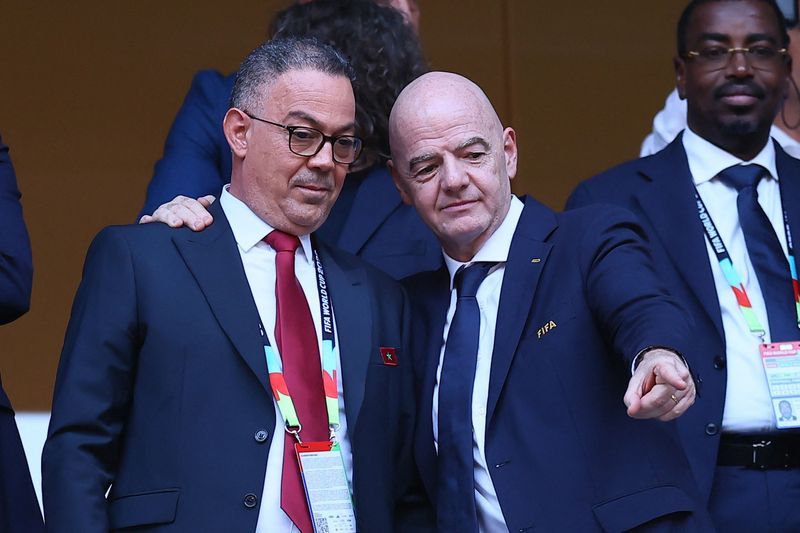
Gianni Infantino's grip on the FIFA presidency faces serious international scrutiny after football governing bodies across Asia, Europe, and the Caribbean withdrew their confidence in his leadership. Yet as the world football chief confronts the prospect of defending his position at next March's presidential election, he has found unexpected salvation in the African continent, where major administrators have begun issuing public endorsements that could prove crucial to his political survival.
The backing from Africa's football establishment came into sharp focus at the Confederation of African Football's executive committee meeting held in Cape Town, where influential leaders including CAF Vice President Fouzi Lekjaa of Morocco, Egyptian FIFA Council member Hany Abo Rida, Niger's Hamidou Djibrilla, and Mauritania's Ahmed Yhaya all expressed support for Infantino. The timing proves strategically significant, as CAF represents 54 member nations—a substantial voting bloc within FIFA's broader membership structure. Additional backing surfaced from Veron Mosengo-Omba, the recently elected president of the Democratic Republic of Congo's football federation and former CAF general secretary, who shares a university education background with Infantino from his time studying in Switzerland.
Infantino's controversial plan to establish a commercial rights body that would have generated $4.2 billion from future World Cup revenues faced intense global pushback over the weekend. However, rather than permanently damaging his standing with African leadership, the FIFA president's swift decision to abandon the FIFA Forward Enterprise initiative appears to have actually strengthened his position on the continent. The five prominent African administrators who released statements welcomed both the cancellation of the scheme and expressed continued confidence in Infantino's stewardship, suggesting that regional power brokers view the reversal as a positive signal of responsiveness to criticism.
The financial relationship between FIFA and African nations forms the bedrock of Infantino's continental support. Since assuming office, Infantino has dramatically expanded the FIFA Forward programme, substantially increasing the development funding distributed to member associations across the continent. This represents a continuation and dramatic amplification of a strategy first employed by his predecessor Sepp Blatter, who famously used pledges of direct financial assistance to secure African backing during his 1998 election campaign against UEFA president Lennart Johansson. The formula has proven remarkably durable: African nations with limited domestic resources and struggling football infrastructures have become increasingly dependent on FIFA's baseline funding guarantee of $8 million per member association over four-year cycles, supplemented by additional annual grants administered through CAF.
The material impact of this funding becomes apparent when examining the constraints faced by smaller African football federations. Saïd Ali Athouman, president of the Comoros Football Federation, articulated the fundamental challenge confronting his nation's football development: the absence of commercial sponsorship opportunities that wealthier nations take for granted. Without external funding sources, Comoros lacks the capacity to provide adequate player training facilities, modern equipment, and professional infrastructure that European and North American nations can mobilise through their own domestic resources. The resulting competitive disparity reflects not merely sporting differences but profound economic asymmetries across the global football landscape.
Malawi's situation exemplifies the desperation facing many African countries as they attempt to develop competitive football programmes. Fleetwood Haiya, president of the Football Association of Malawi, pointed to the fundamental inability of his government to simultaneously address critical healthcare deficiencies and invest in sporting infrastructure. Hospitals in Malawi lack basic medical supplies, creating an impossible choice between public health priorities and football development. In such circumstances, FIFA's financial support becomes not merely helpful but essential to maintaining even basic competitive capacity on the international stage. The stadium construction and training infrastructure that Malawi requires demand resources far exceeding what domestic government budgets can reasonably allocate.
CAF's cautious public stance masks the underlying enthusiasm from senior figures who exercise substantial influence over the confederation's 54 member votes. While the continental body initially released only a measured statement indicating it would study Infantino's FIFA Forward Enterprise proposal, it conspicuously avoided the harsh condemnations issued by Asian, European, and CONCACAF leadership. This calculated silence suggests strategic positioning rather than genuine neutrality. The abandoned revenue-sharing scheme remained technically on the agenda for CAF's executive committee deliberations, though no guarantee existed that the continental governing body would take an explicit public stance on Infantino's political future.
The personal dimension of these relationships adds another layer to African support for the FIFA president. Veron Mosengo-Omba's statement carried particular weight given his prior service as CAF general secretary and his shared university background with Infantino. The Democratic Republic of Congo official praised the FIFA president in almost reverential terms, emphasizing concepts of loyalty and personal friendship that transcend formal institutional relationships. Mosengo-Omba explicitly framed his support in terms of reciprocal obligation, suggesting that individuals who have demonstrated loyalty to African interests deserve corresponding loyalty in return—a value framework resonating strongly within the confederation's political culture.
Infantino's historical leverage over African football leadership stems from his willingness to channel unprecedented resources toward continent-based development initiatives. When he pledged during his 2016 campaign to more than double development funding for FIFA member associations, African nations responded enthusiastically to promises that would tangibly enhance their football programmes. This commitment transformed his election into a defining moment for African football governance, establishing the financial dependency that now anchors continental support for his presidency. The contrast with historical patterns is striking: prior to the Blatter era, African nations received essentially no direct financial assistance from world football's governing body, despite representing nearly one-quarter of FIFA's total membership.
The strategic geography of FIFA's internal politics has fundamentally shifted as a result of these regional divisions. Asia, Europe, and the Caribbean confederation have signaled their loss of confidence in Infantino's leadership, creating a genuine crisis of legitimacy at the global level. Yet African support provides the embattled president with a crucial counterweight and potential path to electoral survival. The March presidential election will ultimately depend on voting patterns across multiple continental confederations, and African federation leaders have demonstrated sufficient enthusiasm for Infantino's continued financial commitment that they will likely maintain their support despite international criticism. This creates a peculiar dynamic in which Infantino's willingness to direct disproportionate resources toward less wealthy nations may ultimately determine whether he survives as FIFA president, regardless of criticisms levelled by more developed football nations.
The abandonment of the World Cup revenue scheme represents a tactical retreat rather than a fundamental shift in Infantino's approach to FIFA governance. As he prepares for the presidential election challenge, maintaining African support becomes strategically essential. Senior African football administrators have signalled their continued backing, suggesting that Infantino's political survival may ultimately depend less on regaining the confidence of European and Asian leadership than on maintaining the crucial coalition of support across the African continent's 54 member nations.

