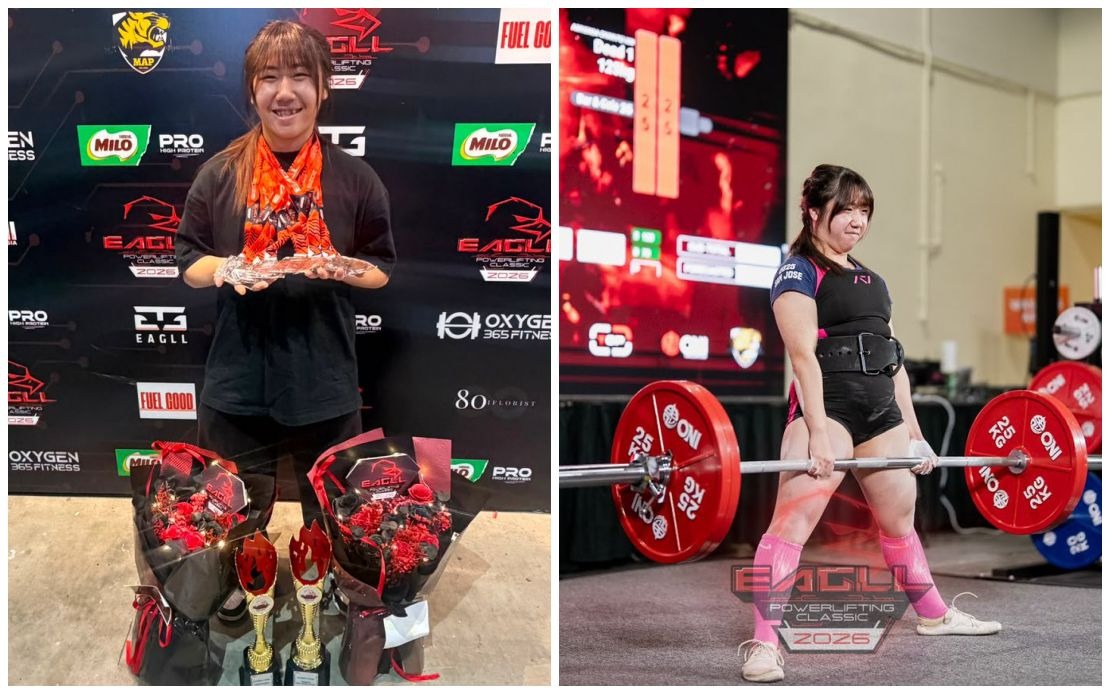
Sarawakian powerlifter Abrienda Chan has translated her competitive ambitions into tangible results by shattering five national records in the Under-57 kilogramme weight division at the recent Eagll Powerlifting Classic 2026 held in Kuala Lumpur. The 20-year-old athlete's performance at the competition underscores her emergence as one of Southeast Asia's most promising strength sports talents and marks a crucial stepping stone in her quest to establish herself on the world stage.
Chan's extraordinary showing at the competition saw her accumulate an impressive medal haul of seven gold medals and one silver across both junior and open age divisions. The records she established in Kuala Lumpur span across multiple disciplines within powerlifting's technical framework. Her open squat record now stands at 128 kilograms, while she set new benchmarks in the bench press across both junior and open categories at 70 kilograms. Most significantly, she established new junior and open total records of 343 kilograms, a metric that aggregates performance across all three main lifts in the sport.
The achievement represents the culmination of months of preparation and demonstrates the strategic planning that has underpinned her recent progression. Just weeks prior to the competition, Chan had publicly articulated her intention to rewrite multiple entries in Malaysia's powerlifting record books as she built towards competing in two major world championships scheduled for 2027. This methodical approach to record-setting reveals a maturity in her competitive philosophy that extends beyond simply attempting maximal lifts.
Despite the remarkable haul of five records, Chan acknowledged that her competition strategy involved calculated restraint in certain moments. She explained that technical difficulties during her final squat attempt prevented her from claiming the junior squat record, while the team made a deliberate decision to adopt a more conservative approach in the deadlift discipline to secure the overall titles that were within reach. This tactical acumen suggests that Chan and her coaching team view each competition not merely as a venue for record attempts but as part of a longer-term development strategy.
What renders Chan's achievements particularly striking is the physical context in which she operates. Standing merely 151 centimetres tall, she competes in a sport where body size traditionally correlates with lifting capacity. Her ability to generate such substantial force outputs from a notably compact frame positions her distinctly within global powerlifting conversations and demonstrates that technical proficiency and training methodology can substantially override conventional biomechanical assumptions. Her historical dominance in the Under-52 kilogramme sub-junior category, where she continues to hold national records across all three individual lifts and the combined total, indicates that her progression has been consistent rather than meteoric.
Chan's finishing position in the open category competition proved particularly instructive regarding her competitive standing. She secured the Junior and Sub-Junior Overall Champion title while simultaneously finishing as runner-up in the Open Overall standings. This dual achievement becomes more remarkable when considering that she was among the youngest participants competing in the open bracket. Chan reflected that this result genuinely surprised her, as she had not anticipated placing competitively in a division typically dominated by more senior athletes with greater experience and training longevity.
The mental dimensions of her preparation have evidently strengthened considerably through the competition process. Chan articulated that the experience of preparing for and competing at the Eagll Powerlifting Classic has materially increased her confidence for the international engagements ahead. The competitive exposure has facilitated deeper self-knowledge regarding her physical capacities and psychological responses under pressure. This kind of experiential learning often proves decisive in international competitions where technical execution and mental resilience determine outcomes more than in domestic settings.
Chan's pathway forward is clearly demarcated by two major international objectives scheduled for 2027. She aims to compete at the World Classic & Equipped Bench Press Championships in Istanbul, Turkey and the World Classic Sub-Junior & Junior Powerlifting Championships in Haining, China. Within the context of these global competitions, she has established a specific performance target of breaking into the world's top three positions in the Under-57 junior category. This specificity of objective demonstrates strategic foresight and acknowledges the competitive depth she will encounter at the world level.
The athlete's acknowledgment of institutional and personal support structures underscores an important dynamic within Malaysian sports development. She specifically recognized the contributions of her family, coaching staff, and Turbo Fitness, which has provided both training facility access and material support for competition-related expenses. This collaborative ecosystem enabled her to concentrate exclusively on performance optimization without navigating the financial barriers that often impede promising athletes in developing sporting nations. The absence of such support frequently constitutes the primary obstacle preventing talented individuals from reaching their potential on international platforms.
Abrienda Chan's trajectory represents a broader narrative within Malaysian powerlifting's contemporary development. Her success at the 2024 Asian Classic Powerlifting Championships, where she captured gold, had already indicated her capacity to perform competitively at regional scale. The progression from Asian medals to accumulating multiple national records within a single competition cycle demonstrates an athlete operating in an ascending trajectory. For Malaysian sports development observers, her emergence provides evidence that competitive infrastructure and talent identification mechanisms are functioning effectively within the powerlifting domain.
The significance of Chan's achievements extends beyond individual medal accumulation or record-setting. Her performances provide tangible evidence that Malaysian athletes can compete at levels approaching world-class standards even in sports lacking the institutional prominence of more traditional disciplines. The financial support she has received through sponsorship and facility access, though modest by international standards, has proven sufficient to enable elite-level performance preparation. This reality carries implications for sports policy considerations regarding funding allocation and development priorities across different sporting domains within Malaysia.

