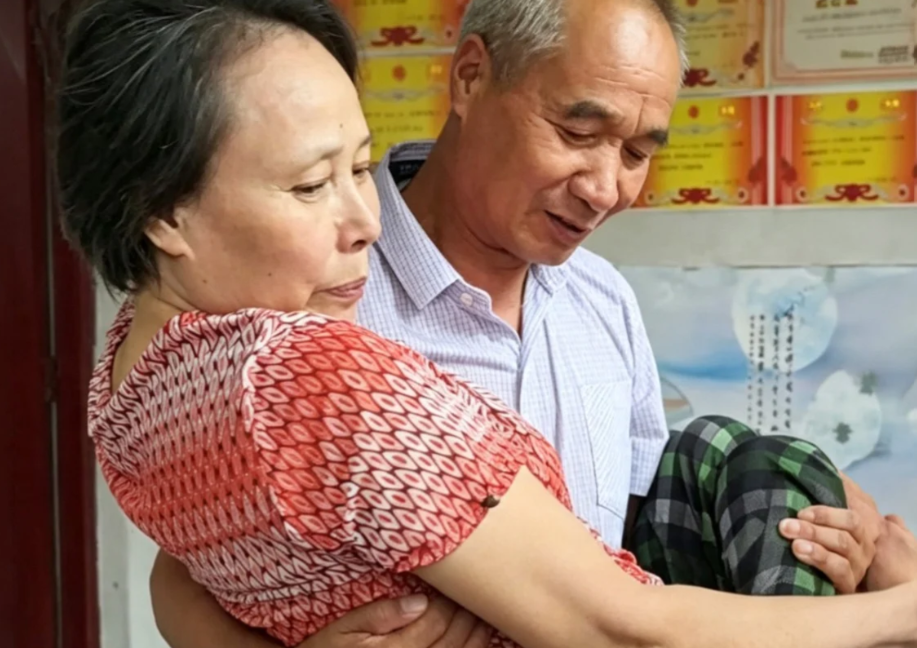
In the central Chinese city of Pingdingshan, Henan province, an extraordinary story of marital commitment has captivated millions across mainland China's social media platforms. Li Junliang, now in his early 60s, has devoted the past quarter-century to the complete care of his wife Jia Fang, who became severely paralyzed following a catastrophic accident that fundamentally altered their family's trajectory and tested the very boundaries of human endurance and devotion.
The turning point arrived in 2001 when Jia, then 36 years old, suffered a devastating fall from a cliff while riding a pedicab. The accident left her paralyzed from the chest downward, transforming her from an active family member into someone entirely dependent on others for the most basic functions of daily living. At the moment of impact, their two children—a 10-year-old son and a 13-year-old daughter—were entering formative years that would require parental guidance and support. Rather than seek institutional care or burden extended family members, Li made an unspoken commitment to become his wife's primary caregiver while simultaneously navigating the complexities of raising two adolescents during a period of profound family upheaval.
The physical demands of Li's role have been unrelenting and exhausting. In the immediate aftermath of Jia's paralysis, he developed a rigorous care protocol that required turning her body every two hours throughout both day and night to prevent the development of dangerous pressure sores, a common and serious complication for bedridden patients. This schedule meant that for years, Li functioned on fragmented sleep, never experiencing the restorative benefit of continuous rest. Over subsequent decades, he gradually extended this interval to four-hour rotations as Jia's condition stabilized, yet even this adjustment has meant that Li has rarely enjoyed an uninterrupted night of sleep for the past two decades. Beyond the physically exhausting turning protocol, he regularly massages her limbs with meticulous care to slow muscular deterioration, transports her to a wheelchair to experience sunlight and fresh air, and manages the complete spectrum of her medical and personal hygiene needs.
What makes Li's commitment particularly striking is that he maintained these caregiving responsibilities while simultaneously helping to raise their children to adulthood. The certificates of achievement that now decorate the walls of their modest home stand as silent testimony to the educational support and parental investment he provided despite the overwhelming demands on his time and emotional resources. Both children have since established their own families and moved toward independent lives, a testament to the stability and guidance their father maintained even as their mother remained completely dependent on his assistance. The household itself reflects his dedication—neighbours consistently observe that despite the challenges of caring for a severely disabled person, the home remains clean and orderly, suggesting that Li manages even these administrative aspects of household maintenance alongside his primary caregiving duties.
Li's efforts have come at a visible personal cost. His hair has greyed completely over the 25-year period, aging him more rapidly than his wife, whose hair remains predominantly dark. When Jia spoke with media representatives covering their story, she reflected on this disparity with a mixture of gratitude and poignancy, acknowledging the physical toll her husband's sacrifice has exacted. She expressed profound appreciation for his tireless work, saying simply: "Junliang, thank you for taking care of me for 25 years." Her statement carried the weight of genuine recognition for the magnitude of what he has endured.
Li's response revealed the philosophical foundation underlying his decades of service. He reframed his caregiving not as a burden or sacrifice, but as a natural expression of his marital commitment and a reflection of vows made long before tragedy struck. He reminded Jia that he had promised on their wedding day that "home is complete only with your presence," and he has honored that pledge through years of thankless labour that few modern spouses would willingly undertake. He pledged to continue his care for another 25, 35, or even 45 years—a statement that carries particular weight given his advancing age and the physical deterioration such prolonged caregiving inevitably causes. His words reframe the caregiving relationship not as obligation imposed by circumstance, but as the fulfillment of a solemn personal commitment made freely between two people who chose each other.
Jia's response to her husband's devotion was equally eloquent. Despite her complete physical dependence, she asserted that she considered herself "the happiest person in the world" because she had "married the right man." This statement suggests that the relationship, rather than being diminished by her disability, has been strengthened by the authenticity of the commitment it demands. She recognizes that her husband's actions cannot be performed out of obligation alone—they require a deliberate choice, renewed daily, to continue providing care despite its profound difficulty.
Their story has resonated deeply within Chinese society, generating widespread comment and admiration on social media platforms. Neighbours have publicly acknowledged Li's extraordinary commitment, noting that such sustained devotion is rare and remarkable. One unnamed neighbour praised not only his loyalty but also his successful management of the household, remarking that many men would find such a situation intolerable and would abandon their responsibilities, yet Li has maintained both his caregiving duties and his home's basic functioning. Online commentators have expressed emotional responses to the couple's story, with many describing themselves as deeply moved by Li's willingness to sacrifice his own comfort and health for his wife's wellbeing. Some have invoked spiritual frameworks, suggesting that such kindness will ultimately be rewarded by divine blessing.
The couple's story carries particular significance within the context of Asian family values that emphasize marital commitment and filial piety. In many Southeast Asian societies, including Malaysia, the concept of caring for disabled or elderly family members remains central to cultural identity and social expectation. Yet Li's example transcends mere cultural obligation—his actions demonstrate a form of love that actively chooses to embrace difficulty rather than escape it. The story implicitly challenges contemporary assumptions about marriage as a partnership that should prioritize individual satisfaction and happiness, instead presenting a model in which fulfillment emerges from the willingness to sacrifice for another person's welfare.
Furthermore, Li's situation highlights the vulnerabilities of families without robust institutional support systems for disability care. The fact that his profession remains undisclosed in reports about his life suggests the possibility that he may have forgone career advancement or stable employment to remain available for his wife's needs. The absence of information about his income raises questions about how the family has sustained itself financially over 25 years—questions that remain unanswered in available accounts. For Malaysian readers and others in Southeast Asia where formal disability support services remain limited in many regions, Li's story serves as both inspiration and cautionary tale, demonstrating both the capacity of human love and the potential cost of inadequate social infrastructure for disability care.
The longevity of their commitment also speaks to the evolution of their relationship beyond romantic idealization toward something more enduring and complex. Jia and Li have navigated not merely the novelty of adversity but the grinding reality of decades-long caregiving, during which the romantic dimensions of their marriage have necessarily yielded to pragmatic necessity. Yet their public statements suggest that their bond has not been weakened by this transformation but rather deepened by the authentic commitment it represents. In an era when many marriages founder under far less demanding circumstances, their 25-year journey of mutual dependence and service offers a perspective on commitment that extends beyond contemporary notions of personal happiness toward something more substantial and ultimately more human.

