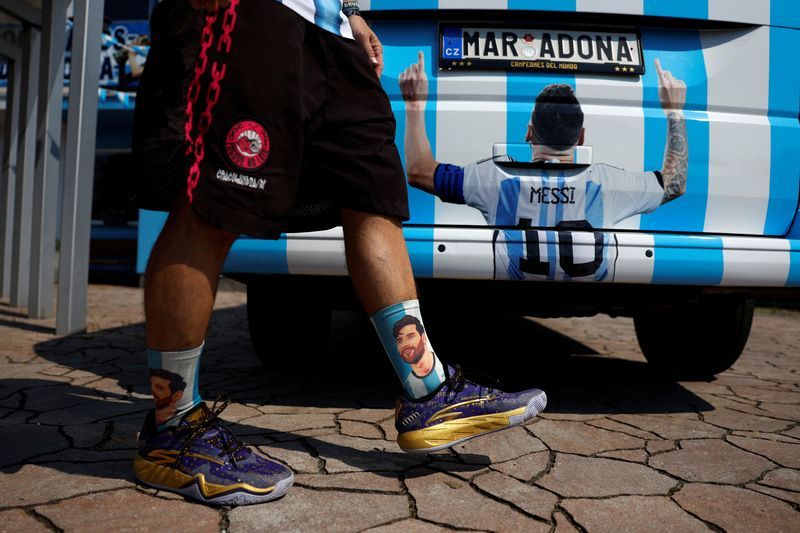
In a small village 90 kilometres east of Prague, an unconventional testament to South American football stands out against the European landscape. Miloslav "Curby" Urbanec has dedicated his life and his home to Argentina's national team, converting a three-storey residence in Bukovka into what amounts to a personal museum celebrating the nation's football heritage. Every surface of the structure communicates his allegiance: the walls painted in Argentina's distinctive sky-blue and white, the sun emblem of the flag emblazoned prominently, and artistic tributes to the country's greatest players that visitors cannot possibly miss.
Urbanec's passion extends far beyond mere decoration. A life-size statue of Diego Maradona stands sentinel in the courtyard, watching over visitors and passersby who venture onto his property. The back wall features an imposing mural of Lionel Messi, whose image has come to dominate the fan's imagination and household. Behind the main building sits a full-weather football pitch, its perimeter ringed with photographs and placards depicting legendary players from Boca Juniors, the Buenos Aires club most closely associated with Maradona's storied career. Even Urbanec's vehicle has become a mobile advertisement for his devotion, painted in the team colours with custom artwork featuring Maradona lifting the World Cup and Messi's likeness, accompanied by the declaration "In Messi we trust" and a number plate reading "MARADONA".
The roots of this extraordinary commitment run surprisingly deep into Urbanec's childhood. At just four years old, the now 51-year-old music promoter watched Argentina's triumphant 1978 World Cup campaign alongside his father, an experience that fundamentally shaped his relationship with football and the South American nation. The flowing locks of Argentine players like Mario Kempes captivated his young imagination, and that initial spark of interest ignited into a lifelong passion that would ultimately define major life choices and investments. What began as a child's fascination with exotic players from a distant continent gradually evolved into a comprehensive identification with Argentine football culture, the Boca Juniors club, and everything connected to the nation's sporting identity.
This devotion has influenced Urbanec's most personal decisions as well. When his second son was born seven years ago, Urbanec chose to name the child Lionel in honour of Messi, convinced even then that the player was destined for extraordinary things. The decision reflects not merely casual fandom but a deep commitment to expressing his values and priorities through his family. For Urbanec, naming his son represented a permanent, tangible way to enshrine his hero within his own household and ensure that future generations would carry forward this connection to Argentine football.
Urbanec's confidence in Argentina's competitive prospects remains absolutely unwavering. He speaks of the current national squad with unreserved enthusiasm, describing La Selección as "absolutely amazing" and asserting with complete certainty that victory will come. His conviction extends beyond mere hope or conditional optimism; he declares with absolute confidence that another World Cup triumph is inevitable. Urbanec believes that Argentina's style of play represents the pinnacle of football aesthetics, arguing that the team showcases "the most beautiful football" that the sport has to offer, a perspective rooted in decades of following the team through various eras and competitions.
For Urbanec, an Argentina victory transcends the boundaries of a single match or tournament. He envisions the success as a catalyst for global celebration, an event that would resonate far beyond the Bukovka village and indeed beyond Argentina itself, creating a moment of collective joy for supporters worldwide. This universalist perspective on football fandom suggests that for Urbanec, supporting Argentina has become less about national pride and more about participating in a shared human experience of beauty, excellence, and achievement through sport.
The physical manifestation of Urbanec's passion in Bukovka represents an unusual phenomenon in Eastern Europe, where football fandom typically gravitates toward European clubs and national teams. His Czech nationality might ordinarily predispose him to supporting Czech football, yet he has instead constructed an elaborate counterculture shrine to South American football. The house has undoubtedly become a local landmark and conversation piece, attracting curiosity from residents and visitors who encounter this striking expression of cross-continental sporting devotion.
Urbanec's story illuminates broader patterns in global football culture, where individual fans can form deep emotional connections to distant teams and nations through the medium of televised sport. His journey from a four-year-old child mesmerized by Argentine players to a 51-year-old man who has fundamentally restructured his living environment around this passion demonstrates football's unique capacity to transcend geographical, cultural, and linguistic boundaries. The sport creates imagined communities that connect disparate individuals across continents, allowing a Czech music promoter to feel genuine kinship with Argentine football culture and its traditions.
As Argentina prepared for its competitive fixtures, supporters like Urbanec embodied the passionate engagement that fuels international football. His unwavering belief in Argentine superiority and his aesthetic appreciation for their style of play reflect the emotional investment that millions of fans worldwide maintain in their chosen teams. For Urbanec in particular, that investment has become comprehensive, informing not only his leisure time and spending habits but also his architectural choices, vehicle modifications, and family naming decisions. In Bukovka, Argentine football is not a weekend distraction but rather a defining characteristic of one man's entire existence, rendered permanently visible in paint, plaster, and steel.

