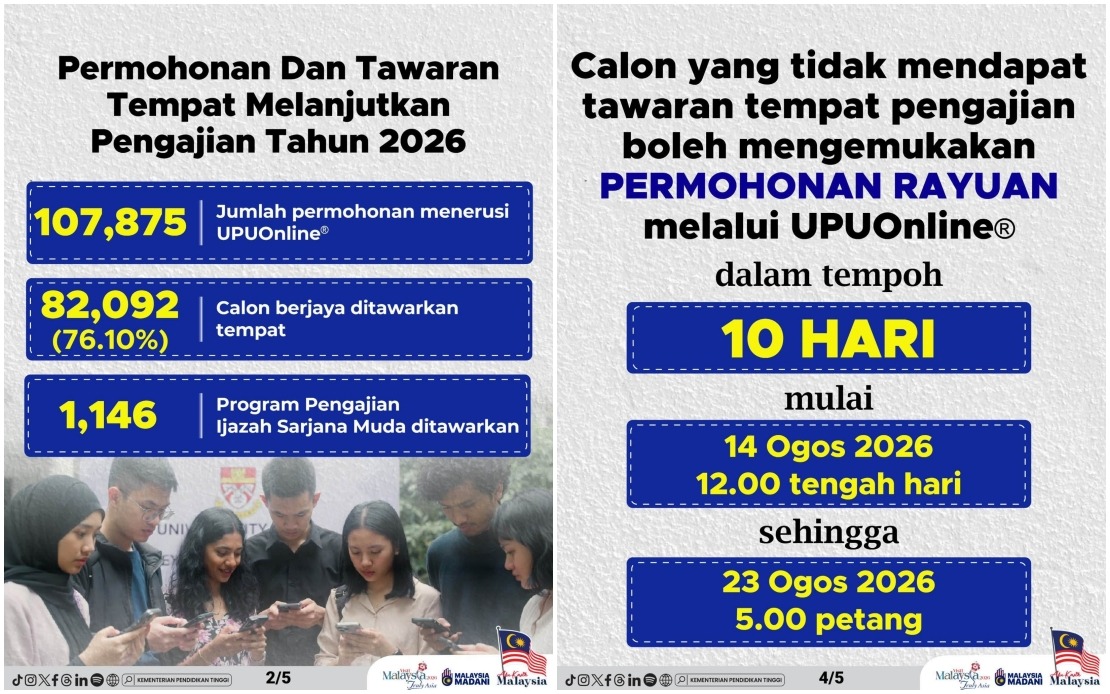
Malaysia's Ministry of Higher Education (KPT) has announced that 82,092 candidates have secured undergraduate places at the country's 20 public universities for the current academic session, reflecting the scale of demand for tertiary education in the region and the capacity constraints facing Malaysian higher education institutions.
The successful candidates represent 76.10 per cent of the 107,875 applications deemed eligible to pursue bachelor's degree studies through the UPUOnline portal, Malaysia's centralised university admissions system. This acceptance rate underscores the competitive nature of public university entry, with nearly one in four eligible applicants unable to secure a place through the main allocation round. The figure illustrates the ongoing challenge facing Malaysia's higher education sector: maintaining quality standards while managing surging demand from school leavers and mature-age applicants seeking degree-level qualifications.
Across the 20 participating public universities, institutions are offering a combined total of 1,146 bachelor's degree programmes spanning diverse fields from engineering and medicine to business, social sciences, and the humanities. This breadth of provision aims to align university offerings with both student aspirations and Malaysia's evolving economic needs, though critics have questioned whether programme diversity adequately reflects future workforce requirements in emerging sectors such as green technology and digital innovation.
The admission process adheres strictly to a merit-based framework, with KPT arranging all eligible candidates according to their merit scores in descending order. This approach represents a deliberate policy choice to prioritise academic achievement as the primary criterion for university entry, reflecting Malaysia's commitment to meritocratic principles in higher education access. However, the system has occasionally drawn scrutiny from stakeholders who argue that alternative selection criteria—such as consideration for underrepresented demographics or socioeconomic disadvantage—warrant greater weight in admissions decisions.
For the substantial cohort of unsuccessful candidates, the KPT has implemented a structured appeals mechanism to provide a second pathway into higher education. Beginning at noon on August 14 and extending until 5 pm on August 23, 2026, eligible applicants may lodge appeals through the UPUOnline system. This 10-day window represents a critical opportunity for candidates to seek reconsideration, potentially accessing additional vacancies created through unsuccessful applicants declining their offers or withdrawing during the confirmation period. Such appeals processes have proven instrumental in absorbing qualified candidates who narrowly missed initial placement thresholds.
The scale of applications processed this cycle—exceeding 107,000 eligible candidates—reflects sustained confidence among Malaysian families in the value proposition of university education. Despite economic uncertainties and debates surrounding graduate employment prospects, the volume of applications continues to rise year-on-year, placing strain on public universities' infrastructure and faculty resources. This demand-supply imbalance has intensified discussions among policymakers regarding the expansion of public university capacity, the role of private institutions in absorbing demand, and the potential for greater uptake of technical and vocational qualifications as alternatives to traditional bachelor's degrees.
The announcement arrives amid broader regional dynamics affecting higher education in Southeast Asia. Malaysia's public universities compete with institutions across neighbouring countries for both domestic and international student talent, while simultaneously navigating government expectations regarding research output, international rankings, and workforce preparation. The UPUOnline system itself represents a technological infrastructure achievement, enabling transparent, centralised management of placements across geographically dispersed campuses—a model that contrasts with more fragmented systems in some regional counterparts.
For successful candidates, the KPT has extended its congratulations and encouraged them to maximise their university experience. The ministry's statement carries an implicit recognition that securing a place represents merely the first milestone in a multi-year educational journey, and that subsequent performance and engagement will significantly influence graduates' trajectories in the labour market. Universities themselves increasingly emphasise pastoral support, career mentorship, and industry linkages alongside academic instruction, recognising that degree attainment alone no longer guarantees employment security in competitive markets.
The distribution of the 82,092 placements across Malaysia's 20 public universities likely reflects variations in institutional size, programme specialisation, and intake capacity. Flagship institutions such as the University of Malaya and Universiti Teknologi Malaysia typically attract larger cohorts and wider programme portfolios, while regional universities may focus on discipline clusters aligned with local economic needs. This differentiation, whilst administratively necessary, creates perceptions of institutional hierarchy that occasionally influences student choice and may inadvertently concentrate resources at perceived top-tier institutions.
Looking forward, stakeholders will monitor whether the intake rate, acceptance rate, and appeal outcomes establish patterns consistent with previous years or signal substantive shifts in candidate quality, application behaviour, or institutional demand. Such trends inform planning discussions regarding capital investment, faculty recruitment, and programme development across the public university sector. Additionally, the experience of unsuccessful candidates navigating the appeals process and alternative pathways—whether through private universities, international institutions, or alternative qualifications—provides valuable data for policymakers assessing whether the current higher education ecosystem adequately serves Malaysia's diverse student population and national development imperatives.

