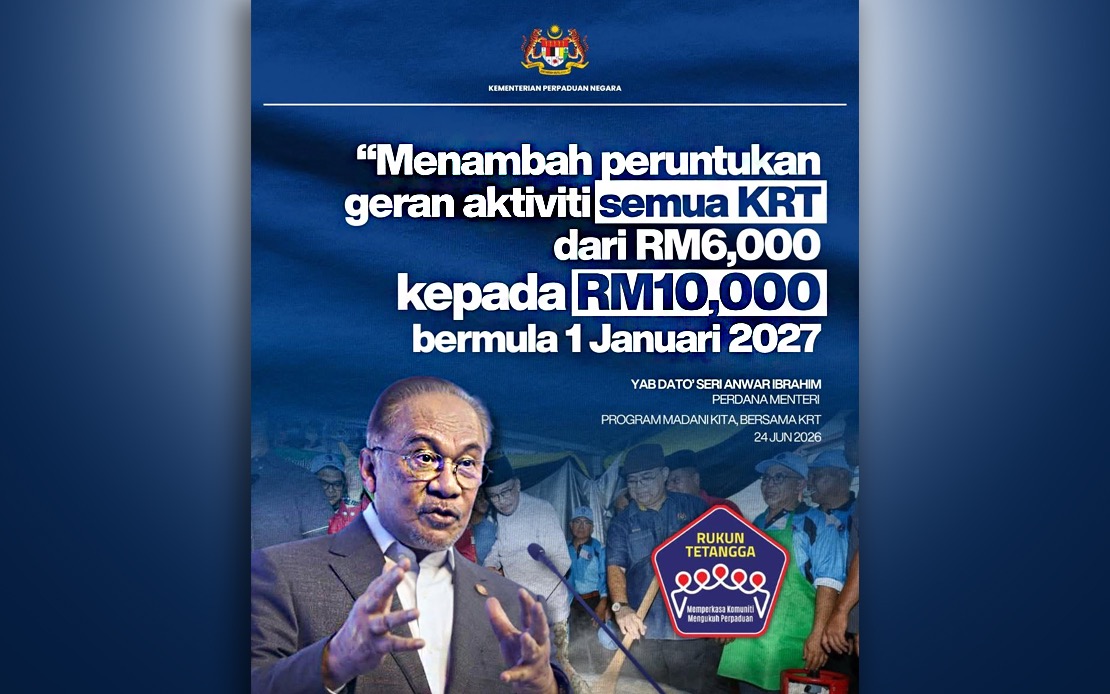
The government has announced a significant increase in funding for Malaysia's neighbourhood watch system, with all 8,615 KRT (Kawasan Rukun Tetangga) groups nationwide set to receive higher annual grants from next year. Prime Minister Datuk Seri Anwar Ibrahim made the announcement during an engagement session with KRT representatives in Dataran Segamat, Johor, revealing that the annual grant will climb from RM6,000 to RM10,000, with disbursements commencing on January 1, 2027. This marks a substantial boost for the community-based safety and social cohesion infrastructure that has underpinned Malaysian society for more than fifty years.
National Unity Minister Datuk Aaron Ago Dagang characterised the funding increase as recognition of the critical work performed by KRT as grassroots institutions that foster social harmony and collective well-being. Speaking in a statement following the Prime Minister's announcement, Aaron stressed that the decision reflects the government's broader policy direction under the MADANI framework, which emphasises empowering community-level movements as essential components of national development. The minister framed neighbourhood watch groups as foundational pillars supporting the construction of a cohesive and forward-looking society, underscoring their role beyond mere security functions to encompass social integration more broadly.
The scale of KRT's reach demonstrates why this funding decision carries significance for Malaysia's social infrastructure. Approximately 250,000 individual members operate within KRT structures, collectively serving the interests of over 12 million Malaysians. During the past year alone, these grassroots organisations conducted more than 100,000 community activities, revealing the breadth of engagement occurring at the neighbourhood level. This extensive network means that the funding increase will have cascading effects across multiple dimensions of community life, from urban centres to rural areas where KRT presence helps maintain social fabric in regions with limited government presence.
The additional resources are intended to expand and diversify the programming that KRT groups can deliver to their constituents. According to Aaron, the enhanced budget will enable initiatives spanning unity promotion, neighbourhood security enhancements, community welfare support, educational advancement, volunteer mobilisation, and grassroots economic development. By providing KRT with greater financial flexibility, the government seeks to move beyond basic neighbourhood patrol functions toward comprehensive community development work that addresses multiple social needs simultaneously. This broader mandate reflects evolving understandings of how to maintain social harmony in diverse communities through multifaceted engagement rather than security measures alone.
For Malaysian practitioners working in community development and social cohesion, this funding boost arrives during a period of renewed emphasis on grassroots-level intervention. The MADANI philosophy underlying the government's approach prioritises local solutions to local challenges, creating policy space for neighbourhood groups to design programmes responsive to their specific contexts. The doubling of per-group budgets—a 67 percent increase—provides meaningful capacity for expanded operations without requiring proportional growth in volunteer labour, potentially alleviating resource constraints that have historically limited KRT effectiveness in wealthier urban areas and less-developed rural zones alike.
Aaron particularly emphasised that neighbourliness itself constitutes the fundamental basis for national unity in the Malaysian context. This formulation recognises that cross-communal trust and cooperation occurring at the residential level—regardless of participants' racial or religious backgrounds—represents Malaysia's distinctive strength as a multicultural nation. By framing neighbouring as a core national asset, the government positions KRT not merely as administrative structures but as cultural institutions embodying pluralism in practice. This rhetorical move aligns with broader MADANI messaging that positions government programmes as reinforcements of existing social practices rather than top-down impositions.
The timing of the announcement, with implementation deferred to January 2027, allows KRT organisations time to prepare for expanded responsibilities and to develop programming plans for deploying additional resources effectively. This implementation window provides approximately eighteen months for planning, suggesting the government envisages a thoughtful transition rather than an immediate operational shift. The staggered approach may also reflect budgetary planning cycles and allow the Ministry of National Unity to establish mechanisms for monitoring how increased funding translates into actual community benefit.
For regional observers monitoring Malaysian governance trends, this decision signals government confidence in community-level institutions as mechanisms for delivering social services and maintaining cohesion. At a moment when some democracies have experienced erosion of civic engagement and local institutional capacity, Malaysia's decision to substantially resource neighbourhood organisations represents a countervailing investment in grassroots vitality. The choice also reflects awareness that government cannot unilaterally produce harmony—instead, it requires conditions enabling communities themselves to build trust and solve problems collaboratively through neighbourhood-level platforms like KRT.
The initiative carries implications for how Malaysia approaches development priorities in coming years. By directing additional resources toward organisations with direct neighbourhood presence, the government acknowledges that prosperity and well-being involve dimensions beyond infrastructure and economic growth. Social cohesion, community safety, and opportunities for civic participation constitute development outcomes worthy of dedicated investment. This represents a policy stance that treats KRT as integral to the broader national development vision rather than as peripheral to core economic and infrastructure agendas.
Minister Aaron indicated that the National Unity Ministry will establish oversight mechanisms to ensure additional funding translates into tangible community benefits rather than merely accumulating in neighbourhood group accounts. This commitment to accountability reflects awareness that resource increases only translate into improved outcomes when coupled with monitoring and support systems ensuring effective utilisation. The government's emphasis on this dimension suggests expectations that KRT organisations will substantially expand their programme portfolios and outreach rather than simply accumulating reserves.
For neighbourhoods receiving these additional resources, the practical implications will depend significantly on how local KRT leadership chooses to allocate funding among competing priorities. Groups operating in areas with acute social challenges may prioritise welfare support, while those in relatively stable neighbourhoods might emphasise education or economic activities. This discretionary space allows KRT to tailor spending to local conditions, though it also creates potential variation in how neighbourhood groups interpret their expanded mandates and translate funding increases into community activities.
Looking forward, the funding increase positions KRT as a central instrument within the government's community-engagement strategy heading into the latter years of this administration. Success in translating the funding boost into measurable improvements in community safety, social harmony, and resident engagement will likely influence future funding decisions and shape how subsequent administrations approach grassroots institutional development. The investment thus represents both recognition of KRT's historical contributions and a substantive test of whether increased resources can meaningfully enhance neighbourhood-level institution-building in contemporary Malaysia.