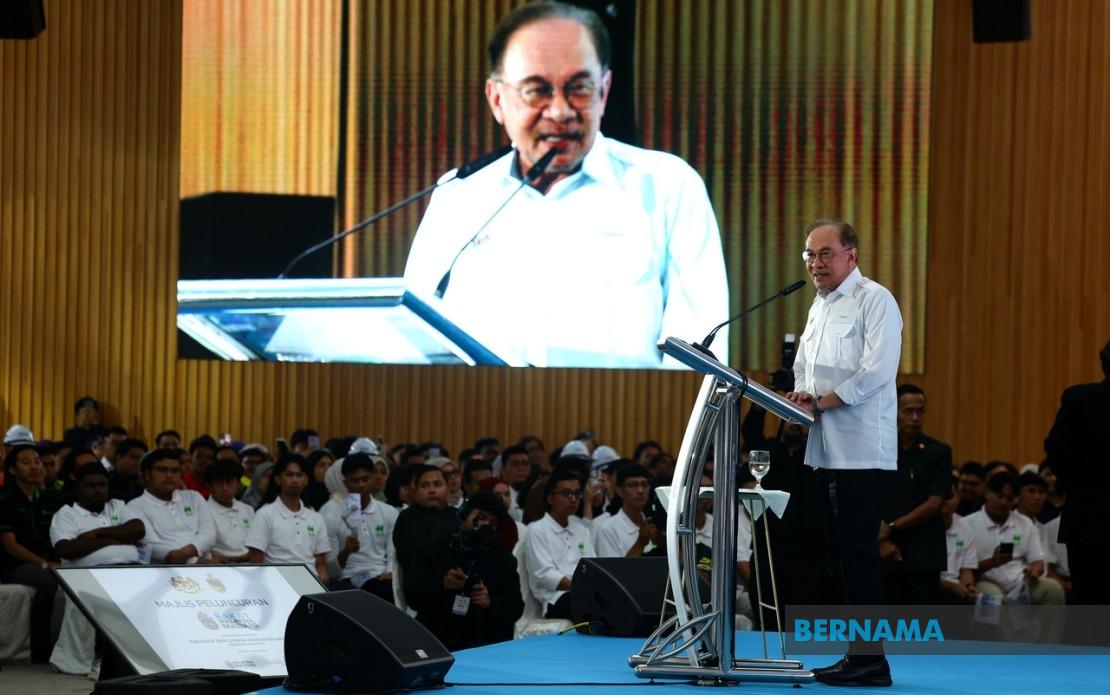
Prime Minister Datuk Seri Anwar Ibrahim officially launched the Bakat MADANI initiative in Seremban on June 29, announcing that the comprehensive talent development programme will directly benefit approximately 25,000 individuals across the nation. The initiative represents a collaborative national effort between government-linked investment companies (GLICs), government-linked companies (GLCs), and Petronas, unified in their commitment to strengthen Malaysia's human capital through structured skills development, high-quality employment creation, and improved pathways for social advancement.
In his remarks at the ceremony, attended by Negeri Sembilan Menteri Besar Datuk Seri Aminuddin Harun and senior government officials, the Prime Minister emphasized the critical role of corporate partners in executing this ambitious programme. Anwar stressed that the success of Bakat MADANI hinges entirely on how well these organizations manage their responsibilities, as they are providing the financial backbone for implementation. He encouraged young participants to acknowledge the essential contribution of these corporate bodies, noting that without their commitment and resources, the initiative could not function effectively.
Finance Minister II Datuk Seri Amir Hamzah Azizan outlined three strategic pillars that form the foundation of Bakat MADANI. The first focuses on strengthening employability and career advancement within the ecosystem of GLICs, GLCs, and Petronas—essentially creating internal pathways for talented individuals to secure quality positions within these major institutions. The second pillar aims to expand job placement opportunities across critical strategic economic sectors that are driving Malaysia's future growth. The third component emphasizes empowering Technical and Vocational Education and Training (TVET) institutions, recognizing their vital role in producing industry-ready graduates.
The overarching philosophy of Bakat MADANI centers on bridging the gap between available talent and real-world opportunities within the Malaysian economy. Amir Hamzah articulated this as the programme's primary objective: connecting skilled individuals with positions that match their capabilities and aspirations. This alignment is particularly significant for Southeast Asia's broader economic context, where talent shortages in specialized sectors continue to pose challenges to regional competitiveness. By systematizing this connection process through a government-backed initiative, Malaysia positions itself as a regional leader in intentional workforce development.
The government has identified high-value sectors as priority areas for Bakat MADANI's focus, specifically targeting semiconductors, renewable energy, the digital economy, and advanced manufacturing. These sectors represent the future growth engines of the Malaysian economy and align closely with global trends toward green technology and digital transformation. By concentrating talent development efforts in these domains, the initiative recognizes that Malaysia's economic trajectory depends on building competitive advantage in knowledge-intensive industries rather than relying on traditional resource-based sectors.
To incentivize industry participation and elevate the quality of training programmes, the government will introduce special tax incentives for companies implementing Bakat MADANI training initiatives. This financial motivation mechanism is designed to encourage firms to invest seriously in skills development and create genuine employment opportunities rather than treating the programme as a checkbox compliance exercise. Additionally, the scheme has been refined to expand coverage to TVET graduates specifically and to increase minimum allowances for trainees, ensuring that participants receive fair and competitive compensation that reflects the value of their training and emerging skills.
Several existing talent development programmes are being substantially enhanced and rebranded under the Bakat MADANI umbrella. Most notably, Petronas is transforming its VISTA programme into Vista i-Plus, undertaken in collaboration with the Malaysian Petroleum Resources Corporation (MPRC) and the Malaysian Oil, Gas & Energy Services Council (MOGSC). This upgraded initiative creates an integrated TVET training model that leverages multiple specialized institutions including MARA Skills Institutes (IKM), National Youth Skills Institutes (IKBN), Advanced Technology Training Centres (ADTEC), and the Malaysian Construction Academy (ABM). This multi-institutional approach maximizes training quality by pooling expertise and resources across the vocational education sector.
Within the GLIC and GLC ecosystem, Khazanah Nasional Berhad is spearheading partnerships with 23 higher education institutions to prepare young talent for workforce entry. These collaborating institutions include prominent universities such as Universiti Teknologi MARA (UiTM), Universiti Teknikal Malaysia Melaka (UTeM), and Universiti Malaysia Sabah (UMS). The partnerships focus on providing industrial training placements, technical certification programmes, and immersive exposure to real industry requirements—bridging the well-documented gap between academic learning and practical workplace expectations that often frustrates both employers and fresh graduates.
The economic philosophy underlying Bakat MADANI reflects a sophisticated understanding of development dynamics. Finance Minister Amir Hamzah explicitly connected human capital investment to national economic strength, noting that improving living standards and fostering economic growth reinforce each other in a virtuous cycle. This approach acknowledges that sustainable development requires not merely capital accumulation but the deliberate cultivation of skills, knowledge, and productive capability throughout the workforce. For Malaysia specifically, where population growth has slowed and aging demographics loom, maximizing the productivity and earning potential of the current population becomes increasingly critical.
The scale and structure of Bakat MADANI signal the government's serious commitment to addressing persistent skills mismatches in the Malaysian labour market. By involving GLICs, GLCs, and Petronas—the largest and most sophisticated employers in the country—the initiative taps into organizations with proven capacity to deliver quality training and genuine employment opportunities. These entities have existing infrastructure, training facilities, and industry connections that would take years for a government agency to develop independently. The collaborative model thus represents pragmatic governance that leverages existing institutional strengths rather than attempting to build parallel structures.
For young Malaysians, Bakat MADANI offers more than temporary training exposure; it potentially represents a pathway toward stable, well-compensated employment in growth sectors that will shape the nation's economic future. The focus on fair compensation and competitive allowances acknowledges the reality that many young people cannot afford to sacrifice income entirely during training periods, a practical recognition that previous vocational programmes sometimes overlooked. The emphasis on TVET institutions is particularly noteworthy, as Malaysia has historically struggled to build cultural acceptance of vocational pathways as genuinely valuable alternatives to university education, despite chronic shortages of skilled technical workers.
The initiative carries important implications for Malaysia's position within the broader Southeast Asian economic landscape. As regional countries compete for foreign investment and seek to climb global value chains, the availability of skilled, trained workers becomes a decisive competitive factor. Thailand, Vietnam, and Indonesia are making similar investments in workforce development, and Malaysia's Bakat MADANI represents this nation's strategic response. By demonstrating that major government institutions and national champions like Petronas are committed to developing domestic talent systematically, Malaysia sends a signal to multinational corporations and regional partners about the country's seriousness regarding sustainable, quality-based economic development.

