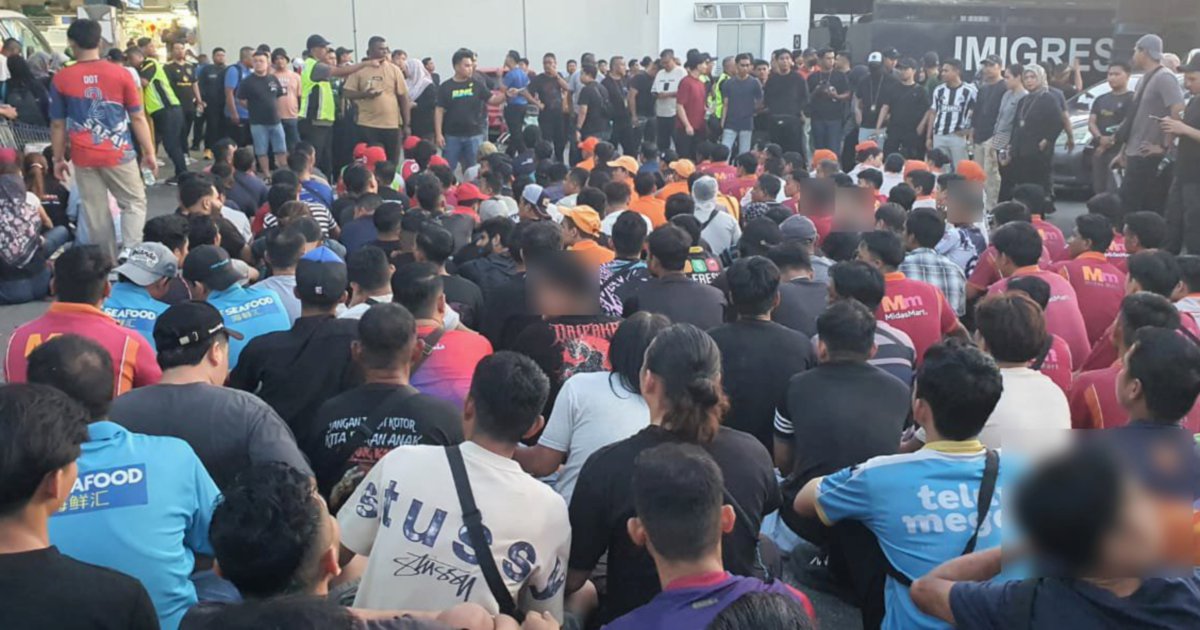
A major enforcement operation in Johor Baru has resulted in the detention of 226 migrants and the exposure of an organised passport fraud scheme that allowed illegal workers to maintain the appearance of legal status for extended periods. The discovery emerged during raids that uncovered how undocumented labourers repeatedly crossed Malaysia's borders to obtain fraudulent entry stamps, creating an illusion of compliance with immigration requirements while continuing their unlawful employment.
The case of an Indonesian fishmonger exemplifies the scale and sophistication of the operation. Over a four-year span, the man travelled across the border monthly to have his passport stamped as though he were making legitimate entries and exits. Between these orchestrated crossings, he returned to Malaysia and worked illegally, exploiting a gap in enforcement that allowed him to operate largely undetected. His routine illustrated how the scheme functioned: obtain a stamp to create a paper trail of lawful presence, then vanish into the informal economy until the next scheduled crossing.
The discovery of this loophole represents a significant challenge to Malaysia's immigration management. The stamping mechanism, designed to track movement and ensure compliance with entry conditions, was subverted by individuals and facilitators who coordinated the timing of border crossings with their periods of illegal employment. This suggests that the fraudsters had sufficient familiarity with immigration procedures and border operations to exploit predictable patterns, raising questions about coordination between workers, smugglers, and possibly others with access to information about border routines.
For Malaysia's economy and labour market, the operation's existence underscores the persistent pull of undocumented work, particularly in lower-wage sectors such as fishing, domestic services, and agriculture. The monthly border runs by the fishmonger, and presumably others in the network, indicate that Malaysian employers were willing to hire workers they knew lacked proper authorisation. The scheme would have been unsustainable without consistent demand for cheap, compliant labour that bypassed formal recruitment and compliance processes.
The detention of 226 individuals signals an escalation in enforcement after the scheme had operated undetected for an extended period. Immigration authorities likely identified the network through intelligence gathering, pattern recognition across multiple cases, or information from informants. The timing and scale of the raid suggest that officials had accumulated sufficient evidence to act comprehensively, rather than pursuing individual cases piecemeal. This approach aims to dismantle the entire operation rather than address symptoms of the problem.
Indonesian nationals make up a substantial portion of Malaysia's migrant worker population, both documented and undocumented. The prominence of an Indonesian fishmonger in this case reflects the specific vulnerabilities and employment patterns within that community. Indonesian workers dominate sectors such as fishing, plantations, and domestic work, where enforcement is traditionally weaker and informal networks can more easily accommodate workers outside the legal framework. The case thus illuminates vulnerabilities within Malaysia's broader migrant management system.
The passport stamping scheme raises implications for border security and document integrity across Southeast Asia. If fraudulent stamps were applied through routine border processes rather than falsification elsewhere, it suggests that checkpoint procedures may lack sufficient verification mechanisms or that officials were compromised. Either scenario points to systemic weaknesses that extend beyond Malaysia's borders, potentially affecting regional movement and documentation standards.
Regional labour flows have long operated through both official channels and informal networks. Malaysia's reliance on migrant workers in essential sectors creates structural incentives for such schemes to develop. The monthly border runs represented a rational response by migrants and employers to a system where formal pathways are lengthy, costly, or restricted, while enforcement in certain sectors remains sporadic. Understanding this dynamic is essential for crafting effective policy responses that address root causes rather than merely symptoms.
The investigation now faces the challenge of determining the full extent of the network and the degree of organisation involved. Authorities must establish whether the operation was coordinated by professional smugglers or evolved organically through workers sharing knowledge with peers. The distinction matters for prosecution and for understanding whether dismantling this particular scheme will eliminate the vulnerability it exploited or whether other networks will emerge using similar tactics.
For Malaysian policymakers, the case highlights the tension between managing irregular migration and maintaining labour supply in sectors that depend heavily on migrant workers. Stricter border controls and enhanced document verification represent one response, but they may increase costs and friction that ultimately harm sectors reliant on migrant labour. Alternatively, expanding legal pathways for lower-skilled workers and improving enforcement in workplaces rather than at borders might reduce incentives for schemes like the one uncovered in Johor.
The detained migrants now face deportation proceedings and potential penalties, though their role in the scheme likely varies considerably. Some may have been passive participants following established routines, while others may have actively facilitated the operation. Balancing accountability with recognition of migrants' limited agency within exploitative systems remains a challenge for Malaysian justice processes.
The investigation will also scrutinise the employment side of the network, identifying employers who knowingly hired undocumented workers and facilitators who organised the border runs. Such accountability is essential to disrupt the demand that sustains irregular migration schemes. Without addressing employer complicity and smuggler networks, enforcement at the migration stage alone will prove insufficient.

