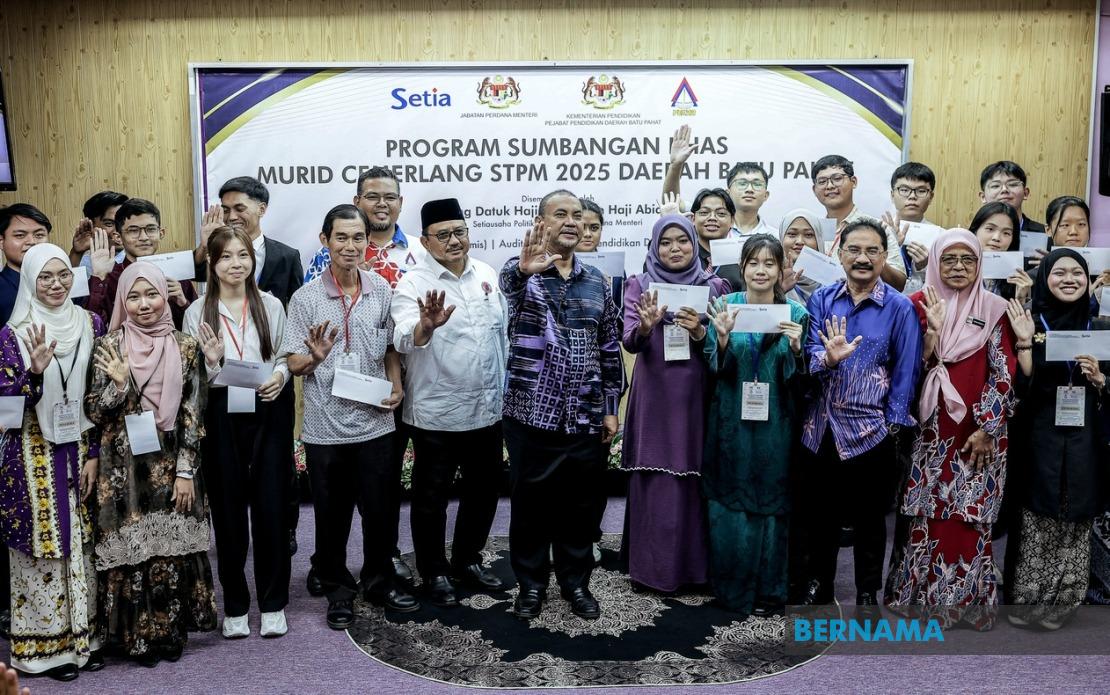
The Prime Minister's Office has distributed special contributions to 214 outstanding STPM students in Batu Pahat district, marking a significant initiative to recognise academic excellence at the pre-university level. The awards were presented at a ceremony held at the Batu Pahat District Education Office, bringing together scholars from 16 secondary schools across the district. This targeted programme underscores the government's commitment to identifying and nurturing high-performing students during a critical juncture in their educational journey.
Datak Azman Abidin, serving as Political Secretary to the Prime Minister, oversaw the distribution and articulated the broader vision behind the initiative. According to Azman, the financial contributions serve a dual purpose: they acknowledge the hard work and dedication of these young achievers whilst simultaneously providing tangible support for their educational advancement. The scheme reflects a strategic investment in human capital, particularly at the transition point between secondary schooling and higher education where financial constraints can sometimes impede progress.
The Prime Minister's Office has positioned this recognition scheme as part of its wider education empowerment strategy. Azman emphasised that the government views such initiatives as concrete demonstrations of its commitment to fostering educational excellence across the nation. Beyond the immediate financial assistance, the programme carries symbolic weight by publicly validating student achievement and setting benchmarks for academic aspiration within schools and communities throughout the district.
Fundamental to the initiative's design is its motivational dimension. Rather than positioning the contributions purely as financial aid, officials have framed them as awards celebrating excellence. This approach encourages recipients to maintain their trajectory of achievement whilst simultaneously inspiring their peers to pursue similar academic standards. The psychological impact of formal recognition, particularly at the national level through the Prime Minister's Office, extends the programme's value beyond its monetary component.
Current planning contemplates expansion of the scheme contingent upon budget availability. Azman indicated that the government intends to roll out the programme to other districts, suggesting this Batu Pahat initiative serves as a pilot demonstrating the viability and impact of such recognition awards. This gradual expansion approach allows authorities to refine programme mechanics and assess outcomes before broadening implementation nationally. The sustainability of funding remains a practical consideration, yet the stated intention to continue and expand indicates institutional commitment to the concept.
Among the recipients was Afida Auni Airulnizam, a 20-year-old former student of Sekolah Menengah Kebangsaan Tun Sardon in Rengit, who articulated the award's significance from a beneficiary perspective. She described the contribution as meaningful recognition that validates her academic efforts whilst providing practical motivation for her forthcoming university studies. Growing up as the youngest of two children, Afida draws inspiration from her older brother's university experience, motivating her own desire to pursue higher education in sports science should she gain university admission.
The tangible benefits extend to easing financial pressures associated with higher education preparation. Muhd Ammar Firdaus Mohd Fadzil, another 20-year-old recipient from SMK Tun Ismail, highlighted how the contribution addresses real concerns facing many Malaysian families. University entrance preparation, whether through application fees, assessment courses, or initial living expenses, imposes substantial financial burdens on households. By providing such support at the critical moment when students transition from secondary to tertiary education, the scheme directly alleviates these pressures whilst removing potential obstacles to deserving students accessing higher education opportunities.
The breadth of schools represented in the awards programme reflects the wide geographic and institutional distribution of academic excellence throughout Batu Pahat. By drawing from 16 secondary schools rather than concentrating recognition among elite institutions, the initiative sends an important message that outstanding achievement occurs across diverse educational settings. This inclusive approach democratises recognition and demonstrates the government's awareness that talented students emerge from schools throughout the district, not merely from traditionally prominent institutions.
For Malaysian policymakers, this scheme offers a targeted intervention addressing a known challenge in the education pipeline. Many high-achieving students from modest economic backgrounds face barriers in transitioning to university despite academic capability. By coupling recognition with financial support at precisely this transitional moment, the programme addresses both the psychological and material dimensions of educational progression. The strategy acknowledges that excellence requires not merely individual talent but also systemic support to transform potential into achievement.
The awards programme illustrates a broader policy direction emphasising meritocratic recognition within Malaysia's education system. By publicly celebrating STPM excellence and providing material support, the government signals that academic achievement at this level constitutes a valued national resource worthy of investment. This positioning potentially influences how students, parents, and educators conceptualise pre-university education, potentially elevating its status and attracting greater focus to academic rigour during these crucial formative years.
Looking forward, the success of the Batu Pahat initiative will likely inform national education policy discussions. As other districts potentially receive similar programmes, comparative data on participant outcomes, university admission rates, and degree completion statistics will accumulate. Such evidence could justify sustained funding and potential expansion, creating a national framework for recognising and supporting STPM achievers. For Malaysian students in other districts, the Batu Pahat experience provides a template of how systematic recognition can combine with financial support to enhance educational trajectories.

