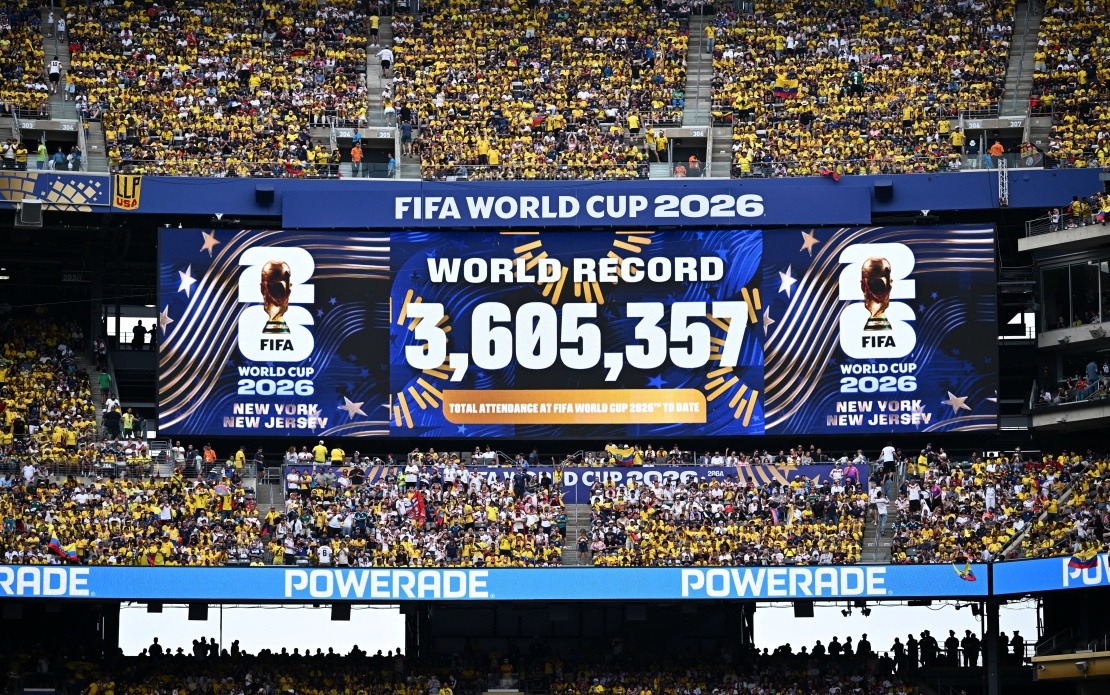
The 2026 FIFA World Cup has etched its place in tournament history by becoming the most-attended World Cup ever held. The milestone was achieved on Thursday during Germany's encounter with Ecuador in East Rutherford, New Jersey, when cumulative attendance reached 3,605,357—surpassing the previous record of approximately 3.6 million set three decades earlier in 1994. The announcement electrified the stadium as giant screens broadcast the achievement to roaring crowds, a moment that underscored the exceptional appetite for football across North America.
What makes this accomplishment particularly striking is the timing. With 48 matches still to be contested across the tournament's remaining fixtures, the attendance figures could potentially approach twice the 1994 benchmark. The 1994 World Cup, held in the United States, consisted of only 52 matches in total—a significantly smaller tournament structure than the expanded 2026 format. The current tournament's architecture and distribution across multiple venues have clearly unlocked unprecedented demand for live football experience.
The scale of public engagement has been consistent throughout the competition. Across all 16 host cities participating in the 2026 edition, stadiums have maintained occupancy rates exceeding 99 per cent on average. This figure demonstrates not sporadic bursts of enthusiasm but rather sustained, widespread interest in World Cup football throughout the tournament's duration. Such consistent capacity utilisation reflects both superior stadium infrastructure in the host regions and the global magnetism of the world's premier football competition.
FIFA President Gianni Infantino has characterised the record-breaking attendance as validation of football's unifying power on the global stage. In his assessment, the tournament has exemplified sport's capacity to transcend geographical and cultural boundaries, creating spaces where diverse populations converge in celebration and shared passion. Infantino's remarks emphasise that the scenes unfolding across venues and surrounding municipalities have demonstrated an exceptional standard of atmosphere and engagement.
For Southeast Asian football enthusiasts and stakeholders, this record carries particular significance. The region has increasingly positioned itself as a developing football powerhouse, with growing investment in infrastructure and grassroots development. The 2026 tournament's success in monetising fan enthusiasm and filling stadiums at such consistently high rates provides a blueprint for how regional tournaments might enhance their own commercial viability and fan experience. Malaysia and neighbouring countries observing these trends may recognise opportunities to apply similar principles to regional competitions and domestic league development.
The expansion of the 2026 World Cup format, incorporating 48 teams instead of the traditional 32, has fundamentally altered the tournament's footprint and accessibility. By distributing matches across more venues and host cities, organisers have reduced travel distances for supporters in some regions while creating multiple focal points of activity. This structural change has clearly resonated with North American audiences, though it also raises questions about whether such a model could be successfully implemented in other continents, including Asia.
The North American hosting arrangement—involving the United States, Canada, and Mexico—has demonstrated the commercial potential of a truly continental approach to major sporting events. The coordination required to manage simultaneous matches across such vast geography, combined with the regulatory and logistical frameworks needed to support 16 venues, represents a significant operational achievement. These lessons will likely inform how future tournaments, potentially including those in Asia-Pacific regions, approach their own hosting responsibilities.
Attendance figures alone tell only part of the story. Beyond raw numbers, the consistency of near-full stadiums suggests that ticket pricing strategies, marketing approaches, and fan experience elements have resonated effectively with target audiences. The demographic composition of crowds, the accessibility of venues, and the entertainment value surrounding match days have collectively contributed to sustaining interest throughout what, by traditional standards, remains a lengthy tournament schedule.
Looking forward, the trajectory established by 2026 raises important considerations for football governance. FIFA faces strategic choices about whether the expanded format should become permanent, how to balance tournament length against fan fatigue, and whether similar expansion could be viable in future host regions. For Malaysian observers particularly, understanding these dynamics becomes relevant as the region potentially positions itself for future hosting opportunities or significant participation in expanded tournament formats.
The record-breaking attendance ultimately reflects a fundamental reality: when football is presented accessibly, within reach of large populations, and supported by adequate infrastructure, demand proves remarkably robust. This principle holds implications not merely for international tournament hosting but for developing domestic football cultures throughout Southeast Asia, where expanded stadium capacity and improved venue quality could unlock similar enthusiasm among regional audiences.

