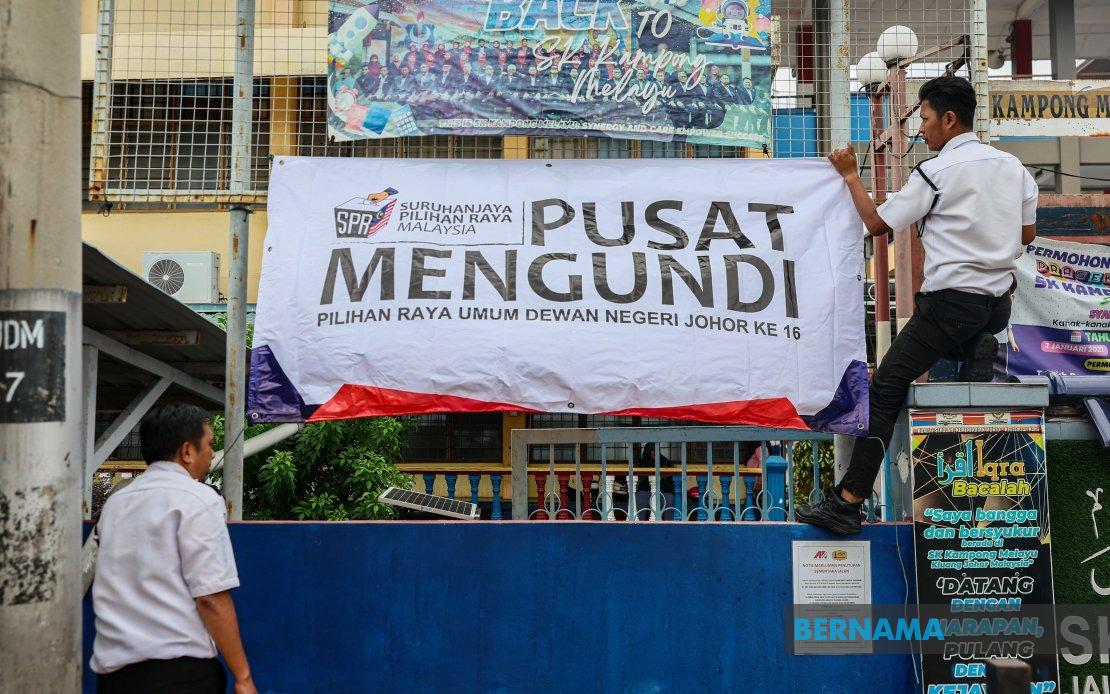
Johor conducted its 16th state election on July 11, with over 2.7 million eligible voters participating in a contest to select representatives for all 56 seats in the State Legislative Assembly. The electoral exercise represented a significant political moment for Malaysia's southern state, following the dissolution of the previous legislature on June 1. Polling operations commenced at 8 am across 1,076 centres with 4,889 voting streams distributed throughout Johor, ensuring voters had sufficient access points to fulfil their democratic obligation.
The Election Commission's preparations revealed the scale of the operation. A total of 43,036 election workers were stationed across the state to manage voting procedures, handle documentation, and facilitate the orderly conduct of the election. This extensive workforce deployment underscored the complexity of managing simultaneous polling activities across multiple districts and constituencies. The commission deliberately staggered the closure of polling stations, with the process extending from 11 am to 6 pm depending on location, a measure designed to accommodate geographical variations and island constituencies. Pulau Besar's station closed earliest at 11 am, while Pulau Aur and Pulau Pemanggil followed at noon.
Postal ballot arrangements added another dimension to the electoral administration. The commission issued 24,677 postal ballots that required return by 6 pm on election day. This mechanism allowed voters unable to attend polling centres—including those working in distant locations or facing mobility challenges—to participate in the democratic process. The postal voting system, though adding administrative complexity, reflected efforts to enhance electoral inclusivity across the geographically dispersed state.
The Election Commission set an ambitious voter turnout target of approximately 70 per cent, reflecting confidence in heightened public engagement compared to the 2022 state election. That previous contest achieved a turnout of 54.92 per cent, indicating that the commission anticipated a substantial increase in voter participation this time. Early voting data provided encouraging signs: 20,607 voters comprising police officers, armed forces personnel, and their spouses cast ballots on Tuesday, demonstrating strong participation among these designated early voter categories. This advance voting segment traditionally represents committed electorate members.
Weather considerations added unpredictability to election day logistics. The Malaysian Meteorological Department forecast morning rain across Johor Bahru, Batu Pahat, Kulai, Muar, Pontian and Tangkak, with conditions expected to improve during afternoon and evening hours. Afternoon thunderstorms were anticipated in Kluang, Kota Tinggi and Segamat, while Mersing faced similar prospects extending into the evening. Such weather patterns potentially affected voter mobility and turnout rates, particularly in rural constituencies where road conditions might deteriorate during heavy rainfall. Nevertheless, the advance scheduling and preparation indicated the commission's readiness to manage such contingencies.
The candidate field encompassed considerable political diversity. A total of 172 aspirants contested the 56 available seats, with representation spanning eight distinct political entities plus independent candidates. Pakatan Harapan and Barisan Nasional each fielded the maximum 56 candidates, positioning themselves as the primary contenders. Perikatan Nasional presented 33 candidates, while Parti Bersama Malaysia ran 15 candidates. Smaller entities including MUDA (four candidates), Parti Orang Asli Malaysia (one), and Parti Sosialis Malaysia (one) rounded out the offering, alongside six independent candidates. This fragmented candidate pool reflected the broader Malaysian political landscape's increasing pluralism.
The preceding electoral landscape established the stakes for this contest. Before dissolution, Barisan Nasional commanded 40 seats, demonstrating dominant control of the State Legislative Assembly. Pakatan Harapan held a distant second position with 12 seats, while Perikatan Nasional maintained three seats and MUDA possessed one seat. The large gap between the ruling coalition and opposition reflected the entrenched political structures that shaped Johor's governance. However, electoral dynamics frequently produce surprises, and the campaign period provided opportunities for shifting voter sentiments.
Employer obligations received explicit official emphasis to ensure voting accessibility. Authorities reminded businesses and organisations that employees required reasonable time away from work to fulfil voting duties. This directive recognised that widespread democratic participation depended on practical facilitation at workplace level. Without such employer cooperation, many voters—particularly those in essential services or demanding occupational schedules—would face genuine obstacles to exercising their electoral franchise. The directive thus represented an important governance principle balancing business operations with democratic rights.
The Election Commission anticipated releasing full results as early as 10 pm on election day, a timeline dependent on efficient vote-counting processes across all centres. This rapid result projection reflected operational improvements and technological advancements in electoral administration, though final certified results typically require additional verification stages. The vote-counting methodology would involve counting votes at individual polling stations before aggregating results at the constituency and state levels. For island constituencies, special logistical arrangements were necessary to transport ballot boxes and election materials, adding time to the process.
Johor's election carried broader implications for Malaysian politics. As a state historically dominated by Barisan Nasional, electoral shifts in Johor influence overall national political calculations and coalition strength. The state's demographic diversity—encompassing urban centres, rural constituencies, and island communities—meant that electoral outcomes would reflect attitudes spanning different socioeconomic groups. Results would consequently illuminate whether voters prioritised continuity of governance, desired policy changes, or responded to leadership personalities. The election thus functioned as a political barometer extending beyond Johor's borders to national political consciousness and coalition dynamics.

