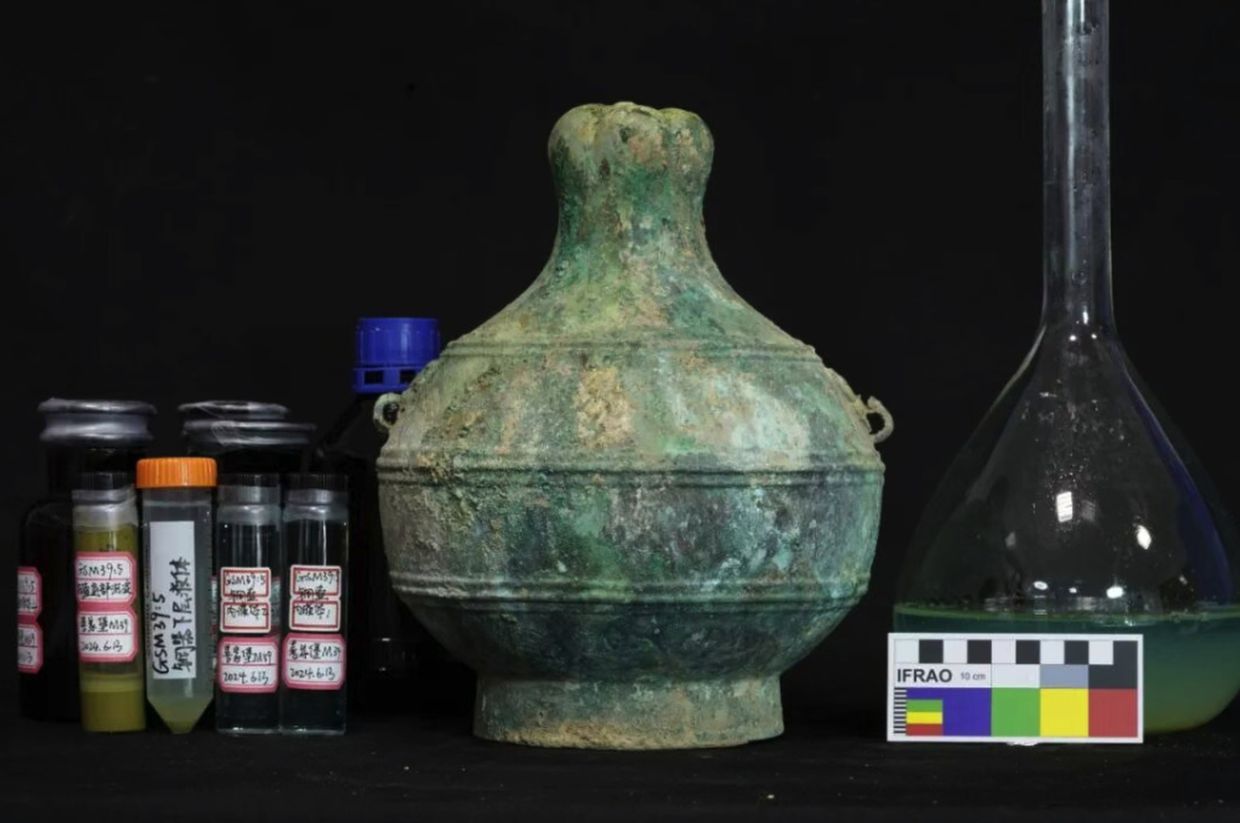
A bronze wine vessel discovered near the ruins of the ancient Qin Great Wall has provided Chinese archaeologists with rare, tangible evidence of how soldiers and garrison communities crafted alcoholic beverages more than two millennia ago. The intact pot, found at the Shanjiabao cemetery located just two kilometres from the Warring States Qin Great Wall in Gansu province, contained approximately 3,740 millilitres of liquid that chemical analysis has confirmed to be grain-based wine from the Warring States period. The preservation of this artefact and its contents represents what Wang Xiaoyang, head of the Shanjiabao cemetery archaeological project at the Ningxia Institute of Cultural Relics and Archaeology, has described as the most well-preserved and information-rich wine relic from the Qin state period yet publicly documented in China.
The archaeological context surrounding this discovery illuminates daily life along one of history's most strategically significant borders. Across the 170-kilometre stretch of the Qin Great Wall in this region, garrison commanders established numerous forts, castles, and barrier outposts to monitor and control movement. These installations were not mere military structures but functioning settlements where soldiers and their families maintained permanent residency within fortified passes and defensive compounds. A systematic excavation of the Shanjiabao cemetery unearthed 183 tombs from the Warring States period, with 179 identified as belonging to Qin culture, suggesting the site served as a shared burial ground for the military personnel and civilian residents who occupied these frontier installations.
The bronze vessel's design itself provides crucial technical insights into ancient manufacturing and preservation methods. The garlic-head-shaped pot, a distinctive hallmark of Qin craftsmanship, employed a sophisticated double-layer sealing system that combined a textile inner lining with an outer coating of organic clay. This ingenious engineering allowed the wine sealed within to remain substantially intact across more than two thousand years, protecting the liquid from microbial contamination and oxidation. The preservation technique demonstrates that ancient craftspeople understood fundamental principles of hermetic sealing, suggesting wine storage was valued enough to warrant careful technological consideration.
Analytical examination of the ancient liquid has yielded detailed information about Qin brewing practices that would otherwise remain unknown to modern researchers. Scientists from Northwest University conducted comprehensive chemical analysis, detecting twenty-four distinct compound types within the residue, including organic acids and their derivatives, amino acids and their derivatives, and carbohydrates. The specific distribution pattern of these organic acids matched the chemical signature of artificially aged yellow wine, a finding that definitively classified the beverage as grain-based rather than derived from fruits such as grapes. This distinction holds particular significance for understanding regional variation in ancient Chinese fermentation practices.
The ingredient profile reveals how northern Qin communities adapted their brewing traditions to available agricultural resources. Through starch residue analysis, researchers determined that over ninety-two per cent of the starch in the vessel originated from broomcorn millet, the dominant grain cultivated across northern China during antiquity. This finding reflects a fundamental difference between China's brewing traditions across its geography: southern regions historically relied on rice fermentation, while northern territories developed their techniques around hardy grains including millet and foxtail millet that thrived in arid and semi-arid climates. The Qin garrison at this Great Wall location clearly maintained this northern grain-based brewing tradition, adapting universal fermentation principles to their specific environmental and agricultural circumstances.
The broader significance of this discovery extends beyond mere technical reconstruction of ancient recipes. China's status as one of the world's earliest regions to develop and consume alcoholic beverages has long attracted scholarly attention, yet systematic understanding of how brewing techniques evolved and diversified across different periods and regions remains incomplete. Recent decades have witnessed an expanding catalogue of ancient alcoholic beverage residues recovered through archaeological excavation, generating considerable research interest in tracing the origins of fermentation technology and documenting technological innovation. The Shanjiabao find fills a previously undocumented gap in this historical narrative, specifically illuminating the winemaking practices of the Qin state during the Warring States period within the Ningxia region.
The discovery carries implications for understanding labour organisation and economic activity along the ancient frontier. The presence of deliberately sealed wine vessels interred with deceased garrison personnel suggests that wine held sufficient cultural and economic value to feature prominently in burial practices. Military communities maintained sophisticated knowledge of fermentation and preservation, indicating that beverage production represented more than casual domestic activity—it likely constituted an organised aspect of garrison provisioning. The inclusion of the bronze vessel in a soldier's tomb suggests that wine consumption formed part of garrison life and that families considered their deceased relatives' enjoyment in the afterlife worthy of this substantial material offering.
The investigation also illuminates patterns of resource management and trade within frontier military communities. The deliberate selection of broomcorn millet for fermentation suggests either direct cultivation of this grain within garrison territories or reliable supply chains connecting frontier outposts to agricultural production centres. The technological sophistication required to produce sealed wine vessels and the knowledge necessary for successful fermentation indicate that garrison settlements functioned as centres of practical expertise, not merely as military installations. Officers and soldiers stationed at the Great Wall maintained specialised knowledge in multiple crafts, from metallurgy to agriculture to fermentation—a reality that challenges simplified understandings of ancient frontier military life.
The human story embedded within this archaeological artefact deserves contemplation alongside its technical and historical significance. Wang Xiaoyang's observation that this vessel likely belonged to a Qin soldier or garrison member who loved wine—someone whose family honoured his memory by filling his most precious bronze pot with fine wine for his eternal journey—connects abstract archaeological data to individual human experience. Across more than two thousand years, this act of familial devotion remains tangible through preserved liquid chemistry. The soldier whose tomb contained this vessel lived in a border landscape of strategic importance, consumed locally produced beverages refined through generations of accumulated knowledge, and was remembered through material choices that would eventually reveal intimate details about his world to modern scientists.
For contemporary scholars studying ancient China and the broader history of fermentation technology globally, the Shanjiabao wine vessel offers an unusually complete dataset. Most ancient beverage remains consist of residual deposits on pottery or chemical traces; rarely does an entire sealed vessel with its contents survive intact. The twenty-four compound types detected provide researchers with a chemical fingerprint of Qin-era grain fermentation that can be compared against other regional or temporal examples, gradually building a more sophisticated understanding of how ancient brewing techniques developed and adapted across China's diverse geographic and cultural regions. Future study of similar archaeological contexts may reveal whether the Shanjiabao practices represented broader patterns or unique local innovations, ultimately deepening knowledge of how ancient peoples harnessed fermentation science to produce shelf-stable beverages that sustained frontier communities far from agricultural centres.

