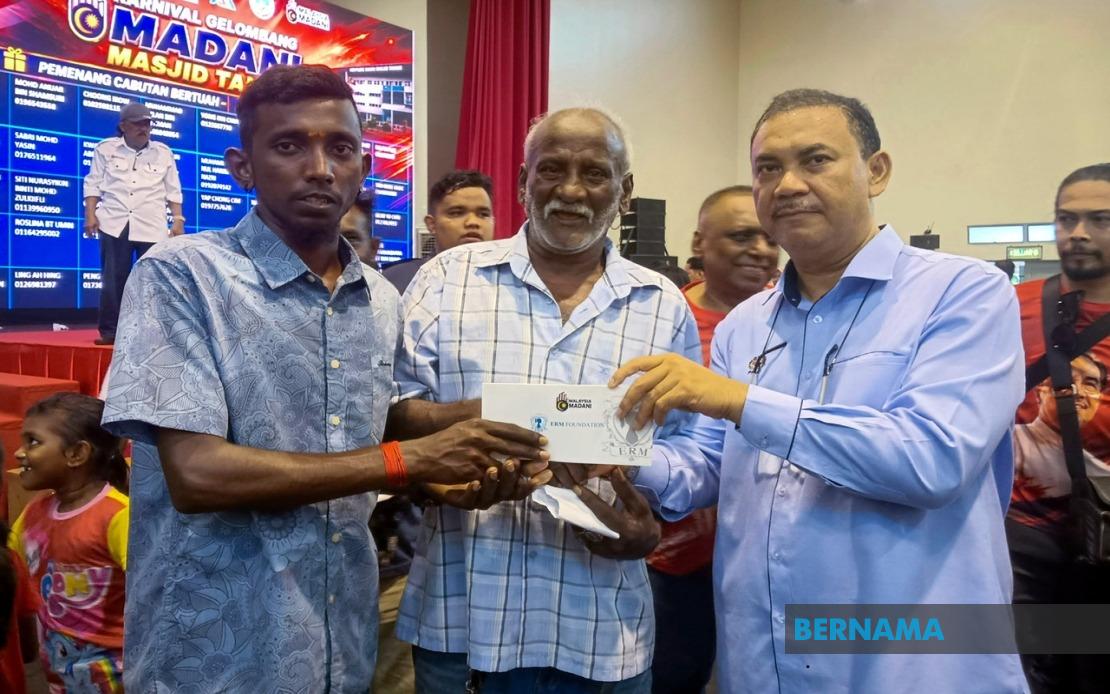
The Sentuhan MADANI Donation initiative brought financial relief to approximately 2,000 underprivileged residents in the Masjid Tanah parliamentary constituency during the Gelombang MADANI Carnival held in Alor Gajah on August 7. The programme, coordinated by the Prime Minister's office, distributed RM200 in cash assistance to each beneficiary, with Datuk Azman Abidin, the Prime Minister's political secretary, overseeing the donation ceremony at the Masjid Tanah Sports Complex.
The outreach covered constituents from five state divisions within the parliamentary area—Kuala Linggi, Lendu, Tanjung Bidara, Ayer Limau, and Taboh Naning—reflecting a coordinated approach to ensuring assistance reached vulnerable populations across the entire constituency. The initiative deliberately targeted multiple demographic groups including B40 households earning below RM4,000 monthly, persons living with disabilities, senior citizens, and other low-income earners, recognising that financial hardship often intersects across these populations in rural and semi-rural areas.
For many beneficiaries, the timing of the assistance proved invaluable given Malaysia's ongoing cost-of-living pressures. The modest but meaningful sum of RM200 per household, while not transformative on its own, addresses immediate needs such as groceries, medications, and utility bills that strain already stretched household budgets. In Peninsular Malaysia's southern corridor, where Masjid Tanah sits, economic opportunities remain concentrated in urban centres, leaving many rural residents dependent on irregular income sources and vulnerable to unexpected financial shocks.
Ramlah Othman, a 63-year-old recipient from Tanjung Bidara, articulated the practical value of the contribution, emphasising how the funds would alleviate her daily household expenses. Her response underscores a reality often overlooked in policy discussions: assistance programmes frequently benefit not only individuals but entire family units, as seniors often shoulder childcare responsibilities or contribute irregular income streams that stabilise multigenerational households. The programme's targeting of senior citizens reflects understanding of their particular vulnerability, as many lack regular pensions or have exhausted retirement savings.
The situation for persons with disabilities participating in the programme presents additional complexity. Stroke survivor N. Mariappan, 69, from Ladang Sungai Baru, noted the assistance helped ease the financial pressure of managing daily needs while living with disability-related health requirements. Medical expenses, mobility aids, and reduced earning capacity compound standard living costs for this demographic, making targeted interventions meaningful. Mariappan's explicit acknowledgement that the initiative reflected government concern for disabled citizens and seniors suggests the programme carries symbolic value alongside material benefit, recognising previously marginalised groups.
The Sentuhan MADANI initiative represents part of broader efforts by Malaysia's current government to address economic inequality through direct assistance mechanisms. Rather than relying solely on structural reforms or long-term development programmes, the MADANI framework emphasises immediate support for vulnerable populations, particularly during periods of economic strain. This approach aligns with the government's stated priority of protecting the B40 demographic, which comprises approximately 40 percent of Malaysian households earning below specified thresholds and constituting a politically significant constituency.
The carnival format employed to distribute assistance—combining financial aid with community engagement activities—reflects contemporary political strategy that prioritises visibility and direct constituent interaction. By conducting distributions through public events rather than bureaucratic channels, the government maximises local awareness and creates opportunities for face-to-face acknowledgement of recipients' circumstances. This approach has become standard across Malaysian political parties, though its effectiveness in building sustainable support versus temporary goodwill remains contested among political analysts.
Geographically, the Masjid Tanah constituency encompasses diverse communities ranging from agricultural workers to fishing communities and small-scale traders. The five constituent state divisions selected for this particular distribution likely represent areas with concentrated poverty or identified need, though the criteria for recipient selection were not detailed in official statements. The decision to conduct the initiative in conjunction with a broader carnival suggests efforts to embed assistance within celebratory community events rather than framing aid delivery as purely transactional governance.
For Malaysian readers familiar with rural economic challenges, the programme illustrates ongoing tensions between adequate safety nets and systemic economic inequality. While direct cash transfers provide immediate relief, questions persist regarding whether such measures address underlying causes of poverty—limited employment opportunities, inadequate education infrastructure, and regional economic imbalances. The MADANI framework positions itself as addressing immediate welfare concerns while presumably complementing longer-term development initiatives, though policy documentation on such connections remains limited.
The beneficiaries' responses, characterised by gratitude and practical acknowledgement of the assistance's utility, reflect both genuine relief and the normalisation of state assistance as integral to household survival strategies among Malaysia's poorest segments. The programme's focus on specific vulnerable groups—rather than universal approaches—requires accurate identification mechanisms and carries implications for those falling outside designated categories who may equally need support.
Moving forward, the sustainability and scale of such assistance programmes merit scrutiny. Whether Sentuhan MADANI represents a one-off initiative or recurring support structure affects beneficiaries' ability to plan household finances. Similarly, the quantum of assistance—while meaningful—may prove insufficient for addressing compound vulnerabilities faced by individuals navigating multiple disadvantages simultaneously. For Malaysian households operating at subsistence levels, understanding whether government support represents temporary relief or foundation for transitioning toward economic self-sufficiency shapes broader policy effectiveness.
The Masjid Tanah initiative exemplifies how Malaysian governance increasingly emphasises direct welfare interventions targeting vulnerable demographics. The visible presence of senior officials, coordinated multi-constituency outreach, and structured assistance formats all reflect sophisticated political engagement with poverty reduction. Yet translating such initiatives into measurable improvements in beneficiary circumstances—whether through reduced poverty indicators, improved health outcomes, or economic mobility—requires longitudinal assessment beyond immediate programme satisfaction.

