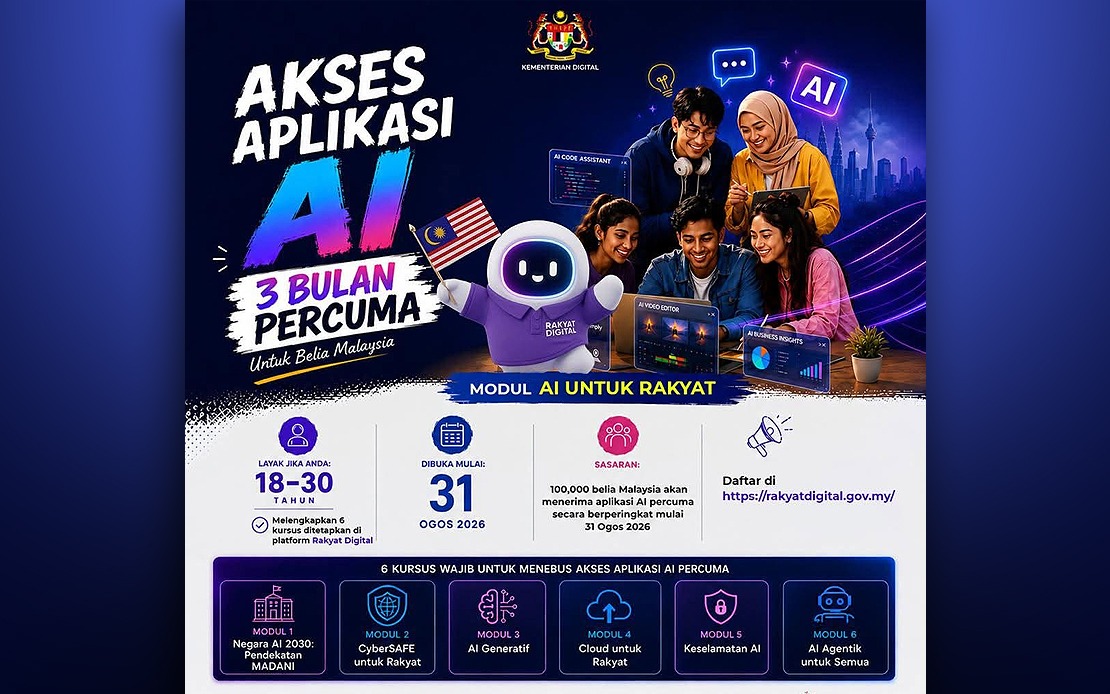
Malaysia's Digital Ministry has introduced a major initiative designed to democratise access to artificial intelligence technology among the country's youth population, with the AI for the People programme launching today through the Rakyat Digital portal. The ambitious scheme, announced by Prime Minister Datuk Seri Anwar Ibrahim at the Putrajaya International Convention Centre as part of the 2026 National Day Premier Address, represents a significant commitment to ensuring young Malaysians can participate meaningfully in the AI-driven economy that increasingly defines the global technology landscape.
The programme sets a target of reaching 100,000 Malaysians between the ages of 18 and 30 by 2027, addressing a critical gap in digital skills development at a time when artificial intelligence is rapidly reshaping employment opportunities across multiple sectors. Young people interested in participating can register through the Rakyat Digital portal at rakyatdigital.gov.my, with registration commencing immediately and proceeding through a phased approach to manage the anticipated high volume of applications. This phased rollout recognises the infrastructure requirements of scaling such an initiative while maintaining educational quality and participant engagement.
Central to the programme's structure are six carefully curated modules that participants must complete and successfully pass to qualify for premium benefits. These courses span both foundational and advanced artificial intelligence concepts, including AI Nation 2030: The MADANI Approach, which contextualises AI development within Malaysia's broader economic and social framework; CYBERSAFE for the People, addressing critical security considerations as citizens engage with AI systems; Generative AI, covering the transformative technologies behind tools like ChatGPT and similar platforms; AI Security, exploring safeguards and ethical considerations; Agentic AI for All, introducing autonomous systems; and Cloud for the People, examining the infrastructure underlying modern AI deployment. This curriculum design reflects an understanding that effective AI adoption requires both technical knowledge and awareness of security, ethics and practical application.
Successful completion of these modules opens access to a distinctive incentive: a complimentary three-month subscription to selected artificial intelligence applications and software from both established international technology companies and emerging local providers. The initial roster of available tools demonstrates deliberate diversification across the global AI ecosystem. Participants will gain special access to YTL AI Labs' IlmuChat, a homegrown solution reflecting Malaysia's developing AI sector; Alibaba's Wonderclip and MuleRun, representing regional technological advancement; and Google's Gemini Enterprise, providing exposure to cutting-edge capabilities from Silicon Valley's dominant player. This curated mix exposes young Malaysians to different AI philosophies and implementations, enriching their practical understanding beyond theoretical coursework.
The Digital Ministry has signalled its intention to expand the roster of available AI tools progressively, with various other software and applications from technology companies scheduled for phased integration. This approach allows the ministry to respond dynamically to evolving market conditions, emerging technologies and participant feedback, ensuring the programme remains contemporary and relevant as the artificial intelligence landscape continues its rapid transformation. The commitment to regular expansion suggests this initiative represents not a static intervention but an evolving ecosystem designed to adapt to technological change.
Ministry officials frame the programme explicitly as an investment in Malaysia's human capital within the artificial intelligence age. By providing youths with both conceptual understanding and hands-on access to professional-grade AI tools, the initiative aims to cultivate expertise that translates directly into enhanced creativity, improved productivity and strengthened digital capabilities. These competencies carry immediate practical value in the job market, where employers increasingly seek candidates with demonstrated AI proficiency. Beyond individual economic outcomes, the programme contributes to addressing broader societal concerns about technological inequality and ensuring that the benefits of artificial intelligence diffusion extend across demographic segments rather than concentrating among privileged populations with existing access to expensive tools.
The AI for the People programme explicitly connects to Malaysia's aspiration to establish itself as an inclusive AI nation by 2030, aligned with the broader Malaysia Digital 2030 strategic vision. This framing situates the youth training initiative within longer-term national competitiveness goals, reflecting recognition that countries successfully navigating the AI transition will build foundations during precisely this period. Southeast Asian economies, including Malaysia, face particular urgency in developing domestic AI capabilities and ensuring their populations can contribute to and benefit from the technology sector's ongoing growth. Initiatives targeting youth prove especially strategic, as younger cohorts will comprise the primary workforce and innovators throughout the 2030s and beyond.
Digital Ministry secretary-general Datuk Fabian Bigar emphasised that the programme addresses a critical dual imperative: fostering genuine technological understanding among young Malaysians whilst simultaneously providing access to tools that transform knowledge into practical capability. Bigar's framing highlights the gap between theoretical learning and applied competence, suggesting that the provision of free AI subscriptions serves as more than a reward mechanism. Rather, the tool access functions as an essential pedagogical component, enabling participants to develop the muscle memory and intuitive understanding that comes only through direct engagement with professional platforms. This recognition aligns with contemporary educational theory emphasising the importance of authentic, situated learning experiences.
The initiative's phased launch through the Rakyat Digital portal, which functions as Malaysia's national digital learning platform under MyDIGITAL Corporation's stewardship, leverages existing infrastructure developed to support broader digital capability building across the population. This institutional approach ensures the programme operates within an established ecosystem for digital education, potentially facilitating integration with complementary initiatives and enabling longitudinal tracking of participant progress and outcomes. The use of a dedicated portal also reduces barriers to entry, as participants engage through a single digital gateway rather than navigating multiple platforms and registration processes.
For Malaysian readers and policymakers, this initiative carries several important implications. First, it signals government recognition that artificial intelligence proficiency increasingly functions as foundational digital literacy, comparable to basic computing skills a generation ago. Second, the targeting of young adults specifically acknowledges that career trajectories during this decade will determine long-term economic outcomes as AI-driven automation accelerates. Third, the programme's emphasis on providing actual tool access rather than purely theoretical instruction suggests a pragmatic approach grounded in evidence that learning AI requires hands-on practice. Finally, the initiative's framing around inclusion and broad-based access indicates awareness that nations succeeding in the AI era will be those that develop widespread capability rather than concentrating expertise among small elite cohorts.
The programme arrives as regional governments across Southeast Asia grapple with artificial intelligence's economic and social implications. Malaysia's approach of combining structured education with subsidised access to professional tools offers a model potentially applicable to other nations wrestling with similar questions about equitable AI development. Whether the initiative successfully reaches its 100,000-participant target and produces meaningful employment or entrepreneurship outcomes will significantly influence both Malaysia's AI readiness and the regional conversation about how developing economies can ensure their populations benefit from rather than suffer dislocation from artificial intelligence advancement.

