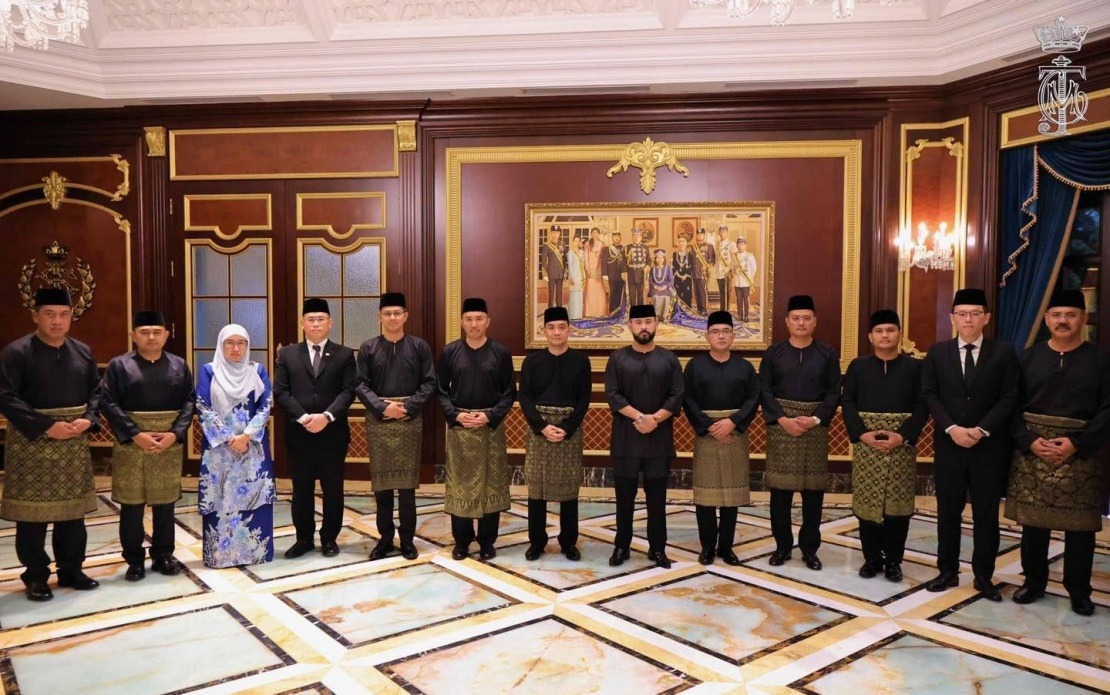
A significant milestone in Johor's political landscape was marked on July 18 when ten assemblymen took their oath of office as members of the Johor State Executive Council, administered by Tunku Mahkota Ismail at Istana Bukit Serene. The ceremony formalised the composition of the cabinet that will drive governance and policy implementation across the southern state for the next term, consolidating the administrative structure following the conclusive election results just weeks earlier.
The newly constituted Exco comprises a blend of experienced and fresh political talent, signalling both continuity and renewal within the state administration. Among those sworn in were Mohd Hairi Mad Shah representing Larkin, Datuk Mohd Jafni Md Shukor from Bukit Permai, Mohd Fared Mohd Khalid of Semerah, Ling Tian Soon from Yong Peng, Lee Ting Han representing Paloh, and Mohamad Fazli Mohamad Salleh of Bukit Pasir. These six members bring accumulated parliamentary experience to their respective portfolios, forming a stable core within the executive council.
Four maiden appointments to the Exco represented a deliberate infusion of new perspectives into the state government's upper echelon. Md Israk Abdullah from Kukup, P. Pannir Selvam representing Perling, Hasrunizah Hassan of Pulai Sebatang, and Muhammad Naqib Md Ghazali from Panti collectively embody the electorate's appetite for fresh voices and younger representation in decision-making positions. This balance between retention and renewal reflects contemporary political expectations for inclusive governance structures that respect both institutional memory and generational progress.
Menteri Besar Datuk Onn Hafiz Ghazi presided over the proceedings, symbolising the continuity of his leadership through a second consecutive term in the state's top executive position. His presence underscored the stability that Barisan Nasional sought to project following the electoral mandate, with key state officials including Royal Court Council Yang Dipertua Datuk Dr Abdul Rahim Ramli and State Secretary Datuk Mohammed Ridha Abd Kadir also attending to validate the constitutional formality of the Exco appointments.
The political context surrounding these appointments carries substantial weight for state administration. Just one week prior, Onn Hafiz himself was formally sworn in as Johor Menteri Besar for his second consecutive term, cementing his electoral victory in the Machap constituency with an impressive majority of 15,375 votes. His personal mandate reflected strong voter confidence in his leadership trajectory, providing political capital that extends into the broader Exco structure and its policy agenda across diverse state ministries and departments.
The broader electoral context that enabled these Exco appointments demonstrates the decisive nature of Johor's political preferences. Barisan Nasional's commanding performance in the 16th Johor state election, securing 48 of the 56 available state seats, delivered an unambiguous electoral mandate that transcended typical competitive margins. This supermajority position insulates the state government from conventional parliamentary vulnerabilities and provides substantial legislative latitude for implementing the coalition's policy programme across the full breadth of state administration.
For Malaysian and Southeast Asian observers, the composition of the Johor Exco carries implications extending beyond ceremonial significance. Johor represents one of Malaysia's largest and economically most significant states, with its governance decisions affecting millions of residents and substantial foreign investment flows. The quality and balance of ministerial appointments therefore influence not merely local outcomes but broader regional economic and political stability, particularly given Johor's strategic position within Malaysia's federal architecture.
The appointment of four first-time Exco members reflects contemporary political dynamics favouring measured institutional renewal without wholesale administrative rupture. This approach permits new leadership cohorts to develop ministerial competencies within established bureaucratic frameworks, reducing implementation risks that accompany entirely novice administrations. Yet it simultaneously addresses electoral desires for generational succession and diversified representation, a calibration that sophisticated political leadership recognises as essential for sustained legitimacy.
The Exco's heterogeneous composition across different constituencies and demographic profiles—reflected in names spanning multiple ethnic and linguistic communities—testifies to Barisan Nasional's continued emphasis on coalition breadth and multi-community representation. This composition mirrors Malaysia's own constitutional commitment to pluralistic governance and suggests that even in contexts of electoral dominance, coalition politics compels attention to inclusive cabinet structuring rather than majoritarian consolidation.
Looking ahead, the effectiveness of this Exco will substantially determine whether Barisan Nasional's electoral mandate translates into sustained governance legitimacy or gradually erodes through administrative underperformance or intra-coalition tensions. The state government must balance competing demands from urban constituencies seeking modernisation with rural areas requiring infrastructure investment, all while managing fiscal pressures and competitive pressures from federal allocations. Success will require the Exco to function as an integrated policy-making body rather than as a collection of individual ministerial fiefdoms.
The symbolic weight of the oath-taking ceremony—conducted before the state's Regent in a formal constitutional setting—emphasises the continuity of constitutional democracy within Johor despite significant electoral volatility in preceding years. This procedural solemnity reinforces institutional norms and demonstrates that political change occurs within established legal and constitutional frameworks rather than displacing them. For a state that has experienced considerable political realignment in recent electoral cycles, such reassurance carries genuine importance for investor confidence and administrative stability.
The path forward for this administration centres on translating the Exco members' diverse backgrounds and the broad electoral mandate into tangible improvements in service delivery, economic performance, and social development. The quality of inter-ministerial coordination and the Menteri Besar's ability to maintain cohesion across constituencies representing different geographic regions and economic interests will prove decisive. Success would strengthen Barisan Nasional's positioning not merely within Johor but across the Malaysian federation heading toward subsequent electoral cycles.

